A Diaspora View of Africa
The AGOA Extension Bill provisions


By Gregory Simpkins
After a few years of discussion about what renewal of the African Growth and Opportunity Act (AGOA) would look like, Senators Chris Coons and James Risch have introduced the AGOA Renewal and Improvement Act of 2024. Perhaps the most significant element is that it extends this trade process for 16 years – six years longer than the current extension.
This legislation aims to enhance the provisions of the country’s premier trade process involving U.S.-Africa trade. In past extensions, the period was insufficient to provide certainty for American companies interested in doing business in Africa – especially manufacturers. Spanning 2025 to 2041, the extension provides plenty of time for planning investments on the continent.
There is a trend in the legislation that could be problematic, though. The new bill calls for biennial rather than annual reviews in the name of saving resources. However, the State Department and other U.S. agencies provide annual reviews that cover much of what an AGOA review would so how much real savings would there be? Moreover, that two-year gap could prevent timely action to address the concerns of American companies.
Also, the bill appoints the State Department as co-manager of the AGOA process with the Office of the U.S. Trade Representative, which has made its decisions on AGOA eligibility based on recommendations from State, the Department of Commerce and the U.S. Agency for International Development (USAID). When I worked on this process with USAID, it was clear that State’s main goal was to maintain good relations with allies and not so much protecting the interests of American business in Africa.
Taking final decision-making from the Trade Representative’s office means that American business will have less protection of their interests in favor of diplomacy. That is, of course, State’s mission, but American businesses need to know that their issues will have priority within U.S. policy as they have under the Trade Representative’s management of AGOA.
As the bill states, the current statute requires that the President terminate a country’s AGOA benefits if that country does not meet the program’s eligibility criteria, and it provides four options for a response to complaints concerning commercial relations with AGOA beneficiaries:
- full termination of benefits,
- termination of benefits for certain products,
- issuance of a warning letter providing notice that benefits will be terminated in the following year without corrective action and
- the option to take no action if U.S. interests are best served by taking no action
Over the past two years, seven African countries have had their AGOA benefits suspended. In the case of Uganda, it was largely due to human rights issues concerning a law about LBGTQ status considered harsh.
Human rights have long been a consideration on U.S. trade policy, including in the Generalized System of Preferences (GSP). Yet AGOA’s trigger on human rights is much more sensitive than GSP. Zimbabwe has been excluded from AGOA from the beginning over human rights concerns, but it is an active participant in GSP.
The bill is specific about AGOA eligibility requirements, although it does not mention religious freedom as one of the criteria even though it really is since violations trigger sanctions that would affect relations with the country in question
Furthermore, when governments are denied AGOA benefits, you are actually denying their private sector, which likely had no active role in the violations that led to the suspension. This was the case with Zimbabwe, where companies doing robust trade with U.S. companies could not compete with African suppliers that had access to the benefits they did not enjoy.
I met some companies from Zimbabwe that were forced to move to Zambia to remain competitive in the U.S. market. Some colleagues and I have supported the concept of exempting companies found to be innocent of the violations cited, but we had to acknowledge that in African countries, it is difficult to be successful and completely independent of the government or government-affiliated entities. Still, it would be helpful to at least try to find a way to not punish companies that bear no real responsibility for trade or human rights violations.
Updating and correcting the AGOA process
Senators Coons and Risch did provide Congress with authority to request out-of-cycle reviews for possible violators and mandates Administration action on such requests. Yet the outcome of the review will depend on trade protection overcoming diplomacy since State will play a major review as the preeminent U.S. agency on the ground.
This bill would correct an omission in the original AGOA legislation by modifying AGOA’s rules of origin to allow inputs from African Continental Free Trade Area (AfCFTA) North African members to count toward the requirement that 35 percent of a product’s value originate in the region.
Back in the 1990s when AGOA was created, North Africa was considered by the U.S. government to be more linked to the Middle East than Africa. However, Africa has made it clear through AfCFTA that the continent is of one whole.
Additionally, the concerns then about Egyptian cotton overcoming U.S. cotton have been significantly diminished. The My Pillow company promotes Egyptian cotton in its advertising, which has achieved success apparently without significant wrangling with American cotton producers.
The bill is specific about AGOA eligibility requirements, although it does not mention religious freedom as one of the criteria even though it really is since violations trigger sanctions that would affect relations with the country in question. In considering how to regard questions on how LBGTQ rights are handled by African countries, laws that mandate harsh penalties for homosexuality certainly would be subject to action on human rights failings, but our government must be careful not to attempt to force significant changes in culture in African countries by using trade policy to require them to handle this issue as the United States does today after many years of debate and contention.
Decades after the original AGOA bill was passed, most countries in sub-Saharan Africa still have not created an AGOA implementation strategy, and some of those that have developed a strategy have failed to successfully implement it. This bill would provide for trade capacity building assistance to countries that develop a utilization strategy. Of course, such assistance has long been available. The provision is well-intentioned, but creating an implementation plan and then carrying it out is a more matter of willingness to do so. As the saying goes: you can lead a horse to water but you can’t make him drink.
Entrenched commercial interests in African countries long ago figured out how to make money under the skewed colonial economic regimes, and they are reluctant to convert to the more modern recommended ways of conducting business. We saw this in the initial reluctance of some African countries, for example Nigeria, to accept the AfCFTA because they were trying to figure out how this affected the business operations they had established over time. That consideration is still a factor in whether they will accept the trade capacity building or continue to ignore it since it already has been available for some time now.
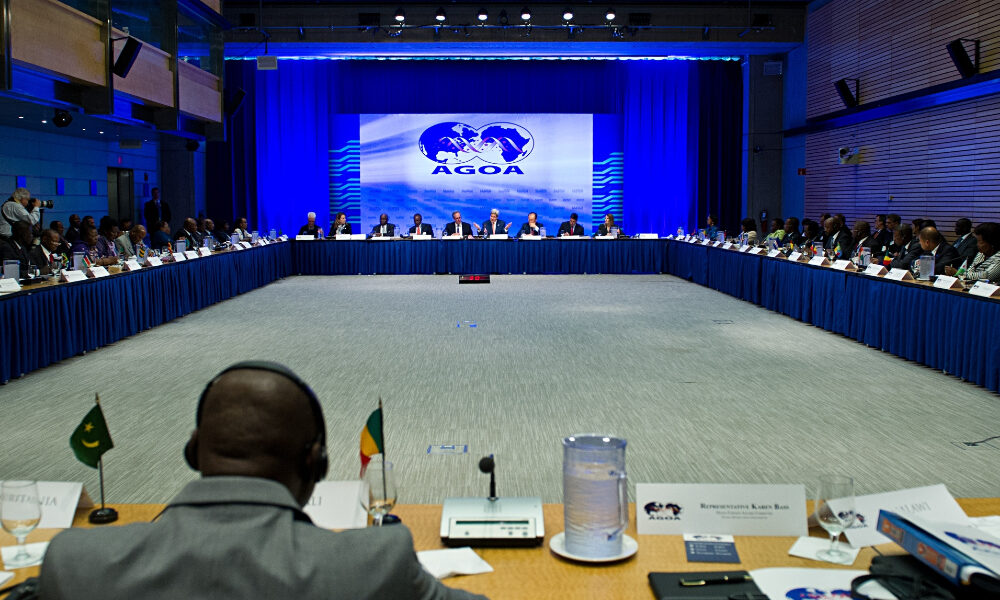
In recent years, the requirement for AGOA Forums to be specifically held each year has been lax. This bill requires such forums by the end of each fiscal year. The initial legislation called for private sector and civil society forums as well, and they are necessary to ensure that AGOA implementation is as effective as possible.
The involvement of the Corporate Council on Africa and the U.S. Chamber of Commerce in the private sector forums in much appreciated, but a greater effort must be made to involve small and medium enterprises (SMEs), which are the backbone of job creation and development worldwide, including Africa and the United States. Also, civil society organizations have been left to their own devices to mount their forums.
Doing so when the forums are held in this country is one thing, but sponsoring forums in Africa is more taxing on these organizations, and some assistance should be provided to facilitate their efforts. For years, I have heard U.S. officials say they can’t do this, but our government provides numerous grants and other forms of funding to civil society groups, and some way surely can be found to include support of civil society forums in Africa as well.
The Coons-Risch bill is generally well constructed and should advance the cause of AGOA tremendously. There are predictions that the 2024 elections in the United States could delay action on this legislation. As this is a presidential election year with primaries and party conventions, it could be that the opportunity to pass this bill slips away this year, but one hopes the bipartisan support for AGOA will overcome an abbreviated political timetable.
Gregory Simpkins, a longtime specialist in African policy development, is the Principal of 21st Century Solutions. He consults with organizations on African policy issues generally, especially in relating to the U.S. Government. He further acts as a consultant to the African Merchants Association, where he advises the Association in its efforts to stimulate an increase in trade between several hundred African Diaspora small and medium enterprises and their African partners.