Business
The African economies seeking a slice of the $130 billion green hydrogen market
By Giza Mdoe
The Exchange Africa | Green hydrogen, which is derived from a clean process of electrolyzation, has the potential to transform the energy landscape in developing nations. Unlike traditional hydrogen production methods, which rely on fossil fuels, green hydrogen is produced using renewable energy sources like solar and wind power.
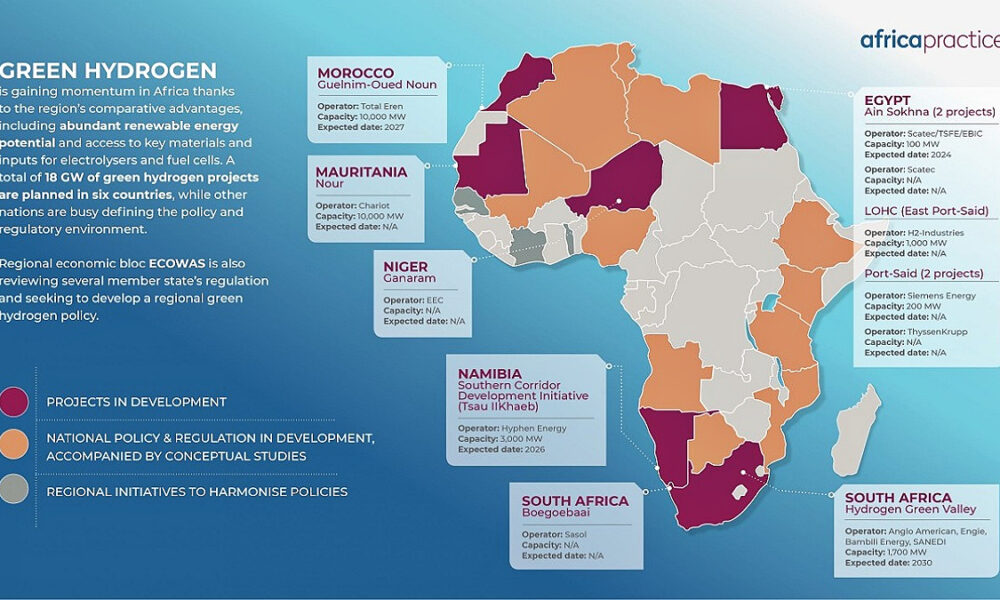
This innovation opens up new possibilities for decarbonization and sustainable energy solutions. South Africa, Morocco, Mauritania, Namibia, Niger and Egypt are trailblazing the way for African economies albeit with financing challenges. Just recently, Kenya outlined its broad plan to tap into this industry, too.
Globally, the hydrogen market exceeds US$130 billion, and the World Bank is projecting an annual growth rate of over 9 percent. Regions endowed with low-cost markets and abundant renewable resources, such as Africa, are becoming preferred destinations for green hydrogen financing.
Africa’s opportunity as a green hydrogen exporter
The rising global demand for clean energy is opening doors for African nations to establish themselves as green hydrogen exporters. Increasingly, governments and stakeholders are appreciating the huge potential of green hydrogen in helping realize their set climate goals. Further, for policymakers, green hydrogen is becoming critical in driving the decarbonization agenda across economies.
What’s more, the introduction of green hydrogen represents a substantial prospect for employment generation across the African continent. With Africa positioned as a potential global green hydrogen exporter, this sector holds the potential to become a huge contributor to the continent’s gross domestic product (GDP). Additionally, the proceeds arising from green hydrogen exports could finance Africa’s infrastructure, education, and healthcare needs.
A report by advisory firm McKinsey on behalf of the Africa Green Hydrogen Alliance shows the continent’s GDP growth ranging from US$66 billion to US$126 billion by 2050 for member countries. To add on, economies across Africa will register 4.2 million new jobs, attributable to investments in green hydrogen.
At the moment, roughly 80 percent of the world’s hydrogen is generated using carbon-intensive processes primarily based on methane. Africa, however, holds the potential to produce an estimated 16,000 million tonnes of hydrogen annually.
The journey to global net-zero objectives
Doctoral Researchers Mulako Mukelabai, Dr. Richard Blanchard from Loughborough University, and Professor Upul Wijayantha of Cranfield University, have developed a blueprint for harnessing Africa’s renewable energy resources and mineral wealth to deliver clean energy to numerous households while contributing to global net-zero objectives.
Featured in the Renewable and Sustainable Energy Reviews Journal in 2022, the research by Mulako and the team zeroes in on hydrogen’s potential driving decarbonization in Africa. Whereas Africa contributes three per cent of global emissions, economies across the continent are paying the highest price globally.
The team examined the feasibility of tapping solar, wind, and biohydrogen (biologically produced hydrogen) to fuel electrolysis for the generation of green hydrogen.
Professor Wijayantha noted: “Africa not only has all the raw materials necessary to produce green hydrogen, but the continent also has excellent platforms for collaborations in the form of regional economic associations. If the right investment environment is created, Africa has the potential to thrive the hydrogen economy and significantly contribute to reducing the global emission levels.”
Kenya’s baby steps in tapping green hydrogen
Kenya has emerged as a leader in embracing green hydrogen technology within the East Africa Community. The country’s investment in green hydrogen production reflects its dedication to a greener and more sustainable future. Kenya is strategically leveraging green hydrogen as a crucial component of its energy transition roadmap.
Kenya’s commitment to green hydrogen was solidified with the launch of its Green Hydrogen Strategy and Roadmap at the inaugural Africa Climate Summit in Nairobi. The strategy outlines the country’s vision for harnessing the potential of green hydrogen in its energy sector.
At the moment, Kenya’s energy landscape is dominated by renewable sources. Data shows that over 90 percent of the country’s electricity is generated from hydropower, geothermal energy, solar, wind energy, and biomass. This positions Kenya as a prime candidate for adopting green hydrogen as an alternative energy source.
Kenya’s Ministry of Energy and Petroleum recognizes the potential of green hydrogen to replace fossil fuels and stimulate the growth of a new economic sector. This transition not only reduces the country’s reliance on imported fuels but also retains more of the value-creation chain within Kenya. The result is the generation of domestic jobs and economic growth.
Key areas of interest in Kenya’s green hydrogen plan
The Kenya Green Hydrogen Organization highlights four critical areas in the development of Kenya’s Green Hydrogen strategy. One of the standout benefits is improved balance of payments.
According to the policy document, producing green hydrogen for industrial processes will reduce the need to import hydrogen-based products such as nitrogen fertilizer and methanol. Additionally, the creation of a domestic market for green hydrogen derivatives can boost exports, thereby enhancing Kenya’s balance of payments.
Further, the ministry says investments in green hydrogen can address food security and bolster resilience. By embracing green hydrogen, Kenya will enhance local nitrogen fertilizer production, thereby enhancing food security and resilience. This self-sufficiency improves agricultural productivity, encourages sustainable farming practices, and mitigates the impact of international commodity market fluctuations.
What’s more, the initiative will facilitate green industrialization and decarbonization plans. Green hydrogen has the potential to drive industrialization by establishing manufacturing value chains for its derivatives. This fosters downstream industries, create jobs, support the growth of renewable energy, and improves access to electricity. It also aligns with global decarbonization efforts and opens new markets for low-carbon products.
Attracting public and private investments
The green hydrogen industry has the potential to attract significant public and private investments, diversifying Kenya’s economy and fostering industrial growth. These investments span various sectors and applications, including power generation, hydrogen production, and related downstream facilities.
Kenya’s embrace of green hydrogen technology is not only a positive step towards achieving energy sustainability but also a powerful driver of economic growth, job creation, and self-reliance. As the country continues to harness its abundant renewable energy sources and innovative mindset, green hydrogen will play a central role in Kenya’s journey towards a greener and more prosperous future.
On September 5, 2023, a partnership between the European Union (EU) and Kenya was unveiled at the UN Africa Climate Summit. The Green Hydrogen Strategy and Roadmap, which comes with a financial commitment of US$13 million, was jointly announced by President William Ruto of Kenya and EU Commission President Ursula von der Leyen.
During their announcement, both leaders highlighted the extensive influence of the strategy and roadmap. In addition to its pivotal role in transitioning Kenya’s economy toward renewable energy sources, von der Leyen and Ruto noted that this partnership will enhance food security and bolster agricultural industry.
Egypt, South Africa, Namibia and Mauritania projects
Throughout Africa, green hydrogen initiatives are taking root in nations such as Egypt, South Africa, Namibia, and Mauritania. South Africa, which stands as the continent’s most advanced economy and the 14th largest global emitter of greenhouse gases, has made green hydrogen a central pillar of its journey towards decarbonization. Estimates indicate that the country needs about US$17.28 billion to initiate its green hydrogen plans. Reuters says South Africa is liaising with Germany on key green hydrogen investments.
In March, the Germany-based company Conjuncta signed an agreement with Mauritania, Egypt’s power company Infinity, and the UAE’s Masdar for a US$34 billion green hydrogen investment in the West African nation. Upon completion, the Mauritania project is slated to yield 8 million tonnes of green hydrogen per year. Conjuncta states that the investment’s electrolyser in Mauritania boasts a capacity of up to 10 gigawatts.
European nations are increasingly turning to Africa to secure future supplies of this fuel, making huge investments in green hydrogen ventures.
Green hydrogen notes from Chile – a mining giant
While Kenya’s plan is largely on paper awaiting implementation, African nations can learn from the Chilean experience. Chile, a nation with approximately 20 million population, is a heavyweight in the global mining industry. Notably, 22 percent of the world’s copper reserves are situated within this South American nation. The World Bank acknowledges that Chile recognizes the potential of green hydrogen in decarbonizing its vast mining sector.
Since 2020, the global lender has been supporting Chile’s efforts to establish regulatory frameworks conducive to fostering the demand for green hydrogen, both in domestic and international markets. In June this year, the World Bank okayed a US$150 million loan, to bolster investments in green hydrogen within Chile.
This strategic move is poised to accelerate Chile’s strides in green growth, energy transition, and its commitment to being carbon neutral by 2050.
The “Chile Green Hydrogen Facility to Support A Green, Resilient and Inclusive Economic Development” project is set to deliver huge benefits to local communities. This initiative is geared towards the local production and use of clean hydrogen, fostering the creation of environmentally-friendly jobs, stimulating economic growth, and facilitating the decarbonization of Chilean industries.
Private sector financing
“Chile has exceptional attributes for developing a competitive green hydrogen industry given its renewable resources and ability to attract investment in large-scale clean energy projects,” said Carlos Felipe Jaramillo, World Bank Vice President for Latin America and the Caribbean.
The World Bank added that the financing will help attract additional resources from the private sector, approximately US$280 million. Chile harbors aspirations to become the global leader in low-cost hydrogen production by 2030. The country also expects to become one of the top three hydrogen exporters by 2040.
Chile’s projected green hydrogen exports
Estimates from Chile’s National Green Hydrogen Strategy suggest that this burgeoning industry may yield up to US$330 billion in private investment opportunities. What’s more, green hydrogen industry can account for about US$30 billion in exports by 2050.
In a broader context, green hydrogen stands out as a crucial tool in decarbonizing sectors. This is especially true in areas where electrification would be either technically challenging or economically impractical.
Industries such as manufacturing and heavy or long-distance transport can greatly benefit from green hydrogen, too. Moreover, green hydrogen offers enhanced energy security as it can be stored for extended periods. This will facilitate the seamless integration of renewable energies into the grid.
Furthermore, the development of this industry has the potential to bolster food security by utilizing green hydrogen in the production of green ammonia, a vital component of fertilizers.