Opinion
The $75 Billion Question: Why Is Africa Penalized for Capital?
Why the world’s fastest-growing continent pays the highest price to borrow – and what it is doing about it.


By Gregory September
When Nigeria tapped global capital markets in 2024, it paid a 9.625 percent coupon on its dollar-denominated bonds. That same year, comparable Latin American sovereigns borrowed at around 6.5 percent.
Emerging Asian economies paid closer to 4.7 percent. The gap is not a footnote.
It is a structural injustice hiding in plain sight – one that costs the African continent an estimated US$75 billion annually in excess interest payments. That figure, staggeringly, exceeds the total official development assistance Africa receives each year.
The conventional explanation is risk. Africa, the argument goes, is volatile – prone to political instability, currency crises, and governance failures that justify a higher premium.
But this explanation collapses under scrutiny. The International Monetary Fund has consistently projected stronger growth for many sub-Saharan African economies than for their peers in Latin America or Southeast Asia.
Infrastructure investment is rising. Demographic dividends are compounding. And yet the price of capital remains stubbornly, punitively high.
The more honest explanation is not risk. It is perception.
The Rating Trap
Credit ratings are, in theory, a dispassionate calculus of a borrower’s ability to repay. In practice, they are an interpretive exercise – one that layers in subjective assessments of political risk, governance quality, and institutional stability.
The problem is that these assessments are not applied uniformly. Reports from both UNCTAD and the United Nations Development Programme have documented a persistent pattern: African sovereigns are routinely rated lower than their macroeconomic fundamentals warrant, while similarly situated economies elsewhere receive more favorable treatment.
The consequences are severe. Only a handful of African nations – Botswana and Mauritius among them – currently hold investment-grade status with the major agencies: Moody’s, S&P Global, and Fitch Ratings.
The rest are consigned to speculative territory, which mechanically excludes them from the portfolios of pension funds, insurance companies, and other institutional investors bound by investment-grade mandates. Demand falls. Yields rise. Borrowing becomes costlier – and the cost feeds the perception that justified the low rating in the first place. It is a self-reinforcing trap.
Ghana and Senegal offer cautionary illustrations of just how punishing this dynamic can become. Both countries experienced rapid credit downgrades in recent years that sent yields spiraling above 20 percent, effectively locking them out of international capital markets entirely – not because their economies had collapsed, but because ratings agencies moved faster and further than the underlying data supported.
The result was a liquidity crisis manufactured, in part, by the rating itself.
The $75 Billion Question
To understand the true scale of this problem, consider a simple arithmetic exercise. If African sovereigns could borrow at the rates available to their Latin American counterparts, the annual savings would run to tens of billions of dollars.
If they could approach the rates available to emerging Asian economies, the savings would be larger still. Analysts at various development finance institutions have coalesced around an estimate of US$75 billion per year as the cumulative cost of the “Africa premium” – the excess interest burden attributable not to genuine default risk, but to systematically pessimistic assessments of African creditworthiness.
Seventy-five billion dollars is not an abstraction. It is hospitals unbuilt, roads unpaved, schools understaffed, and energy grids left incomplete. It is the compound interest on a perception problem, paid in foregone development every year.
An African Answer
African leaders are no longer content to simply critique the existing architecture. They are building an alternative.
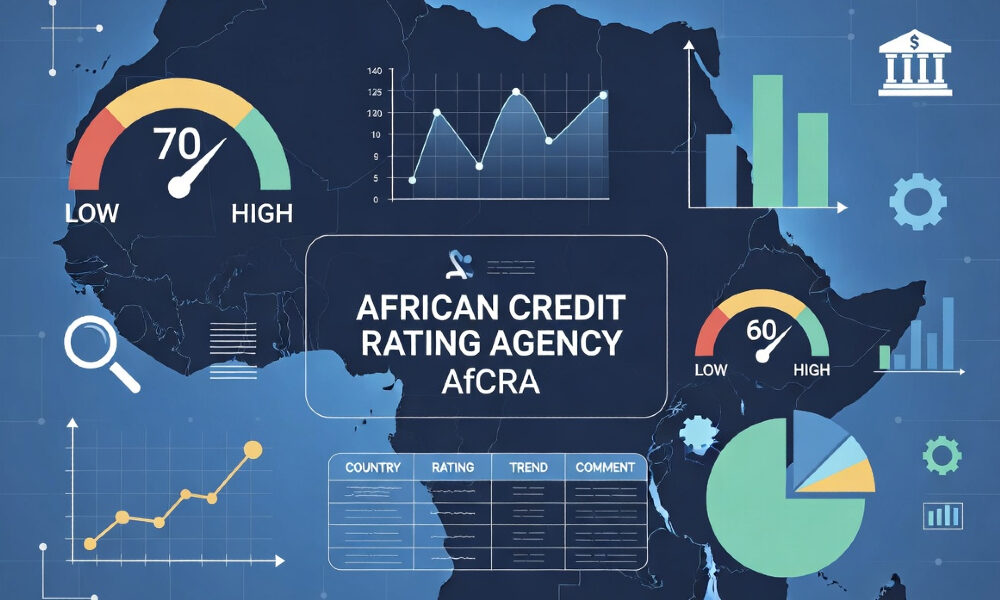
The African Credit Rating Agency – known as AfCRA – is currently in advanced development, with operations targeted for 2026. The initiative has attracted high-level political backing, including from Nigerian President Bola Tinubu, and is designed with a deliberate structural feature: private-sector shareholding intended to insulate it from political interference and lend it genuine analytical independence.
The agency’s core proposition is straightforward. African economies are best assessed by institutions with deep local knowledge – entities that understand the nuances of informal economic activity, the structure of regional trade relationships, and the political economies of individual states in ways that analysts in New York, London, and Frankfurt simply do not.
By incorporating local data and regional expertise, AfCRA aims to produce ratings that more accurately reflect underlying economic reality, rather than recycling longstanding narratives of African fragility.
The model is not without precedent. Asia developed its own regional financial architecture after the 1997 financial crisis, partly in response to frustration with Western institutions whose prescriptions were seen as ideologically rigid and contextually blind. Africa’s ambition is analogous: not to withdraw from global capital markets, but to engage them on more equitable terms.
The Credibility Challenge
Skeptics will raise legitimate questions. A rating agency that exists to counter negative perceptions of African creditworthiness faces an inherent tension: can it be simultaneously credible to global investors and committed to more favorable assessments of African borrowers?
The accusation of motivated reasoning will be difficult to preempt. AfCRA’s founders are aware of this challenge, which is why the private-sector governance model and methodological transparency are central to its design.
The answer, ultimately, will come from the market. If AfCRA produces rigorous, defensible analyses that diverge from Moody’s and S&P in ways that are subsequently vindicated by actual repayment performance, its credibility will build. If it becomes a vehicle for political cheerleading dressed up as financial analysis, investors will ignore it. The incentive structure, at least, is aligned with quality.
Priced Differently, Not Riskier
The deeper issue AfCRA represents is one of narrative power in global finance. For decades, the story of African debt risk has been written almost entirely by institutions based in the wealthy world, applying frameworks developed for wealthy-world contexts, informed by wealthy-world assumptions.
The result is a pricing structure that systematically disadvantages African borrowers – not through malice, necessarily, but through the quieter mechanics of institutional bias and path dependency.
Africa is not uniformly low-risk. No continent is. But it is not uniformly high-risk either, and the evidence increasingly suggests it has been paying for a reputation that its economic fundamentals do not fully deserve.
The US$75 billion annual penalty is not a market verdict on African creditworthiness. It is a market verdict on African perception – and perception, unlike risk, can be changed.
AfCRA will not solve this problem on its own. But it is a serious, substantive attempt to shift the terms of a debate that has cost the continent too much, for too long. The question is no longer whether Africa needs an alternative. The question is whether the world’s capital markets will listen when one arrives.
Gregory September is a South African academic, author, and geopolitical analyst with extensive experience in government and Parliament. He is the founder and CEO of SAUP (Sustainability Awareness and Upliftment Projects NPC), which focuses on sustainability education and community development. He previously served as Head of Research and Development for the Parliament of South Africa. His work centers on sustainability, African geopolitics, and economic development, and he regularly contributes to analysis of global political and economic affairs.