Opinion
Sudan and South Sudan: Shared Roots, Diverging Destinies


By Des H Rikhotso
When South Sudan declared independence on July 9, 2011, following an overwhelming referendum vote, it became the world’s newest sovereign nation – the 193rd member state of the United Nations and a symbol, however fragile, of the right to self-determination. Yet the euphoria of that moment has long since given way to the harder arithmetic of nation-building.
Today, Sudan and South Sudan occupy neighboring territories and share deep historical bonds, but their trajectories tell starkly different – and equally troubled – stories.
A Tale of Two States
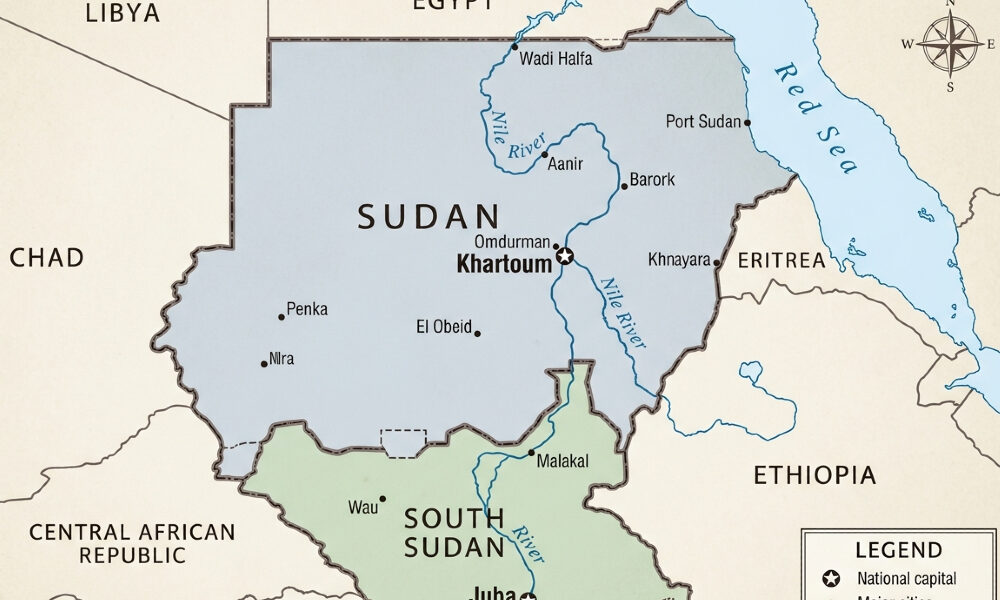
Sudan, with a population of approximately 50 million and a landmass of roughly 1.89 million square kilometers, retains the geographic heft of its former self. Before the 2011 partition, it was the largest country in Africa by area. What remains is still a continental giant: the third-largest nation on the African continent, Arabic-speaking, and anchored by Khartoum on the confluence of the Blue and White Nile.
South Sudan, by contrast, covers some 620,000 square kilometers (240,000 square miles) and is home to around 12 million people, with Juba as its capital and English as its official tongue.
The Nile – that ancient artery of civilization – flows through both countries, a reminder that geography binds what politics has divided.
Assets and Squandered Potential
On paper, both nations are richly endowed. Sudan boasts vast agricultural lands, significant mineral deposits, and a coveted strategic position along the Red Sea – a corridor of commerce that great powers have long sought to cultivate.
Its territory encompasses the legacy of the Kingdom of Kush, one of antiquity’s most sophisticated civilizations, a heritage that underscores the country’s deep historical significance.
South Sudan’s natural inheritance is no less impressive. The country sits atop substantial oil reserves that, at independence, accounted for roughly three-quarters of the former Sudan’s total petroleum output.
Beyond hydrocarbons, it harbors extraordinary biodiversity, vast wetland systems, and some of the largest wildlife migrations on earth – ecological assets with considerable ecotourism potential. Its agricultural land, largely untouched by industrial farming, represents a long-term food security opportunity for a continent increasingly strained by climate pressures.
Yet potential, as economists are fond of noting, is not destiny.
The Resource Curse and the Conflict Trap
South Sudan’s near-total dependence on oil revenue has proven more liability than lifeline. The collapse of oil prices, chronic mismanagement, and a brutal civil war that erupted in 2013 – just two years after independence – devastated the young country’s finances and its people.
Despite a peace agreement signed in 2018, political instability and intercommunal violence continue to undermine reconstruction.
Sudan’s predicament is, if anything, more acute. The country has endured successive cycles of military rule, economic mismanagement, and regional insurgency for decades.
The ousting of longtime president Omar al-Bashir in 2019 raised hopes of a democratic transition, only for a military coup in 2021 to extinguish them. More recently, catastrophic fighting between rival armed factions has plunged Sudan into one of the world’s most severe humanitarian crises, displacing millions and threatening a broader regional conflagration.
The Path Forward
Neither country can afford the luxury of squandered decades. The structural challenges they face – weak institutions, aid dependency, ethnic fragmentation, and the ever-present temptation of resource predation by ruling elites – are formidable but not insurmountable.
Other post-conflict states have demonstrated that durable peace, inclusive governance, and transparent management of natural resources can, over time, transform potential into prosperity.
For Sudan, the immediate priority must be ending the current conflict and restoring a credible civilian-led political process. For South Sudan, consolidating the 2018 peace deal and diversifying an economy dangerously tethered to a single commodity are existential imperatives.
Both nations also share something that no peace agreement or economic reform package can manufacture: a common cultural memory, intertwined ethnic communities, and a mutual interest in regional stability. The deep historical, social, and cultural ties between Sudanese and South Sudanese peoples are not merely sentimental footnotes – they are potential diplomatic assets, if political will can be summoned to leverage them constructively.
The question is not whether Sudan and South Sudan possess the raw ingredients for development. They plainly do. The question is whether their leaders – and the international community that has too often looked away – will finally summon the resolve to turn inheritance into opportunity.
What factor do you believe is most critical to achieving lasting stability and development in Sudan and South Sudan? The answer may be less about resources than about the institutions built to steward them.
Des H Rikhotso is a seasoned C-Suite Multi-Industry (Automotive – OEM + Retail, Logistics, Oil & Gas, etc) business executive with 25+ years of Business Leadership Experience across the South, East and Western Sub-Sahara Africa Region. Based in Kampala, Uganda he serves as East Africa Region Country Director and Business Executive, driving Business Strategic Growth and Operational Excellence – contributing his Business Leadership Experience to the Region. Des has held Business Leadership roles at BMW Group Africa, Volkswagen Group Africa, Peugeot Motors South Africa, Toyota/Lexus South Africa, Lexus East Rand (Unitrans/CFAO), Nissan Group of Africa, G.U.D Holdings (Africa Exports Operations Division),The HDR Group of Companies and The Ezra Group of Companies (a Leading Uganda & East Africa Conglomerate). He holds Under-Graduate and Post-Graduate business degrees from the University of the Western Cape, Wits University (Wits Business School) and the University of South Africa.