Opinion
Beyond the Kit Car: Phasing Out SKD Subsidies to Restructure South Africa’s Auto Industry
By ending support for semi-knocked-down kits, Pretoria is betting that a car made in South Africa should be made mostly of South Africa.


By Des H. Rikhotso
A car bolted together from a box is not the same thing as a car built in a country. For years, South African policy treated the two as equivalent. This month, it stopped.
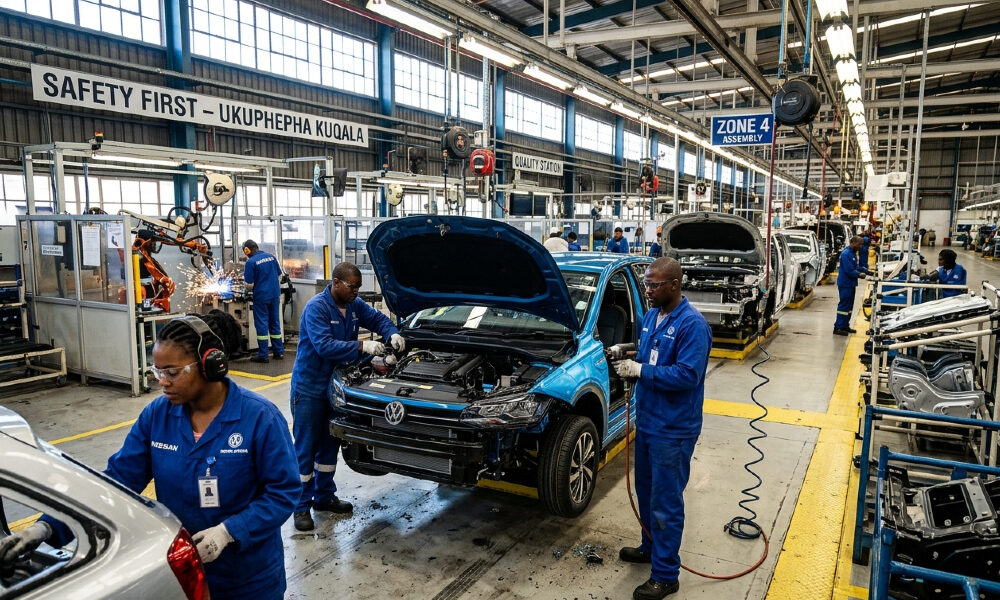
Trade, Industry and Competition Minister Parks Tau announced in October that the government will phase out support and subsidies for semi-knocked-down (SKD) vehicle kits. The “screwdriver plants” that import near-complete bodies and components for final assembly, adding little local value, will lose the incentives they have enjoyed. The Department of Trade, Industry and Competition (DTIC) is also tightening the legal definition of complete knocked-down (CKD) manufacturing, which will force carmakers to build with far more locally made parts. The shift is structural, not cosmetic.
A Grievance Finally Heard
Established manufacturers will welcome it. Toyota South Africa, Ford South Africa, BMW and Nissan have spent billions on local supply chains, complied with local labor law and employed thousands. Newer entrants, mostly Chinese and Indian brands, took a cheaper route. They used SKD arrangements to import near-finished vehicles, collect policy credits and sidestep steep import duties, creating few jobs along the way. By withdrawing support, Pretoria removes the cost advantage that low-investment assembly enjoyed over those that built real industrial capacity.
A Bet on the Supply Chain
The move fits the South African Automotive Master Plan (SAAMP), whose targets for 2035 are bold. It aims to lift local content in vehicles from an average of 38 percent to 60 percent, double employment across the automotive ecosystem and raise South Africa’s share of global vehicle output to 1 percent.
The prize goes to local component makers, the Tier-1 and Tier-2 suppliers of plastics, electronics, exhausts, leather and pressings. Demand for their products should rise sharply and durably. But demand alone does not make a supplier. Global carmakers are exacting about quality and volume, and local firms will need to scale quickly and spend heavily to qualify. Policy can create the opportunity, but it cannot supply the capital.
Build or Pay
For the newcomers, the choice is stark. They can deepen their commitment by moving to full CKD production, investing in tooling, body shops, paint shops and local sourcing. Or they can import fully built-up vehicles and pay South Africa’s standard 25 percent import duty, which would erode the aggressive pricing that won them market share. Neither path is cheap, and both reward those who intended to stay all along.
The “Bakkie” Question
The policy spares medium and heavy commercial vehicles, since their lower volumes do not yet justify localized component manufacturing. The pickup truck, known locally as the bakkie, is another matter. The DTIC has opened a formal investigation into the lucrative light commercial vehicle framework. Mr. Tau has signaled that any future protection or production credits will come with “reciprocal commitments” on local employment, black economic empowerment and export targets. Carmakers should read this as a warning: the era of unconditional incentives is ending.
Who Pays
The consumer, at least at first. Cheap imported and SKD-assembled vehicles have given cash-strapped South Africans affordable choices in recent years. Deeper localization will raise production costs in the short run. Unreliable electricity, with its load-shedding, and congested rail and ports, courtesy of Transnet, make building locally more expensive than it should be. Vehicle prices could rise as a result.
That is the real test of the policy. Industrialization that delivers jobs, investment and a stronger economy is worth some short-term pain. But a local-content target is only as credible as the grid, the railways and the harbors that support it. If Pretoria fixes those, the kit car’s demise will look like a turning point. If it does not, it will look like a tax on the motorist.
Des H. Rikhotso is a business commentator and C-suite executive with more than 28 years of leadership experience across Southern, East, and West Africa. He has held senior roles at BMW Group Africa, Volkswagen Group Africa, Toyota/Lexus South Africa, Nissan Group of Africa, and other leading automotive and industrial companies. Rikhotso is the recipient of South Africa’s NAAMSA Accelerator Award as the 2026 Automotive Industry Social Commentator and Influencer of the Year. He writes on business, mobility, industrial policy, and leadership in Africa and the Middle East. He holds undergraduate and postgraduate business degrees from the University of the Western Cape, Wits Business School, and the University of South Africa. He contributes opinion articles in a private professional capacity. He can be reached via email at: hdr7619@gmail.com.