A Diaspora View of Africa
South Africa faces brutal post-election politics


By Gregory Simpkins
The Republic of South Africa has long been considered the hub of the wheel of the southern Africa region. It is the most developed country in Africa’s south, and with the establishment of majority rule in 1994 and the installation of the revered Nelson Mandela as the first black president of the country, the expectation was that South Africa would lead a surge in regional development.
However, as the recent elections in South Africa have amply demonstrated, Mandela’s African National Congress (ANC) has failed to meet those expectations since he left office.
A record 27.7 million South Africans registered to vote prior to the May 29 elections. However, only 16.2 million votes were cast on election day. It was the lowest turnout election since majority rule was ushered in (58.64 percent of voters).
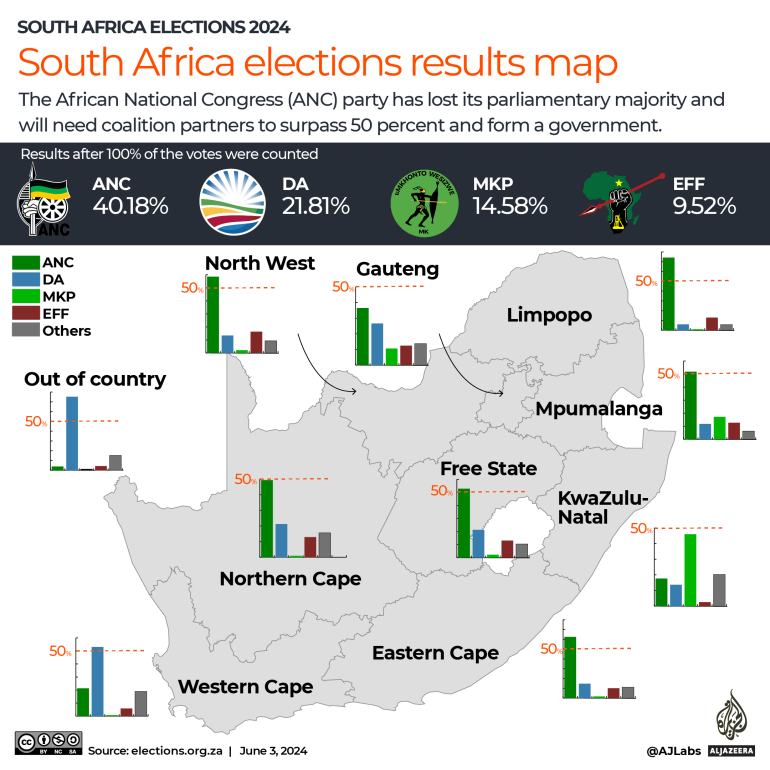
The ANC received 40.18 percent of the vote. Its vote share dropped from 57.5 percent in 2019 to 39.7 percent, and it now holds only 159 seats out of 400 in the national assembly, a fall of 71. But it is still the largest party and the biggest political force in the country. The Democratic Alliance (DA), the main opposition party, was second with 21.81 percent. The new party, uMkhonto we Sizwe (MK), led by ex-President Jacob Zuma, won 14.58 percent of the vote while Julius Malema‘s Economic Freedom Fighters (EFF) placed fourth with 9.52 percent of the vote.

My fellow blogger at The Habari Network, Fidel Amakye Owusu, an African risk analysis expert writing on LinkedIn, says that under Mandela, the expectations of regional integration were deemed realistic, but the opportunity apparently expired with the end of Mandela’s one term in office.
“After Mandela stepped down, almost all his lieutenants during the transitional period were psychologically inclined to believe that they had the right to lead the country. Like in all groups, these figures ranged from liberals to radicals,” he writes.
“What followed was acrimonious and zero-sum politics within the ANC party that made it impossible for the successors of Mandela to complete their second terms in office. Both Mbeki and Zuma could not. Ramaphosa will struggle to have a second term – considering the current situation.”
Owusu said one of the factors that seems to have been taken for granted was the overwhelming support the ANC enjoyed after 1994. With that, the main actors in the party felt there was nothing to fear outside the party.
They “prioritized” internal scramble. Perceptions and accusations of corruption became a feature of the internal wrangling of the ANC, he explained. Just before the current elections, a speaker of Parliament stepped down due to corruption.
According to Chatham House, an independent analytical organization, the ANC leadership has accepted the result of the election, which it says speaks volumes in a region where dominant parties of government and national liberation movements have manipulated systems to retain incumbency.
But the party is not a unitary force. It is famously a broad church, with many interest groups, factions, and alliance partners all operating under the one banner – each with separate views on who a preferred coalition partner should be.
A second colleague, Mary Alorh, a noted defense and security analyst, also writing on LinkedIn, says President Cyril Ramaphosa has openly admitted that the ANC has not been able to meet the expectations of the people since attaining power in 1994. He had promised to do better if they won the election.
Since 1994, Alorh says, the ANC has steered the governance of South Africa, inheriting stable power, industries creating jobs for employment and natural resources of the nation that could be utilized for the betterment of the economy in the areas of infrastructure, making South Africa the economic and infrastructure giant of Africa.
“The story is different now in the last three decades of the ANC-led government. The ANC has plunged the rainbow nation into a plethora of economic issues such as youth unemployment and poverty. Unemployment in 2023 stood at 28.4 percent and poverty stood at 62.7 percent same year,” Alorh writes.
“The power sector is not free from the mismanagement by the ANC government. Eskom (the state-owned power company) has been plunged into debt unable to fully function to power the country hence the frequent power outages and load shedding.”
Recovering from an Electoral Loss
In discussions with other colleagues, some speculated that entrenched ideological and political cleavages makes the creation of a coalition government difficult, especially due to the widespread alienation of the youth voters. The ANC can hardly negotiate with DA, a whites-led party that has been its longtime main opposition and has taken actions contrary to what many citizens are demanding, for example assistance on housing.
The MK, which was officially established in December 2023, grew out of the ANC, and its voters are largely still registered under the ANC. It has been accused of being little more than a vindictive cult organized around the person of Zuma to avenge his ouster by the party by aggravating the mostly self-inflicted damage on ANC. MK appears to have focused on punishing the ANC for its insensitivity to the economic difficulties of its citizens, including the post-majority rule care of veterans of the MK, formerly the ANC’s armed wing. However, it locked in more than 14 percent of the vote nationwide, and although a recent political party, it showed electoral strength outside KwaZulu-Natal, belying the assumption that it is purely a Zulu party.
The EFF is regarded as radical, but there is no doubt it is more principled than had been presumed. It opposed popular but retrogressive xenophobia despite the political cost. Malema’s combative style may have alienated potential support within certain social classes, though.
The ANC has itself to blame for many of its current problems, too often flaunting the wealth of ANC officials. Truth be told, it took over a troubled nation trying to overcome the aftermath of apartheid. At least a generation lacked the education to make a decent living in a legitimate trade, and many of them resorted to crime, which became rampant. Refugees came to South Africa from all over Africa, and this led to a xenophobic reaction that caused violence against the newcomers, especially when the refugees, such as those from neighboring Zimbabwe, had more education and skills to enable career success or operated stores in their areas that competed with established South African stores.
ANC officials had much to overcome to ensure that not only their nation, but their role in regional progress succeeded. It would have been difficult in any event, but when the ANC took their eye off the ball, so to speak, they guaranteed failure on both counts. Now the once-dominant political party must find a willing partner or partners to form a coalition government, and the history of African coalition governments is not good.
Gregory Simpkins, a longtime specialist in African policy development, is the Principal of 21st Century Solutions. He consults with organizations on African policy issues generally, especially in relating to the U.S. Government. He further acts as a consultant to the African Merchants Association, where he advises the Association in its efforts to stimulate an increase in trade between several hundred African Diaspora small and medium enterprises and their African partners.