Business
Six astounding ways Africa is paving the Way for the future of technology
By Jack Smith IV
Every week, the American tech sector uses the most advanced mobile technologies in the world to create some new meaningless distraction. Tinder for dogs; Airbnb for boats; Yo – all sorts of luxury convenience tools created to manufacture and solve problems that do not exist and extract some in-app purchases along the way.
Meanwhile, in Africa, a budding generation of technologists, coders and entrepreneurs are rising to solve their continent’s most pressing problems. Entire new industries around payment solutions, crowdsourcing and entertainment media are springing up in tech hubs in Kenya, Nigeria and other countries.
This is the rise of Silicon Savannah – and a few ways it’s going to change the global face of technology.
1. Africans are more mobile, and mobile is the future
Every few months, the mobile Web – the Internet on your phone, as opposed to your laptop – eats away at another corner of the Internet. Gaming, payments, social media, search, communication and everything else you can think of is giving way to the supercomputers in our pocket. People are meeting the loves of their lives, running businesses, writing their memoirs on their phones.
In Africa, the past 10 years have seen a boom in cellphone ownership and usage. Two-thirds of all homes in sub-Saharan Africa own at least one mobile phone, according to a Gallup poll.
“In a few short years, the proliferation of mobile phone networks has transformed communications in sub-Saharan Africa,” the Pew Research Center reports. “It has also allowed Africans to skip the landline stage of development and jump right to the digital age.” Essentially, Africa leaped over the PC era and landed directly in the mobile revolution.
In fact, most of the rest of the world is way ahead of the United States in terms of mobile. China is the largest cellphone market in the world, with 1.25 billion mobile phone subscribers, many of whom are mobile exclusive. And these countries have a major leg up when it comes to developing mobile solutions.
2. Which is why they’re better at paying with their phones
In the United States, every app is trying to become some kind of mobile PayPal. Facebook messenger, Snapchat, Instagram, Pinterest – not to mention apps explicitly for payment, like Apple Pay. But nobody is really using them – at least not compared to Kenyans.
In Kenya, an app called M-PESA allows people to store money on mobile accounts and make simple transfers via SMS messaging – you do not even need a smartphone to use it. Multiple sources in the venture capital investment community have told us that many Africans are simply stunned the United States does not have something similar.
The rise of M-PESA is largely due the dominance of mobile on the continent, yes, but also to the dangerous and insecure ways money was moving before they had access to mobile payments. According to the Next Africa, about 85 percent of Africans were carrying money in bags and asking bus couriers to transport money for them 10 years ago. As the Economist points out:
Cash can thus be sent one place to another more quickly, safely and easily than taking bundles of money in person, or asking others to carry it for you. This is particularly useful in a country where many workers in cities send money back home to their families in rural villages. Electronic transfers save people time, freeing them to do other, more productive things instead.
Because of M-PESA, Kenya is the leading e-commerce capital of the world. This one app moves an entire third of the Kenyan gross domestic product (GDP) among its 15 million, mostly rural, users.
3. Africa will never be cord-cutters because there’s no cord to cut
In the United States, we will probably spending the next few decades watching the aged titans of the media industry, such as Time Warner, Paramount and Disney, fight against the tide of Internet services like Netflix and Amazon. After all, we have businesses like cable, publishing and network TV that will not go down without spending the fortunes they amassed in the 20th century to battle against the 21st century.
Not in Africa. Africa does not have a robust broadband infrastructure, or continent-wide digital-rights laws and copyright regulations, so new startups like iROKOtv can rapidly become the Netflix of Africa, bringing Nollywood movies and shows to the continent. There are dozens of examples just like this – industries where Africa can develop robust tech solutions to local problems like entertainment delivery and payments without having to fight back a monolithic incumbency.
“One of our biggest headaches in the United States is that you do not own your medical records,” Aubrey Hruby, co-author of The Next Africa: An Emerging Continent Becomes a Global Powerhouse, told us. “But if you travel to another part of Kenya or South Africa, there is no one who has your medical records, so Africa can leapfrog to carrying medical records on their phones.”
4. There’s more money flowing into African tech than ever
In the United States, investments in domestic companies are slowing down for the first time in the past few years of venture-driven app startup boom. But in Africa, venture capital investments – many of which are coming from traditional Silicon Valley venture capitalists and telecommunications – are skyrocketing.
This is because Africa is one of the last “blue oceans” for the tech business, a vast market that is ripe for development and profit but has gone largely untouched.
From the Next Africa: An Emerging Continent Becomes a Global Powerhouse:
Technology in Africa is becoming more than just a social venture or narrow business proposition. The continent’s tech movement will infuse every facet of [sub-Saharan Africa’s] transformation: commerce, health, education, finance, governance and creative culture. This evolving tech ecosystem will continue to empower Africa’s markets, people, and potential in meaningful ways, playing a pivotal role in taking the continent from the world’s economic margins into the digitized mainstream.
5. Which is empowering Africans to generate a local tech economy
In the United States, tech accelerators and incubators are more quaint than necessary. Sure, there are mammoth co-working conglomerates and king-making accelerators like Techstars and Y Combinator, but for the most part, American venture capital is driven by trends, nepotism and, of course, privilege.
But the tech hubs, incubators and accelerators of Africa are one of the best places for young Africans to encounter tools, training and the influx of investments.
“These droves of young African techies who might have left for the United States, their first point of interest is to go show up at a tech hub in Cameroon, Nigeria, Kenya, or Rwanda,” the The Next Africa: An Emerging Continent Becomes a Global Powerhouse co-author Jake Bright told us. “And they are becoming central points for young techies – or those interested in becoming techies – to meet seniors.”
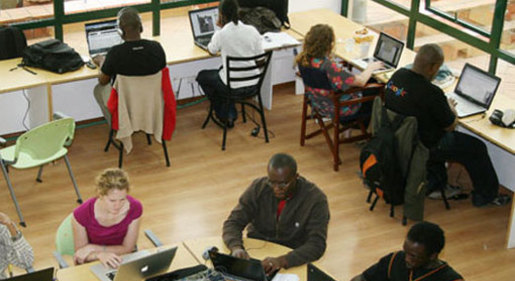
Bright and Hruby estimate 200 of these hubs exist across sub-Saharan Africa, like iHub Research in Kenya, which are integral parts of their neighborhoods and accessible to anyone fighting for access to tools and equipment.
“I don’t think an American high school kid could just wander into one of the best known American incubators,” Bright said. “It’s a flatter structure than in the U.S.”
6. And eventually, they will export their innovations, technological and cultural, all over the world
What Africa makes, it will inevitably export, the same way Germany gave us SoundCloud or Israel gave us Waze. In fact, it is already happening.
A WiFi device called BRCK that was made at an African tech incubator has been used to patch up dead spots in Wisconsin. A system called Ushahidi – a crowdsourcing platform that was used to track incidences of violence around elections in Nigeria – has been used by the Washington Post to track snow cleanup, and by the Huffington Post to monitor election polling. That is to say nothing of the potential for African innovations to spread to other parts of the developing world, which deal with similar problems and have similarly mobile-focused societies.
And that’s not all they will export and Africa becomes more connected. “Innovation isn’t just in tech,” Hruby said. “There is innovation in culture.”
The authors of The Next Africa: An Emerging Continent Becomes a Global Powerhouse believe that the natural conclusion of Africa becoming an innovation hub is that it brings us closer to African culture, literature, fashion and media.
“You are going to be listening to Nigerian music, and African authors are going to be best-sellers,” Hruby says. “There’s not just a growing integration of African countries for goods and services, but for ideas and cultures as well.”
Jack Smith IV is a blogger and writer, that covers the tech scene and trends. The original version of this article was first published in Mic.