Opinion
Senegal’s Pharmaceutical Breakthrough: A Blueprint for African Health Sovereignty
By manufacturing generic hydroxyurea at home, Senegal is dismantling the continent’s reliance on expensive imported drugs and rewriting the rules of African health security.


By Ratnakar Wagh
For decades, a bitter irony has defined the treatment of sickle cell disease in Africa: the continent bears the overwhelming brunt of the illness yet has had almost no hand in manufacturing its cure. Africa accounts for nearly 80 percent of cases of the inherited red blood cell disorder but relies on expensive imported medication from Europe and the Americas. That dependency has just cracked. A laboratory in Dakar has begun producing hydroxyurea, the gold-standard treatment for sickle cell disease, marking the first time it has been made anywhere in Africa.
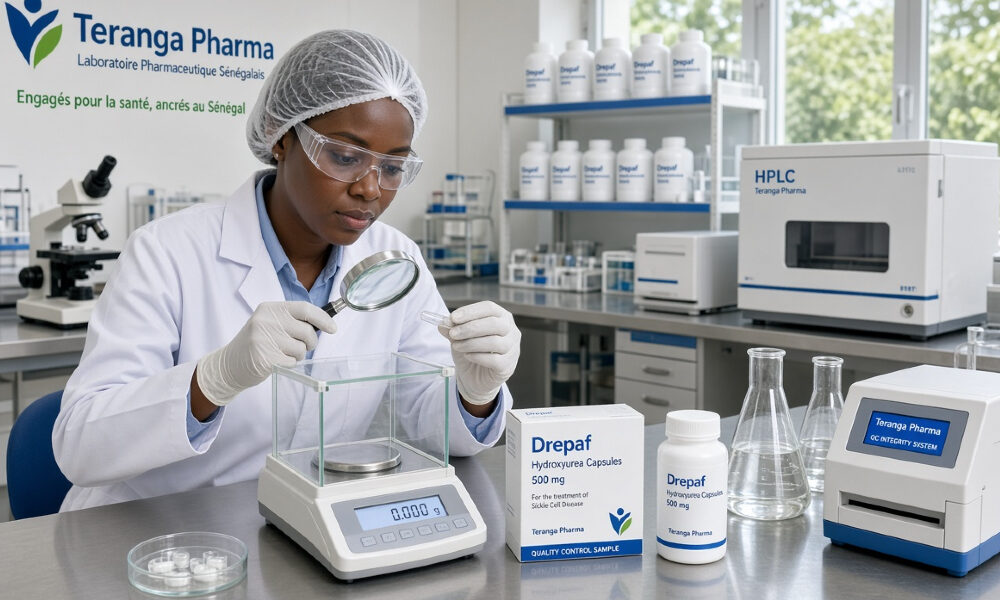
The drug, called Drepaf, is the work of Teranga Pharma, a Senegalese pharmaceutical firm founded by Mouhamadou Sow. Sow argues that Africans have long lacked access to the drug’s active ingredient, and that his company has changed that. The product launched in November 2025 and comes in doses for both adults and children, with the explicit aim, in Sow’s words, of “reducing the crisis threefold.”
The Economics Are the Story
What makes Drepaf newsworthy isn’t just where it’s made, but what it costs. A 500-milligram capsule for adults now sells for 98 CFA francs (US0.16), roughly half the 203 francs (US$0.35) charged for the imported equivalent. That is not a rounding error; it is the difference between a treatment that reaches patients and one that doesn’t. In Senegal, only about 17 percent of patients who need the drug have been able to get it, a gap driven less by ignorance of the science than by the blunt arithmetic of supply chains built for wealthier markets.
Sow puts the underlying logic bluntly: medicines taken by Africans, he argues, ought to be produced in Africa if the continent is to develop and enjoy good health. It’s a point that sounds almost too obvious to need making – until you consider that it took this long for anyone to act on it.
A Tragedy With A Name and A Face
Behind the pricing tables are patients like Mamadou Tahirou, 18, whose frame is frail from the disease’s toll – bone pain, severe anemia, fatigue, and headaches that repeatedly land him in the hospital. His mother described a household exhausted by the disease’s relentless demands and the cost of managing it. Stories like theirs are the reason pharmaceutical self-sufficiency is not an abstract policy goal but a matter of daily survival for millions.
Beyond Senegal’s Borders
The ambitions here are explicitly regional, not merely national. Burkina Faso, Guinea, and Ivory Coast are already working with Teranga Pharma to bring the drug across their borders, while the Democratic Republic of Congo, Gabon, and Cameroon have made requests of their own. Teranga’s own goalpost is continental: it plans to supply all of sub-Saharan Africa by 2030. As one observer tartly summarized the venture, “This is not charity. It is manufacturing.” That distinction matters. Charity is dependency dressed up as generosity; manufacturing is capacity that compounds.
The project has real financial backing behind it, too – the initiative is supported by US$7.1 million in funding, a modest sum by the standards of global pharmaceutical R&D, but one that has already produced a working factory and a functioning supply chain, which is more than many far larger initiatives can claim.
Why this Should Matter Beyond Dakar
Drepaf is a small case study with large implications. It suggests that African-led manufacturing, paired with regional trade cooperation, can do more for public health than another round of foreign aid or subsidized imports ever could. It keeps capital, jobs, and technical know-how on the continent rather than shipping them abroad along with the profits. And it offers a template – local production of a WHO-recommended essential medicine, priced for local incomes, scaled through regional partnerships – that could be replicated for other diseases that disproportionately burden Africa but are treated, if at all, with medicines made somewhere else entirely.
The question now is whether Drepaf remains a singular success story or becomes the first entry in a much longer list. Continental bodies like the African Union and the Africa Centres for Disease Control have talked for years about building local pharmaceutical manufacturing capacity; Senegal has just shown what that talk looks like when it’s put into practice. The test for other governments and investors is whether they can match ambition with the same unglamorous, patient work of building factories, training technicians, and negotiating regional supply deals – the parts of “self-reliance” that rarely make headlines but are the only parts that actually deliver medicine to a patient’s hand.
Ratnakar Wagh is an entrepreneur, management professional, and CEO of Tanzania-based Kinglion Investment Company, an investment firm driving industrial development across Africa through initiatives in manufacturing, renewable energy, and logistics infrastructure. He specializes in organizational transformation, sustainability, and leadership, with a strong focus on building high-performing teams and creating long-term value across emerging markets.