Opinion
Rwanda’s Grand Prix Ambition Holds Lessons for Africa
A small country’s bid to host Formula 1 is really a lesson in how to compete for the world’s notice, and how not to waste it.


By Ratnakar Wagh
The last time a Formula 1 car screamed around an African circuit, Nelson Mandela had been president of South Africa for less than a year and the Kyalami track outside Johannesburg was hosting its final Grand Prix. That was 1993. In the three decades since, the world’s most glamorous motor race has visited Azerbaijan, Singapore and Saudi Arabia, while a continent of 1.4 billion people has watched from the sidelines.
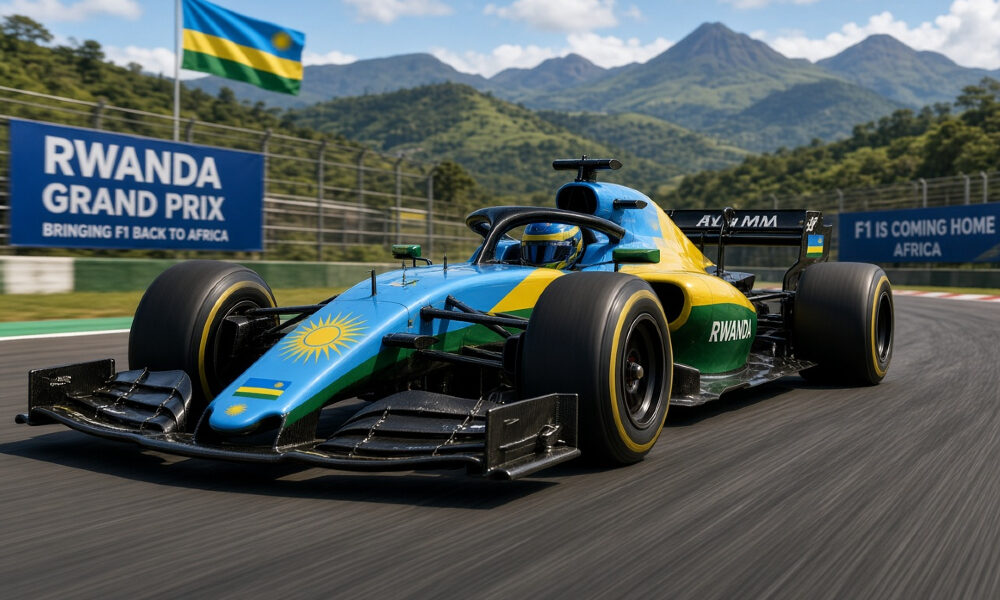
Paul Kagame, Rwanda’s president, would like to change that. Speaking at the FIA General Assembly in Kigali, he announced plans to pursue a Formula 1 Grand Prix, arguing that Africa has every right to host the world’s great sporting events. The ambition is bold for a landlocked country of roughly 14 million people. It is also calculated, and other African governments would be wise to study the calculation.
Attention as an Economic Asset
Rwanda has long understood something that many of its neighbors have been slow to grasp: in a crowded global marketplace, visibility is a form of capital. Through major sporting events, aggressive tourism promotion and a steady courtship of investors, Kigali has spent years constructing an image as a safe, orderly and business-friendly destination. A Grand Prix would be the most spectacular chapter yet.
The logic is easy to follow. Formula 1 beams its races to hundreds of millions of viewers, and each broadcast is a showcase of the host city. The benefits Kagame has pointed to are plausible:
- Tourism. Visitors fill hotels, restaurants and tour operators, and many stay on for safaris and gorilla treks.
- Business. Construction, logistics, transport and event-management firms all stand to gain from a project of this scale.
- Visibility. Few platforms can put a country in front of so many fans, sponsors and prospective investors at once.
- Skills. Motorsport is a training ground for engineers, mechanics and technicians, and could seed a technical-education pipeline that outlasts the race itself.
The Cost of a Glittering Weekend
Yet a sober assessment must begin with a warning. Global attention does not pay the bills. Hosting a Grand Prix is staggeringly expensive: circuits must be built or upgraded, hosting fees paid, security arranged and roads, power and telecommunications strengthened. Several countries that chased the sport’s glamour have discovered that the spectacle can cost far more than it earns, and that white-elephant stadiums and half-empty grandstands are poor monuments to ambition.
Rwanda’s critics will ask whether a country with pressing development needs should spend scarce public money on a rich man’s sport. It is a fair question, and the answer depends on details that remain unclear: who pays, over what period and against which measurable returns. A hosting deal that is transparent and financially disciplined could be a sound investment. One that is neither could prove an expensive vanity project.
What Other African Countries Should Take From Kigali
Whatever happens to the Grand Prix bid, the strategy behind it holds three lessons for the rest of the continent.
First, have a proposition. Rwanda knows what it is selling: stability, efficiency and a welcoming climate for business. Too many African governments promote themselves with vague talk of “untapped potential.” Investors do not respond to adjectives, and they notice when a country has decided what it wants to be.
Second, build partnerships deliberately. Rwanda has courted international federations, sponsors and global brands with patience and persistence. Attracting a marquee event is rarely a matter of luck. It is the result of years of relationship-building and of showing that a country can deliver.
Third, stop waiting to be discovered. The world will not stumble upon Africa’s strengths unaided. Governments must market their advantages, build infrastructure that meets international standards and create openings that foreign partners cannot easily ignore.
From Spotlight to Substance
The deepest lesson, however, is about what comes after the cameras leave. Attracting attention is a strategy. Converting it into investment, jobs and durable growth is the achievement. A race weekend that ends with a round of applause and little else is merely an expensive advertisement.
The test for Rwanda, and for any African country tempted to follow its example, is whether the glow of a global event can be turned into factories, training programs, supply chains and repeat visitors. If it can, a few days of roaring engines in Kigali could echo for decades. If not, the checkered flag will mark the end of the story rather than the beginning.
Africa has waited 33 years for Formula 1 to return. The wait itself is less important than what the continent does with the moment when it comes.
Ratnakar Wagh is an entrepreneur, management professional, and CEO of Tanzania-based Kinglion Investment Company, an investment firm driving industrial development across Africa through initiatives in manufacturing, renewable energy, and logistics infrastructure. He specializes in organizational transformation, sustainability, and leadership, with a strong focus on building high-performing teams and creating long-term value across emerging markets.