A Diaspora View of Africa
Rwanda-DR Congo Crisis Is More Complex Than It Might Seem
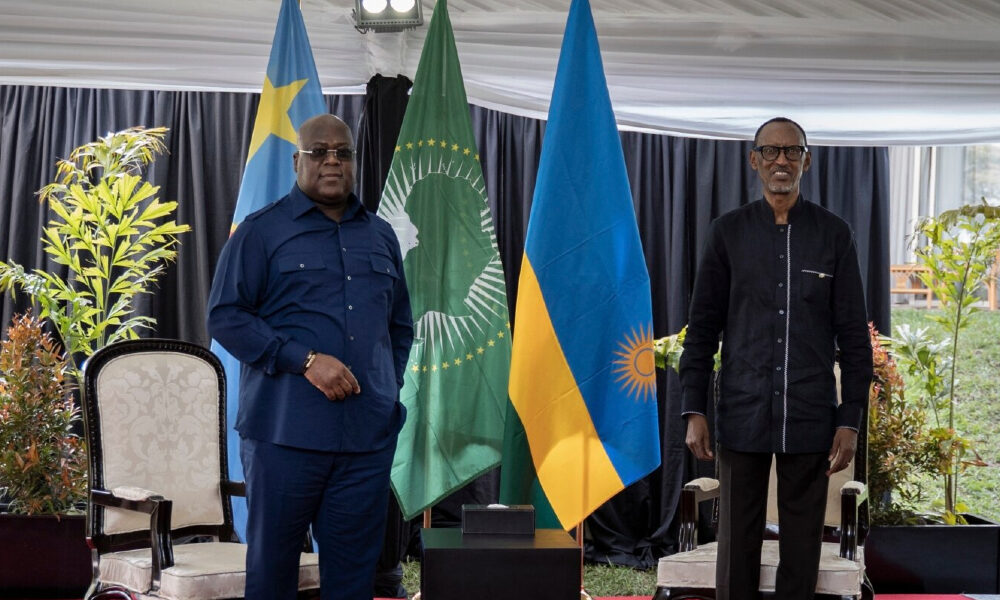


By Gregory Simpkins
Over the years I have worked on analyzing international politics, economics and social issues, I have found that not only is each situation unique, but each circumstance has a background that must be taken into consideration if solutions are to be found. Too often, policymakers look at what is happening today without any consideration of what led to it nor how the past impacts the present or the future.
Here is a prime example of a case where failure to understand or acknowledge the past makes solutions unlikely if not impossible under such circumstances.
Current Tensions Between Rwanda and DR Congo
The conflict in East Africa between Rwanda and the Democratic Republic of the Congo (DR Congo) has become increasingly perilous. Rwandan President Paul Kagame is more confrontational with each passing day.
People who know him have said he is volatile, but being belligerent in international affairs can start wars.
Historical Origins: The 1994 Genocide and Its Aftermath
Understanding this situation requires an examination of the background of the Rwanda-DR Congo tensions. Its genesis actually is in the Rwandan genocide of 1994, in which hundreds of thousands of Rwandan Tutsis and moderate Hutus were mercilessly slaughtered by Hutu extremists.
The world recalls this tragedy, but it is still deeply felt by Rwandans, none more so than Kagame himself.
Many of the murderous Hutu militias fled into the DR Congo, often being housed in United Nations refugee camps near the Rwandan border. The Democratic Forces for the Liberation of Rwanda (FDLR), an armed rebel group active in eastern DR Congo, is an ethnic Hutu group opposed to the Tutsi influence in the region.
The FDLR is one of the last factions of Rwandan rebels active in the Congo and considered to be responsible for attacks into Rwanda.
First-Hand Observations and Early Interventions
This is not a situation I just read about; it is something I confirmed while leading a Congressional staff delegation to the region in 1998. We were told that the UN did not police the Hutu militiamen nor was the DR Congo government able to restrain them at the time.
Our delegation was present in Goma when the provincial governor was called to Rwanda to explain how he would restrain the Hutus from continually attacking. Evidently, his response was unsatisfactory because conflict broke out between the two counties within weeks of our departure.
Rwanda’s Military Involvement and the M23 Connection
Repeated cross-border attacks led Kagame to conclude that he needed some force on the ground to counter the Hutu incursions. When Rwanda officially entered its neighbor in 1996 and 1998, it had the sympathy of many in the international community, as it alleged its only goal was self-defense against the militias who had carried out the genocide in 1994.
However, when pressured by the international community to end its support for the Tutsi-led National Congress for the Defense of the People (CNDP), which the Rwandan military fought alongside, Rwanda did so, even arresting its leader, Laurent Nkunda and striking a deal to integrate the rebels into the Congolese army.
But in a 2012 report by the Rift Valley Institute, which works in Eastern and Central Africa to bring local knowledge to bear on social, political and economic development, the current M23 Tutsi-led group emerged from the remnant of the CNDP with continued backing by the Rwandan government. According to the Institute’s report, intelligence officers present helped to expose a number of mass graves that, according to locals, held the victims of massacres carried out by the Rwandan army and its Congolese allies in 1996–7.
The Banyamulenge Factor and Resource Exploitation
Despite agreements to cease its attacks, M23 has continued its anti-government and anti-citizen actions in DR Congo. There is a community related to Rwanda that has been endangered in eastern DR Congo.
The Banyamulenge are a community that lives mainly in South Kivu Province in DR Congo. The Banyamulenge are not culturally and socially distinct from the Tutsi of the area.
Two Presidents of the DR Congo declared the Banyamulenge “enemies of the state: Mobutu Sese Seko in 1996 and Laurent Kabila in 1998.
In addition to protecting their fellow Tutsis and their homeland, the Rwandans also have an interest in taking out DR Congo resources for profit.
The UN Panel of Experts on the Illegal Exploitation of Natural Resources and Other Forms of Wealth of the Democratic Republic of the Congo, in its final report on 8 October 2002, stated that despite withdrawing troops following the Second Congo War, the Rwandan Patriotic Army conspired to maintain a presence in DRC to secure its interests in that country.
Rwanda has no known production sites for many of the minerals that were exported at vastly higher rates after their invasion of the DR Congo. “Free zone areas” make diamonds difficult to track because they can be repackaged and “legally” sold as diamonds from that country.
The DR Congo exported few minerals after the invasion because the destruction of the rural infrastructure caused mining and agricultural outputs to wane (“Report of the panel of experts on the illegal exploitation of natural resources and other forms of wealth of the Democratic Republic of the Congo”).
When the delegation I led to the region in 1998 spoke with Rwandan officials about the smuggling of resources from DR Congo, they had no reasonable, verifiable response to explain their possession of the resources in their possession.
Military Escalation and Regional Tensions
UN officials say as many as 4,000 Rwandan troops were escorting the M23 rebels in their current rampage, and UN peacekeeping chief Jean-Pierre Lacroix said that: “There was no question that there are Rwandan troops in Goma supporting the M23.” Still, Kagame continued to deny the presence of Rwandan troops in DR Congo despite plentiful evidence.
Hundreds of Rwandan troops have been killed during covert operations in the eastern DR Congo, contradicting claims from Kigali that its soldiers are not involved in the conflict there.
Multiple intelligence, military and diplomatic sources say that “very significant” numbers of soldiers from the Rwanda Defence Force (RDF) have died supporting an offensive by the M23 in DR Congo. Satellite imagery of one military cemetery in the Rwandan capital of Kigali indicates at least 600 graves have been dug since the M23 – backed by RDF troops – restarted operations within DR Congo three years ago.
Two high-ranking intelligence officials with knowledge of the RDF say the true losses sustained by Rwanda probably run into the “thousands”, but pinning down a definitive figure is challenging.
In a February 3 interview with CNN, the Rwandan president said he didn’t know if Rwandan troops were operating inside DR Congo.
Thirteen South African troops reportedly were killed in an M23 and Rwanda Defence Force (RDF) attack on the Armed Forces of the DR Congo (FARDC) and peacekeepers from the SADC Mission in the Democratic Republic of Congo (SAMIDRC). Kagame says the SAMIDRC have no place in DR Congo, but South African President Cyril Ramaphosa said his peacekeepers are there to prevent, not provoke, violence in eastern DR Congo.
“South Africa’s military presence in the eastern DR Congo is not a declaration of war against any country or state,” Ramaphosa insisted in a statement. In that same statement, he accused the M23 rebels and the Rwandan army – dismissed as a “militia” — of attacking the peacekeepers sent by SAMIDRC.
“When we were at Goma, the DR Congo forces were fighting Rwandan forces over our heads. That is where we lost three people. So, we had to quickly communicate with M23 to say ‘we are not part of the battle so don’t fight over our heads’,” Angie Motshekga, the South African defence minister said at a recent press briefing.
“President Cyril Ramaphosa did warn them to say if you are going to fire at us, we will take it as a declaration of war, and we’ll have to defend our people and that’s when the firing also stopped.”
Uganda’s Entry and Escalating Regional Tensions
Now Ugandan military forces have been deployed to the town of Bunia in the eastern part of the DR Congo, which only increases the danger of a wider conflict.
“There were massacres being committed by some militia groups, and we agreed with our Congolese counterparts to carry out joint operations to save lives,” Ugandan military spokesman Felix Kulayigye told Agence France Presse.
The belligerence expressed by Kagame recently could be the spark for a wider conflict. Speaking on the X social media platform, Kagame was quite combative towards the South Africans.
“If South Africa wants to contribute to peaceful solutions, that is well and good, but South Africa is in no position to take on the role of a peacemaker or mediator. And if South Africa prefers confrontation, Rwanda will deal with the matter in that context any day.”
As of this writing, Kagame had made no public statement on the entrance of Ugandan troops into the conflict in eastern DR Congo.
In an October 2022 report, Human Right Watch revealed that the Congolese military, in its desperation to stop advances by M23, provided support to the FDLR. However, this was not reported as an invitation to invade Rwanda itself, and the danger of further FDLR cross-border attacks is considered to be greatly diminished.
Consequently, there is less reason for the Rwandan President to be so combative with so much at stake for peace in the region. The question is: what will the international community do to stop this situation before it does break out into regional conflict.
The Role of International Community and Economic Leverage
The U.S. Department of the Treasury’s Office of Foreign Assets Control (OFAC) imposed sanctions on James Kabarebe, Rwanda’s Minister of State for Regional Integration, who is considered central to Rwanda’s support for M23, but will the United States and other Western powers do more to use what leverage they have to halt Rwandan support for the growing rebellion?
Without increased donor pressure on Rwanda, it is believed that the M23 and its Rwandan backers are in Goma to stay and that their occupation could last months and even years.
While Rwanda’s dependence on donors has decreased in recent years, foreign grants still contribute 13 percent to their budget; the World Bank estimates that total aid in recent years was the equivalent of 25 to 40 percent of its revenue (much of that does not go through the national budget, hence the discrepancy). Currently, it receives around US$1.3 billion in aid; its total budget is just over US$4 billion.
More importantly, Rwanda depends enormously on its reputation as a stable, peaceful place; it was projected to earn US$660 million from tourism in 2024 and has positioned itself as a major conference hub, hosting more than 150 conferences in 2023, earning them US$91 million in revenues. Sports business also has boosted earnings: the NBA is partnering with Rwanda in its Basketball Africa League (BAL); the country is hosting a prestigious world cycling event this year; and it has put in a bid for a Formula 1 race.
The Path Forward: Preventing Further Crisis
The international community must finally overcome its guilt over the 1994 genocide in Rwanda and the failure to halt repeated attacks by Hutu rebels and take action soon to end this crisis. For his part, Kagame must come to realize that the FDLR danger is much diminished if not eliminated, at least for the time being.
There remains time to prevent a catastrophe greater than the Rwandan genocide, but the status quo must end quickly. Understanding the depth of this situation is vital to devising the means to prevent a greater crisis, and that understanding must be brought to bear now.
Gregory Simpkins, a longtime specialist in African policy development, is the Principal of 21st Century Solutions. He consults with organizations on African policy issues generally, especially in relating to the U.S. Government. He further acts as a consultant to the African Merchants Association, where he advises the Association in its efforts to stimulate an increase in trade between several hundred African Diaspora small and medium enterprises and their African partners.