Opinion
Rwanda, AGOA and the Price of Trade Paternalism
By removing Rwanda from AGOA, Washington has turned a development program into an instrument of judgment. Africa’s answer should be a single, continental one.


By JP Følsgaard Bak
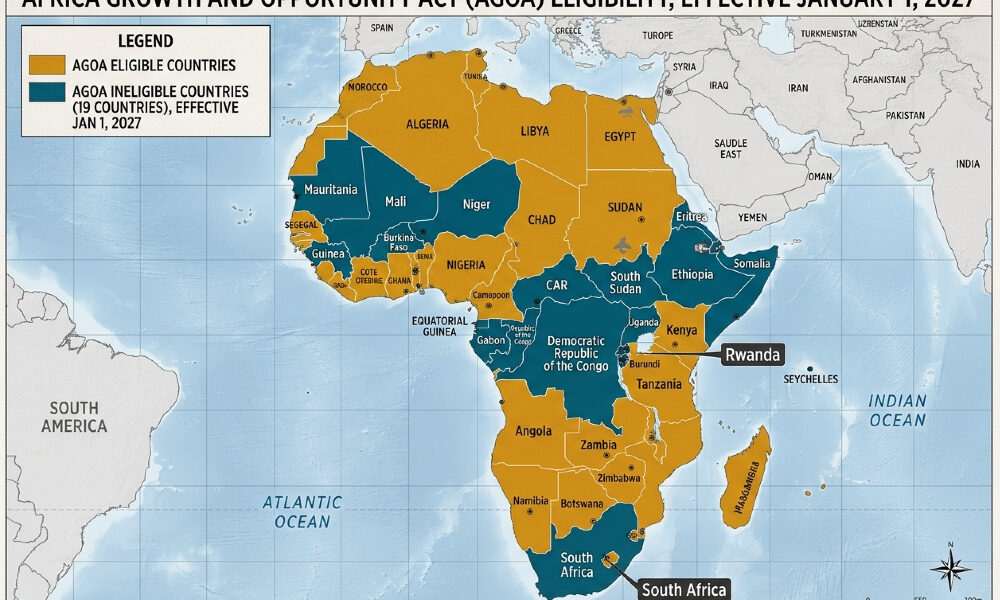
On January 1, 2027, Rwanda will lose its duty-free access to the American market under the African Growth and Opportunity Act (AGOA). It will not be alone. South Africa goes with it, in a decision announced days after the U.S. Treasury sanctioned Rwanda’s defense ministry over its alleged backing of M23 rebels in eastern Congo. Kigali denies the allegations. Washington has made up its mind.
Start with what the exclusion does not do. Rwanda’s exports to the United States are modest, and the immediate financial damage will be limited. The cost lies elsewhere: in reputation, in investor confidence, and in the message that a country long held up as Africa’s model of order has been publicly placed among its miscreants.
The 2020 Precedent
I know this argument from the other side. In 2020, my company, Industry Five, worked to persuade then-Secretary of State Mike Pompeo that Congo’s private sector should not be shut out of the AGOA arrangement because of localized unrest along its eastern borders with Uganda and Rwanda. The Democratic Republic of Congo was reinstated that December, despite fighting in the east that had not gone away. The principle was sound: businesses in Goma and Kinshasa should not be punished for a conflict they did not start and cannot end.
That principle has now been abandoned in one direction only. DR Congo was readmitted with the eastern conflict unresolved. Rwanda is expelled over the same conflict. Whatever Washington intends, the sequence reads as an assignment of blame: Kinshasa is the victim, Kigali the aggressor. That is a verdict on one of Africa’s most tangled wars, and it has been delivered through a trade program with no standing to render it.
Why AGOA Was Created
When Bill Clinton signed AGOA into law in 2000, the promise was partnership: market access in place of aid, trade as a ladder rather than a leash. Defenders of the current decision will note, correctly, that the statute carries eligibility criteria, including ones touching on U.S. national security and foreign policy interests. But criteria that elastic invite exactly the arbitrariness now on display. Under a rule that can mean almost anything, the question is not whether a country complies. It is whether Washington is in a forgiving mood.
The result is a patchwork. Cameroon, Ethiopia and Uganda have all been cut at different times, for different reasons, under different administrations. Others were readmitted when the political winds shifted. A program meant to give African exporters certainty instead teaches them to lobby Capitol Hill. I have sat in enough of those meetings to know who prospers in such a system: not the coffee grower in Musanze or the apparel maker in Kigali, but whoever can afford a Washington presence.
The Case for a Continental Treaty
The remedy is structural. Africa should stop negotiating its access to the world’s largest consumer market one capital at a time. A single treaty between the United States and the African Union would replace the annual beauty contest with a rules-based framework: transparent criteria, independent review, graduated remedies, and disputes settled through a process rather than a press release. The African Continental Free Trade Area has given the continent the institutional scaffolding to speak with one voice. It should use it.
Such a treaty would also be good for Washington. America’s stated goals in Africa, from critical-minerals supply chains to counterweights against Chinese influence, are poorly served by a trade framework that Africans perceive as capricious. Predictability is a strategic asset. An arrangement that punishes a country on Monday and promises it “a path back” by Friday is the opposite.
Rwanda’s Integrity, and Africa’s
The allegations deserve to be tested, not simply asserted. Rwanda has built a reputation that few African states can match for public safety, cleanliness, administrative efficiency and a business-friendly climate. Whatever one thinks of its role in the Great Lakes, a decision that treats that record as irrelevant, and a one-sided account of the eastern Congo conflict as settled fact, risks tarnishing more than one country. Reputation in a continent still fighting for investor trust is collective. When Rwanda is made an example, every African exporter pays a premium for the association.
President Paul Kagame should not let the matter rest. With the backing of the African Union, Rwanda should lodge a formal, coordinated appeal, one that is substantive rather than rhetorical, and that puts the continental treaty on the table as the constructive alternative.
Africa has come a long way. Its progress is hard-won, and it is not guaranteed. The right response to a decision made by one capital about one country is not silence, and it is not a scramble for individual exemptions. It is unity, delivered in a single voice, with a single demand: a trade relationship built on rules, not moods.
JP Følsgaard Bak, Esq., a former lawyer, is a dedicated international social entrepreneur and serial entrepreneur. He co-founded several technology companies, including EMX Group (a biomedical microchip manufacturer in California), Sûrtab S.A. (a tablet PC manufacturer in Haiti), and Bak USA. Currently, he serves as Chairman of Industry Five Group, with operations in the USA, Denmark, Uganda, Nigeria, Gabon, and Ethiopia.