Zina’s Youth View on Africa
Russia’s African Gambit: Moscow’s Diplomatic Dash for the Continent
Moscow can no longer count on Washington or Brussels. So it is counting embassies instead – and Africa’s smallest states are where the tally is rising fastest.


By Godfred Zina
There is a certain irony in watching a country isolated from the West’s boardrooms and banking systems respond by opening more front doors. Yet that is precisely Russia’s strategy in Africa. Having been shut out of Western markets, financing, and technology since its invasion of Ukraine, the Kremlin has settled on an unglamorous but effective countermeasure: diplomacy, delivered one embassy at a time.
The latest additions to Russia’s African address book are The Gambia, Liberia, Togo, and the Union of the Comoros – four states not typically found on the front pages of global affairs coverage, and that is rather the point. None of them commands vast oil reserves or a seat at the G20. What they offer instead is something quieter but no less valuable: votes at the United Nations, membership in regional blocs such as ECOWAS and the African Union, footholds along strategic maritime routes, and a diplomatic imprint that Western governments have often taken for granted – or simply neglected.
Sanctions as a Catalyst, Not a Cause
It would be tempting to read this expansion as a reaction to sanctions, full stop. Western restrictions on Russian trade, finance, and technology, tightened further as Ukraine has struck at Russian energy infrastructure, have undeniably squeezed the Kremlin’s finances and closed off traditional avenues of influence. But treating Africa policy as merely a pressure-release valve misunderstands what is happening on the ground.
Russia opened embassies in Niger, Sierra Leone, and South Sudan just last year, and created a dedicated Department for Partnership with Africa inside its foreign ministry to manage the growing portfolio. That is not the behavior of a country improvising a workaround. It is the behavior of a country executing a plan – one that predates the current war and will likely outlast whatever settlement eventually ends it.
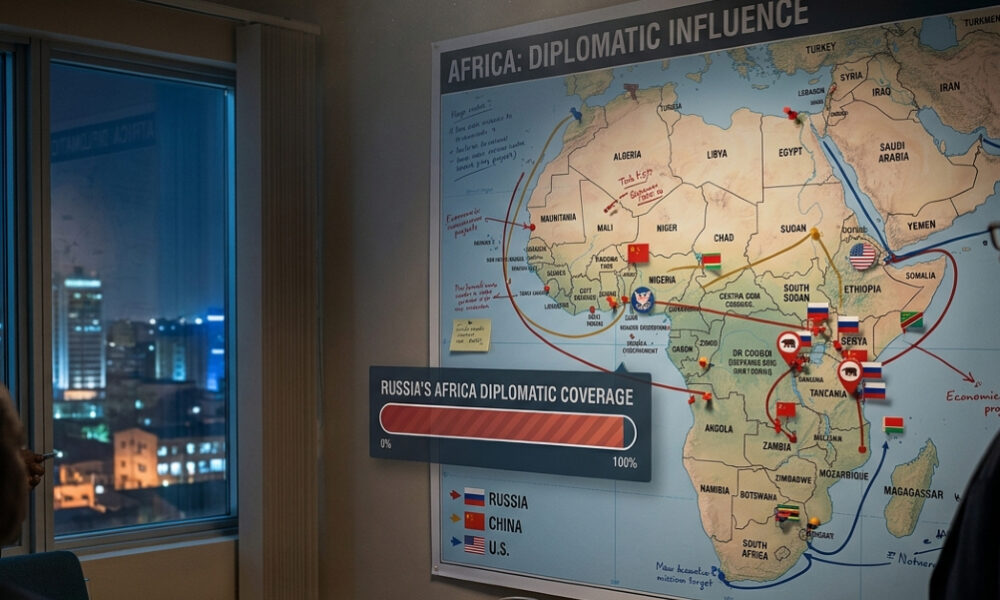
With 45 embassies already operating across the continent and Moscow angling for near-total diplomatic coverage – leaving only a handful of countries without a Russian mission once the current expansion is complete – the numbers speak for themselves. This is not opportunism. It is architecture.
Why Small States Matter
Great powers have historically measured African engagement in barrels of oil and tons of lithium. Russia’s approach suggests a different calculus, one that treats diplomatic presence itself as the asset. A seat at the table in ECOWAS, a sympathetic vote at the UN General Assembly, a naval-friendly port along the West African coast – these are currencies that do not show up on a balance sheet but matter enormously in the arithmetic of international politics.
For the African governments on the receiving end, the appeal is fairly straightforward. Russian engagement offers alternatives: to security partnerships dominated by Western militaries, to investment flows controlled by Western institutions, and to diplomatic relationships that have often come bundled with governance conditions Moscow shows little interest in imposing. Whatever one thinks of the Kremlin’s motives, it is offering options – and options have their own market value.
The Real Story Is Competition, Not Charity
None of this occurs in a vacuum. China has spent two decades building infrastructure and trade ties across Africa. The United States and European powers, however unevenly, continue to invest in security cooperation and development aid. What has changed is the intensity of the contest and the entrants now competing for a seat at Africa’s table.
Russia’s calculation is unlikely to be measured in fiscal quarters. Sanctions accelerated the timeline, but the ambition – rebuilding the kind of Soviet-era influence Moscow once enjoyed across the continent – is a generational project, not a crisis response. Building an embassy in Banjul or Lomé costs relatively little and buys a permanent seat at the table for decades to come.
The takeaway for Western capitals should not be alarm so much as recognition. Africa is no longer a periphery to be managed from Paris, London, or Washington on an as-needed basis. It is becoming one of the central arenas of twenty-first-century strategic competition, where diplomatic presence, security ties, and trade relationships are being contested seat by seat, embassy by embassy. Russia has simply decided to show up more often – and, for now, few others are matching the pace.
Godfred Zina is a freelance journalist and an associate at DefSEC Analytics Africa, a consultancy specializing in data and risk assessments on security, politics, investment, and trade across Africa. He also serves as a contributing analyst for Riley Risk, which supports international commercial and humanitarian operations in high-risk environments. He is based in Accra, Ghana.