A Diaspora View of Africa
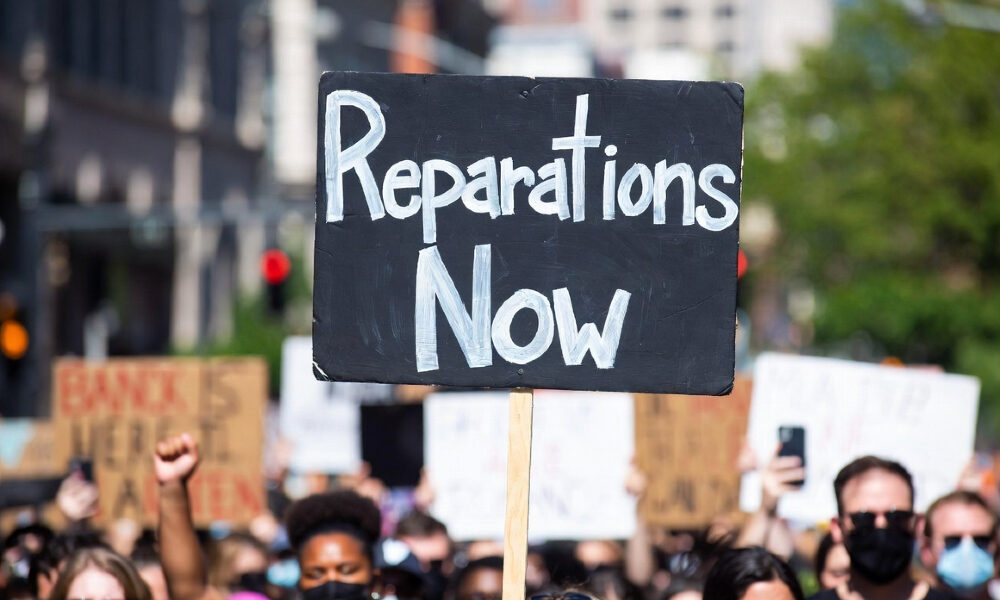
Reparations Remains a Most Complex Issue


By Gregory Simpkins
“Forty acres and a mule” was the slogan for American reparations for former slaves. However, as I demonstrated in the previous post, that promise was short-lived. After Abraham Lincoln’s death, his successor rescinded that offer, and in fact, land was returned to southern whites.
Arguments for restitution are:
- Return or compensation for stolen property. While some former slave owners were compensated for their “property” being liberated, former slaves could not use this rationale since they were the so-called property being taken away. This is quite different from what Japanese Americans faced before, during and after World War II, for example, since they could identify their property that was confiscated and prove their ownership. Those black families that received land under the reparations process after the Civil War might have been able to identify the property they had been given, but under the Reconstruction governments, the emphasis was on reconciliation between North and South and not compensating former enslaved.
- Deterrence: You could make penalties so severe that wrongdoing became expensive so it doesn’t repeat. The 13th amendment to the constitution legally abolished slavery so it was no longer legal to own other people. However, the system of sharecropping tied former slaves, who lacked land, money and equipment to farms, in many cases to the very people who had owned them under slavery. Paying rent and the costs of implements to farm took so much of their revenue that they couldn’t stay ahead of payments, keeping them perennially trapped.
- Closing wealth gaps: Past wrongs cause present economic disparity. If you are in a 100-yard dash and your competitors start at the 50-yard line while you start at the beginning, it will be nearly impossible to catch up. The lack of political power, economic benefits and even education hamstrung black people in the United States for more than a century after slavery ended. Affirmative action was created to bridge this gap, but cynical officials turned it into quota systems, ignoring the hunt for genuinely qualified individuals. It seemed to those of us at the time that it was created that there was a deliberate effort to make affirmative action fail by overlooking the best and brightest among our people.
The term “affirmative action” was first used in the United States in Executive Order 10925, signed by President John F. Kennedy on March 6 1961, which included a provision that government contractors “take affirmative action to ensure that applicants are employed, and employees are treated [fairly] during employment, without regard to their race, creed, color, or national origin”. In 1965, President Lyndon B. Johnson issued Executive Order 11246 which required government employers to “hire without regard to race, religion and national origin” and “take affirmative action to ensure that applicants are employed and that employees are treated during employment, without regard to their race, color, religion, sex or national origin.”
The Civil Rights Act of 1964 prohibited discrimination on the basis of race, color, religion, sex or national origin.
Neither executive order nor the Civil Rights Act authorized group preferences. The Senate floor manager of the bill, Senator Hubert Humphrey, declared that the bill “would prohibit preferential treatment for any particular group” adding “I will eat my hat if this leads to racial quotas.” Again, affirmative action in practice would eventually become synonymous with preferences, goals and quotas as upheld or struck down by Supreme Court decisions even though no law had been passed explicitly permitting discrimination in favor of disadvantaged groups.
Arguments against:
- No living perpetrators/victims: Opponents of reparations for slavery present point such as only 2 percent of white people owned slaves or that there were white people who hid slaves of facilitated their escape from slavery in efforts such as through the Underground Railroad. There were indeed many whites in the 19th century who actively opposed slavery, such as the radical abolitionist John Brown. There are no former slaves or former slave holders still alive, although there are perpetrators of illegal discrimination in recent memory.
- Individual or class reparations: Everyone has ancestors who were wronged. The issue is: reparations are old, but payments to descendant classes rather than direct victims are a 20th/21st century development. Most successful cases involve living victims, clear documentation and a state that admits legal liability. Slavery/colonialism reparations are still mostly unresolved because the gap between wrong and payment is 150+ years, and the legal/political hurdles are higher.
- Practical: How to define eligibility, how much, and who pays? Reparations have taken the form of cash payments; funds for education, housing or community development; symbolic apologies, holidays, memorials or land return, or institutional programs such as scholarships or preferential contracting, for example.
This last point gets us to the most difficult conundrum regarding modern-day reparations for slavery in the United States: who are the responsible parties and who are the legitimate descendants deserving recompense.
Post-Slavery Immigration Clouds the Issue
From the year after the Civil War and slavery ended (1866) through 2023, the total naturalizations numbered about 37.9 million people. The annual average of naturalizations was about 800,000 to 1 million per year. In 2023, there were 878,500 new citizens. These numbers don’t include their US-born kids, who are citizens automatically.
Until 1900, almost all legal immigrants were from Europe: Germans, Irish, British, Scandinavians and Italians. The 1924 Immigration Act banned Asians, set tiny quotas for Southern/Eastern Europeans and banned Africans. The 1965 Immigration Act ended national-origin quotas. Since then, there have been about 9.8 million naturalized from Latin America – 4.1 million from Mexico alone. Approximately 7.6 million came from Asia and about 2.1 million were from Europe.
Among the Diaspora nations, the Caribbean had 1.8 million naturalized since 1965, and Africa had 1.3 million.
Since slavery ended, people from almost 200 countries/national origins have become US citizens, totaling about 38 million naturalizations. The ethnic composition flipped: between 1865-1965 about 90 percent were European. Since 1965 about 85 percent were Latin American, Asian, African or Caribbean.
Then there is the often-unacknowledged issue of mixed marriages, especially since the 1967 Loving v. Virginia Supreme Court decision legalizing such unions. Some mixed marriages existed where legal prior to the Loving case, however.
In the 1960 census, there were 51,000 Black-White couples. Since the Loving case, Black-White marriages grew to 677,000 in 2023. About 18 percent of Black newlyweds today marry someone of another race, with Black men doing so twice as often as Black women. Total interracial marriages involving Black Americans since 1967 is likely between 1.5 million-2.5 million, though Census only gives snapshots, not a running total.
Given the influx of immigrants from all over the world since slavery ended and the mixed-race marriages producing people of multiple ethnic groups, how do you neatly decide who owes for reparations and who deserves to receive reparations? An Irish family that arrived long after slavery ended would rightly object to being billed for reparations. Do recent Black immigrants deserve a share of any slavery reparations? Moreover, does a person who is half Black and half White earn a full share of whatever reparations end up totaling per person?
Modern US City/State-Institutional Reparations
Given the complexities involved in slavery reparations, perhaps reparations for more recent and identifiable discrimination would be more appropriate, for example for employment or education discrimination or for “redlining,” an illegal practice in which financial institutions or insurance companies deny or limit services such as mortgages or loans to residents of designated neighborhoods based on race or ethnicity.
In 2021, Evanston, Illinois, became the first US city to pay reparations – US$10 million over 10 years via housing grants to Black residents affected by redlining between 1919-1969. New York, Detroit, St. Paul, Providence are all studying or passing resolutions, but there are no checks yet, and it remains unclear whether they will follow Evanston’s focus on more recent, identifiable discrimination.
Georgetown University initiated a US$400,000/year fund in 2019 for descendants of 272 slaves sold in 1838. Princeton Seminary started a similar US$27 million fund for the same purpose.
A California Task Force in 2023 recommended up to US$1.2 million per eligible Black Californian, but the legislature hasn’t funded it. The estimated cost is US$800 billion. From the reporting on this process, it will run into the same obstacles concerning who owes reparations and who receives reparations. There was no slavery in California, nor was there in other states such as Vermont or those that joined the union after slavery ended.
This is an issue of justice denied that isn’t going away, but it is not as cut-and-dried as many people seem to think. Fairness goes beyond the descendants of slaves and must be extended to others in a multi-ethnic nation as well.
Gregory Simpkins, a longtime specialist in African policy development, is the Principal of 21st Century Solutions. He consults with organizations on African policy issues generally, especially in relating to the U.S. Government. He further acts as a consultant to the African Merchants Association, where he advises the Association in its efforts to stimulate an increase in trade between several hundred African Diaspora small and medium enterprises and their African partners.