Opinion
Refine It Here, or Don’t Buy It: Congo’s Cobalt Gamble and Africa’s Growth Trap
Kinshasa is trying to turn its mineral wealth into industry. Whether it works may depend on a problem that has nothing to do with minerals: Africa’s governments are running out of money to build anything.

By Gregory September
The message from Congo to the world’s battery makers is blunt: refine it here, or do not buy it.
On August 6, 2026, the government confirmed an order banning exports of copper concentrate and cobalt concentrate outright. It is the latest in a series of restrictions. Congo already caps how much cobalt can leave the country as a finished product, at 96,600 metric tons a year for 2026 and 2027. That ceiling combines an 87,000-ton base allocation with a 9,600-ton reserve. Congo supplies about 70 percent of the world’s mined cobalt, so these rules are not a sideshow. They reach into the supply chains of electric vehicles and consumer electronics.
A Squeeze at Both Ends
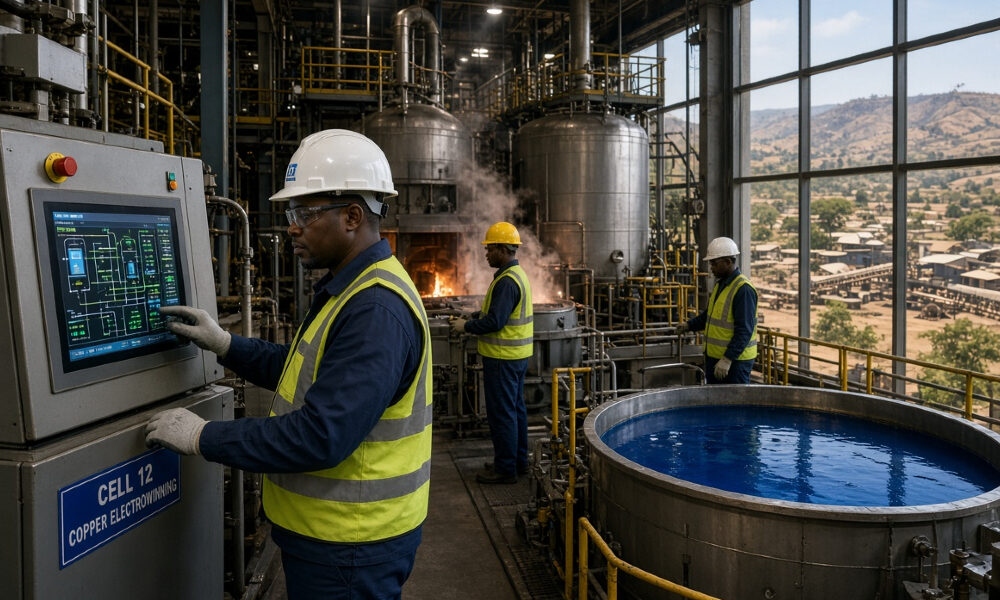
The design is deliberate. Quotas limit the finished product, and the ban shuts the door on raw concentrate. Miners are squeezed at different points on the value chain and left with one clear exit: process the material inside Congo.
The logic is sound. For decades, Africa’s minerals have been shipped abroad in crude form, and the jobs, technology and profits have gone with them. Refining at home could bring investment (SDG 9), skilled employment that raw exports never create (SDG 8) and a fairer distribution of environmental costs (SDG 12), since the pollution of processing would no longer be someone else’s concern.
But a ban is a stick, not a strategy. Refineries need reliable power, water, transport and a trained workforce. If those are missing, miners will not build; they will simply produce less. The question Kinshasa must answer is whether its order will build a refining industry or merely slow its own trade.
The Number that Never Moves
That question sits against a sobering backdrop. Africa’s growth is expected to hold near 4.2 percent this year, almost unchanged from last year. The headline sounds stable. It hides a widening gap.
The averages mask real variation. East Africa remains the continent’s fastest-growing region, at about 5.9 percent. North Africa is slowing as tourism weakens. Twenty-two countries grew above 5 percent last year. Yet a steady aggregate can conceal a continent that is running hard to stay in place.
The reason is money. Debt service now consumes about 18 percent of government revenue, double the 9 percent it took in 2017. Public capital investment is roughly 20 percent below its 2014 level. Governments are spending more on yesterday’s borrowing and less on tomorrow’s roads, grids and ports. Growth without rising investment risks becoming growth without jobs (SDG 8). Debt payments crowd out the spending that lifts people from poverty (SDG 1). And the financing gap limits how far any growth can stretch (SDG 17).
One Story, Not Two
These two stories are really one. Congo’s ban is a bet that Africa can capture more of the value in its own ground. Africa’s stagnant growth shows what happens when that value escapes, and when the public purse is too thin to build the infrastructure to keep it.
A refinery is not just a plant. It is a power line, a rail link, a training college and a stable regulatory regime. Those are exactly the things that falling public investment fails to deliver. Indonesia’s ban on nickel ore exports is often cited as proof that this approach can work, but it was backed by heavy infrastructure and foreign capital as well as by prohibition.
Congo has the leverage. Buyers need its cobalt, and that gives it a rare chance to set terms. The risk is that policy outruns capacity: a ban announced in Kinshasa but undermined by blackouts, unpaid debts and an empty treasury.
A steady growth number is not a sign of strength. It is a sign that Africa is standing still unless it turns its resources into capital, and its capital into things that last. Congo has chosen to try. The rest of the continent should watch closely, and finance the effort accordingly.
Gregory September is a South African academic, author, and geopolitical analyst with extensive experience in government and Parliament. He is the founder and CEO of SAUP (Sustainability Awareness and Upliftment Projects NPC), which focuses on sustainability education and community development. He previously served as Head of Research and Development for the Parliament of South Africa. His work centers on sustainability, African geopolitics, and economic development, and he regularly contributes to analysis of global political and economic affairs.