Owusu on Africa
Redrawing the Map: The High-Stakes Geopolitics of Africa’s New Regional Order
From Algeria’s Sahel reset to the East African Community’s sprawling expansion, regional powers are forging ambitious security and economic pacts. But can infrastructure and diplomacy outpace violent extremism?


By Fidel Amakye Owusu
Six months ago, Algeria’s southern border looked less like a frontier and more like a fault line. Today, it looks like the foundation of a new regional strategy – and the shift says as much about Algiers’s anxieties as it does about its ambitions.
From Frost to Thaw
At the start of this year, Algeria’s relationship with its Sahelian neighbors had curdled into open hostility. Algiers shot down a Malian drone it accused of violating its airspace, detonating a crisis with Bamako that had already been simmering. Mali’s junta had walked away from Algiers-brokered peace talks, and Algeria’s hosting of a prominent junta critic did little to smooth things over. Niger, meanwhile, drifted into its own quarrel with Algiers – partly over migration policy, partly out of solidarity with Mali.
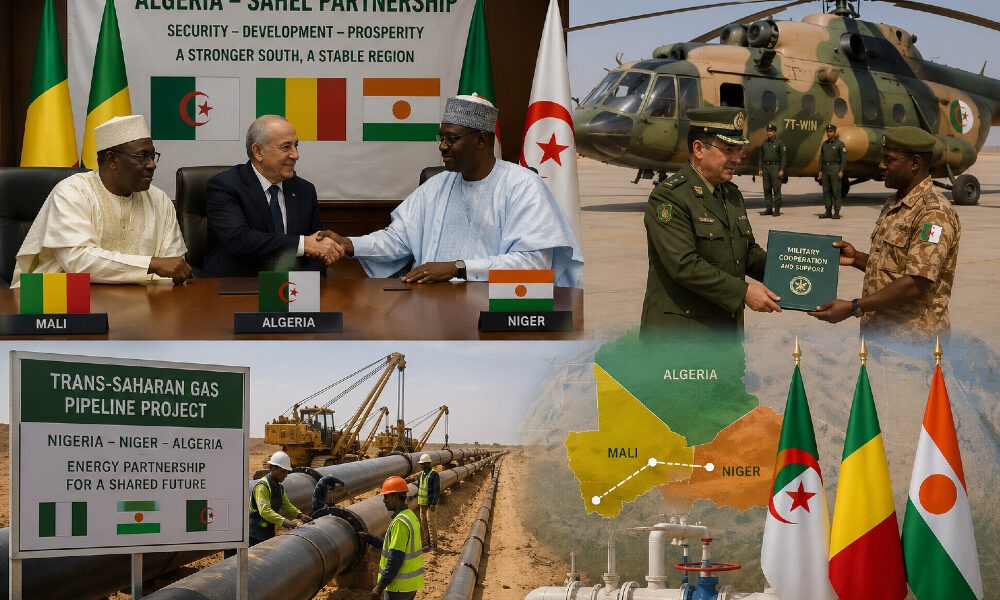
That frost is now thawing, fast. Algeria’s recent gift of four military helicopters to Niger is the most visible sign of the reset, but it is far from the only one. Algiers has also moved to restore diplomatic ties with Mali, a striking about-face given that the rupture came in the wake of a major extremist offensive. The timing is not incidental. It is the message.
Why the Sudden Warmth?
Three forces are driving Algeria back toward its southern neighbors, and each reveals a different layer of strategic calculation.
Terrorism is a shared enemy, not a national one. Algeria knows better than most countries how extremism metastasizes across borders. Al-Qaeda in the Islamic Maghreb grew directly out of the ashes of Algeria’s own civil war, and its affiliates have since spread violence throughout the Sahel. Algiers has learned the hard way that unilateral border security is no match for a regional insurgency – cooperation, however uncomfortable, is the only durable defense.
Morocco is not standing still. Algeria’s rivalry with Rabat has always been as much about influence as ideology, and Morocco has been quietly expanding its footprint in the Sahel even without sharing a border with Mali, Niger, or Burkina Faso. Its proposed trade corridor linking the region to the Atlantic coast is a direct challenge to Algiers’s claim as the Sahel’s natural gateway to the Mediterranean and beyond. For Algeria, ceding this ground – especially as other outside powers deepen their own footholds – was never an option.
There is a pipeline at stake. Perhaps the most concrete driver is economic: a proposed multibillion-dollar gas pipeline stretching from Nigeria’s Atlantic coast, through Niger, to Algeria’s Mediterranean shore. That is a lot of exposed, extremist-plagued desert for a fragile Nigerien military to secure alone. Algeria, with a far larger economy and a considerably more capable armed forces, has every incentive to help protect a project that would cement its role as an energy conduit between West Africa and Europe.
A Regional Pattern
Algeria is not alone in recalibrating its neighborhood ties. Across the continent, states are redrawing the map of alliance and rivalry as old blocs stretch and security threats spill across borders. The East African Community offers a telling parallel: once a tidy regional grouping, it now spans three distinct security complexes – the Horn of Africa, East Africa, and Central Africa – stretching from the Indian Ocean to the Atlantic since the Democratic Republic of Congo joined in 2022, with Somalia following in 2024 as its northernmost member. Kenya anchors the bloc economically, while the DR Congo, Tanzania, and Uganda add heft of their own. Yet the community remains shadowed by conflict in the DR Congo, South Sudan, and Somalia, and by the enduring threat of groups like al-Shabaab and the Islamic State–linked Allied Democratic Forces.
The lesson, in both the Sahel and East Africa, is the same: economic ambition and security anxiety are becoming impossible to separate. Regional powers that once treated diplomacy and counterterrorism as separate tracks are now folding them into a single calculus.
The Bottom Line
Algeria’s overtures to Mali and Niger are not a sudden burst of neighborly goodwill. They are a hedge – against extremism spilling further north, against Morocco’s growing regional pull, and against the risk of watching a multibillion-dollar pipeline become a target in territory Algiers cannot fully secure alone.
Helicopters and restored embassies are the visible gestures. The real story is a North African power recalculating that its southern neighbors are now too important, and too exposed, to keep at arm’s length.
Fidel Amakye Owusu is an International Relations and Security Analyst. He is an Associate at the Conflict Research Consortium for Africa and has previously hosted an International Affairs program with the Ghana Broadcasting Corporation (GBC). He is passionate about Diplomacy and realizing Africa’s global potential and how the continent should be viewed as part of the global collective.