Business
Private Equity investors placing bets on Africa growth opportunity
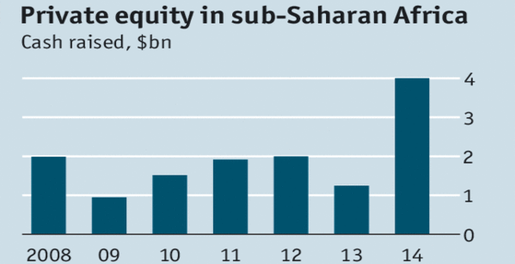
From milk churning in Zimbabwe to rose growing in Ethiopia, private equity investments in Africa have returned to pre-recession levels of 2007 and should keep rising as funds seek big returns in far-flung markets.
Private equity deals in Africa totalled US$8.1 billion in 2014, the second highest on record after the US$8.3 billion posted in 2007, according to the African Private Equity and Venture Capital Association (AVCA).
This year could be even bigger as investors tired of low returns in developed markets look to cash in on the rapidly emerging middle-class consumers in Africa.
According to AVCA, private equity deals in Africa between 2007 and 2013 earned 60 percent more than the Morgan Stanley Capital International (MSCI) emerging market index.
Traditionally private equity buyouts in Africa have been supported by development organizations but there are signs over the last year that global funds are taking more aggressive steps to tap into a continent of 1 billion people.
“The growth story in Africa is compelling,” said John van Wyk, the head of Africa at Actis, an emerging-market focused fund. “Global funds are realizing they need to have some sort of Africa strategy and that has not always been the case,” he added.
Large U.S. private equity firms, including TPG and Kohlberg Kravis Roberts (KKR), have made their first investments in Africa in the last year. The New York State Common Retirement Fund, one of the largest U.S. pension funds and worth about US$180 billion, said in April it could invest up to US$5 billion in Africa over the next 5 years to boost returns and diversify its portfolio.
TPG said in June it would invest up to US$1 billion in African companies under a tie-up with Sudanese billionaire Mo Ibrahim’s Satya Capital, which has interests ranging from health care in Nigeria to manufacturing in Tanzania.
Investments are focused on fast-moving consumer goods, financial services, health care and telecommunications.
Bigger funds are looking at infrastructure projects, including filling massive unmet electricity demand across Africa.
KKR last year invested US$200 million in Afriflora, a rose farm in Ethiopia, one of Africa’s fastest-growing economies.
Though interest in Africa is rising it comes off a very low base with even large funds raising only about US$1 billion, a meagre sum compared with developed markets. More money was raised in India last year than in all the 55 countries in Africa.
“While there has been more capital raised, it is low compared to other geographies,” said Marlon Chigwende, the managing director of Carlyle’s sub-Saharan African business.
High returns (like in any other market) are also far from guaranteed.
Food and drinks giant Nestlé offered a dose of reality last month, saying it was cutting 15 percent of its workforce in Africa because it had over-estimated the growth of the middle class. Still, middle-class households in 11 key sub-Saharan African countries, excluding South Africa, are set to triple to 22 million by 2030, according to Standard Bank.
Many fund managers believe African investments have longevity because money is increasingly flowing to markets outside South Africa. Nigeria and Ethiopia, Africa’s two most populous countries, are often cited as new opportunity areas.
Verod, a small Nigerian private equity firm, earned 15 times its investment this year when it sold its stake in GZI Industries.
While optimism is increasing, major obstacles remain, from huge infrastructure and skills deficits to lingering political instability.
“There is risk everywhere. There is risk on Wall Street,” said Muvirimi Kupara, the head of Spear Capital, a Zimbabwean fund with interests in dairy processing.
Source: Reuters