Owusu on Africa
President Ruto’s Latest Visit to China: A Strategic Signal Amidst Washington’s Uncertainty?


By Fidel Amakye Owusu
As part of my regional analyses and forecasts for Africa in late 2023, I highlighted Kenya as a nation to watch closely in terms of investment, technology, and security. The country’s strategic importance cannot be overstated – it boasts the largest economy in the East African Community (EAC), operates the busiest ports in the region, and is home to a youthful, educated population, with over 75 percent under the age of 30.
Kenya has also made significant strides in modernizing its infrastructure, particularly in transportation. Heavy investments in road and railway projects have been pivotal in sustaining economic activity, especially given Nairobi’s inland location.
Additionally, Kenya’s position along the Indian Ocean coast makes it a critical gateway for trade and connectivity in East Africa.
Despite some economic headwinds, Kenya’s growth trajectory remains promising, with projections estimating an average GDP growth rate of 4.9 percent between 2025 and 2027. Foreign direct investment (FDI) continues to flow into the country, underscoring its appeal as a regional hub.
On the security front, Kenya has emerged as a key player in regional stability, most notably through its recent peacekeeping mission in Haiti – a bold move aimed at restoring order in a Caribbean nation with deep historical ties to Africa.
Kenya’s Historical Alignment: A Pro-Western Stance
Since gaining independence, Kenya has traditionally aligned itself with Western powers. Even during the height of the Cold War, when many African nations were drawn into East-West rivalries, Kenya maintained its pro-Western stance.
This alignment was further reinforced by the country’s relative stability during decades marked by coups and political upheaval across the continent. Although Kenya faced post-election violence in the late 2000s and more recent protests, it has largely retained its reputation as a bastion of stability in East Africa.
This relationship was underscored earlier this year when President William Ruto became the first African leader to be invited for a state visit to the White House under President Joe Biden.
The visit was laden with symbolism, signaling Washington’s recognition of Kenya’s strategic importance. Significant bilateral agreements were signed, and the groundwork was laid for Kenya’s ambitious peacekeeping mission in Haiti.
These developments seemed to reaffirm Kenya’s tilt toward the West.
A Pivot to Beijing? Reading Between the Lines of Ruto’s China Visit
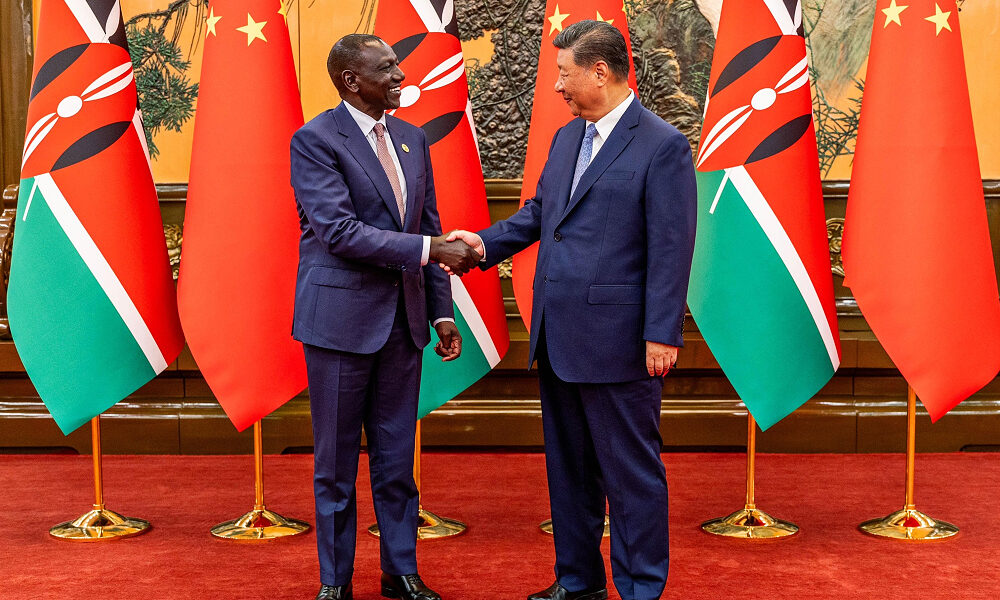
However, the geopolitical landscape is shifting, and Kenya’s foreign policy appears to be adapting accordingly. On Tuesday this week, President Ruto arrived in Beijing for yet another state visit – an invitation extended by Chinese President Xi Jinping.
While this marks Ruto’s third trip to China since taking office, the timing of this visit is particularly noteworthy. It comes amid escalating trade tensions between Washington and Beijing, raising questions about Nairobi’s evolving diplomatic priorities.
Is Kenya sending a message to an increasingly unpredictable Washington? Consider this: earlier this year, the Trump administration reportedly froze funding for Kenya’s Haiti mission under the Department of Global Engagement (DOGE).
As Washington’s influence wavers and Beijing’s grows, African nations like Kenya are increasingly asserting their sovereignty and exploring partnerships that align with their national interests
Moreover, during the last round of U.S.-imposed tariffs on African nations, Kenya was hit with a 10 percent import levy – a move that likely did not go unnoticed in Nairobi.
China, on the other hand, has consistently positioned itself as a reliable partner for Africa, offering infrastructure financing, trade opportunities, and diplomatic support without the strings often attached to Western aid. For Kenya, deepening ties with Beijing could serve as both a hedge against Western unpredictability and a means to secure much-needed investment for its ambitious development agenda.
Broader Implications for Africa: Will Others Follow Suit?
Kenya’s recalibration raises a broader question: Could other African nations historically aligned with the U.S. begin to reassess their partnerships in light of Washington’s erratic policies? If so, who stands to benefit beyond China?
While China is the obvious beneficiary of any African pivot, other global players like Russia, India, and even Türkiye could seize the opportunity to strengthen their foothold on the continent. For African nations, diversifying partnerships offers a chance to assert greater agency in international relations and avoid over-reliance on any single power.
What’s Next for Kenya – and Africa?
President Ruto’s visit to China is more than just a diplomatic gesture; it reflects a recalibration of Kenya’s foreign policy in response to the realities of a multipolar world. As Washington’s influence wavers and Beijing’s grows, African nations like Kenya are increasingly asserting their sovereignty and exploring partnerships that align with their national interests.
The implications of this shift extend far beyond Kenya’s borders. How African countries navigate the delicate balance between competing global powers will shape the continent’s future – and perhaps even the global order itself.
One thing is clear: in an era of uncertainty, Kenya’s actions may well serve as a bellwether for the continent’s diplomatic trajectory.
Fidel Amakye Owusu is an International Relations and Security Analyst. He is an Associate at the Conflict Research Consortium for Africa and has previously hosted an International Affairs program with the Ghana Broadcasting Corporation (GBC). He is passionate about Diplomacy and realizing Africa’s global potential and how the continent should be viewed as part of the global collective.