Opinion
Powering Africa’s Fields: Why Electric Tractors Are the Future of Farming


By Jean Claude Niyomugabo
For generations, African farmers have fed nations with little more than hand hoes, resilience, and deep agrarian knowledge. They have sustained food systems, anchored rural economies, and kept communities alive – often without access to the mechanization that transformed agriculture elsewhere.
But the world is changing – and Africa is changing with it. By 2050, the continent’s population is projected to double, adding more than 1.2 billion people who will depend on local food systems.
This isn’t just a demographic shift; it’s an urgent call to action.
Continuing to rely on manual labor alone is no longer viable. Africa needs mechanization – but not the fossil-fueled, high-maintenance models of the past.
What’s required is a new kind of agricultural revolution: one that is sustainable, affordable, scalable, and tailored to the realities of smallholder farmers who produce up to 80 percent of the continent’s food.
A New Kind of Mechanization for a New Generation
Enter the electric tractor.
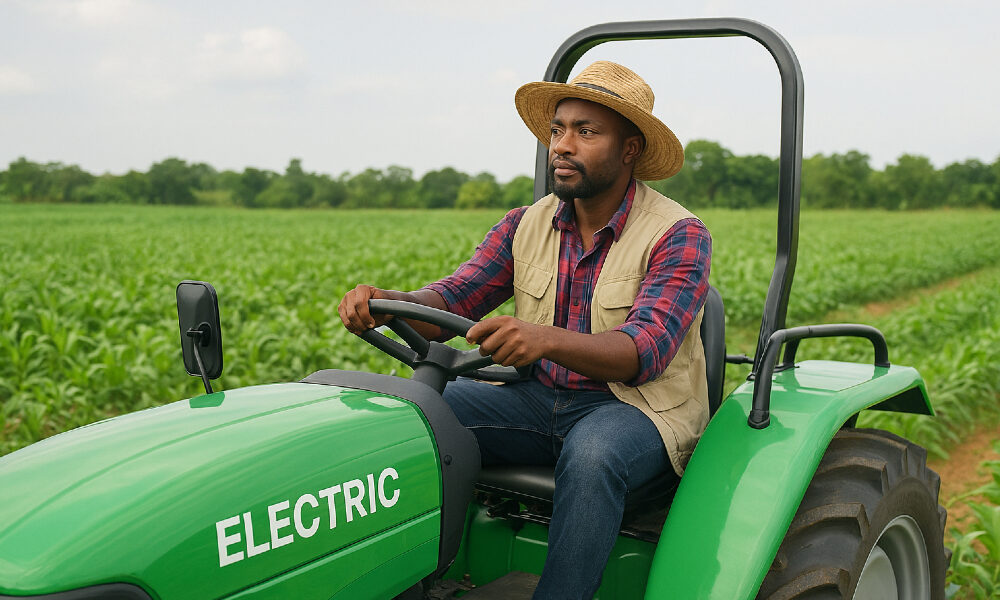
More than just a machine, the electric tractor represents a turning point – a fusion of clean technology, local innovation, and economic pragmatism. Unlike diesel-powered alternatives, e-tractors slash operating costs, eliminate fuel dependency, reduce emissions, and require less maintenance.
For small-scale farmers – many of whom are women and youth – these benefits translate into real gains: higher yields, lower expenses, and greater time efficiency.
But the impact goes beyond economics. There’s a profound psychological shift at play. Sitting behind the wheel of an electric tractor isn’t just about ploughing a field – it’s about reclaiming dignity in farming.
It signals that agriculture in Africa is not a relic of the past, but a dynamic, tech-enabled profession ready for the future.
Beyond the Field: Building Resilient Food Systems
Critically, this transformation aligns with broader continental priorities: youth employment, climate resilience, food sovereignty, and inclusive growth. Agriculture remains Africa’s largest employer, yet it struggles to attract young talent.
Modern, clean, and efficient tools like electric tractors can help rebrand farming as a forward-looking, entrepreneurial vocation – not a fallback option.
Moreover, as global supply chains face volatility and fuel prices fluctuate, localized, renewable-powered solutions offer greater stability. Solar-charged tractors, paired with mobile financing and digital agronomy platforms, can create integrated ecosystems that empower farmers while protecting the environment.
Mechanization is no longer a luxury – it’s a necessity. Africa has the land.
It has the labor. And now, it has the technology.
The path to food security, climate-smart agriculture, and rural prosperity runs through the fields – and it’s powered by electricity.
It’s time to scale electric tractors across the continent. Not as symbols, but as practical tools in the hands of those who feed us all.
Because the future of African agriculture won’t be dug by hand. It will be driven – clean, quiet, and unstoppable – one electric tractor at a time.
Jean Claude Niyomugabo is an entrepreneur and digital communication specialist with a strong passion for Africa’s development. He is dedicated to harnessing the power of social media to drive positive change and enhance livelihoods. With diverse interests and a strategic approach to digital engagement, he strives to create meaningful impact through innovation and connectivity.