A Diaspora View of Africa
Population changes pose complex issues for Africa


By Gregory Simpkins
Most of the world is experiencing a population decline. According to a August 31 article in the New York Post, for the first time in the 60,000 or so years that human beings first arrived on the planet, we are not having enough babies to replace ourselves.
“Because of ever-lengthening life spans, the population will continue to grow until mid-century. But when this demographic momentum ends – and it will end – we will reach a second grim milestone on humanity’s downward trajectory: For the first time since the ‘Black Death’ in the Middle Ages, human numbers will decline.”
“The 14th century Bubonic Plague was the worst pandemic in human history. It killed off half the population of Europe and perhaps a third of the population of the Middle East.”
“But even as the plague was filling mass graves, the survivors kept filling cradles. And because the birth rate remained high the global population recovered, although it took a century or so.”
The article further stated:
“This time around, we may not be so fortunate. All of the factors that influence fertility, from marriage rates to urbanization to education levels, are pushing births downward.”
That is, everywhere except in Africa. According to an August report by the wealth management firm Bridgewater – Changing Sub-Saharan Africa’s Growth Trajectory – sub-Saharan Africa’s population is projected to explode. While Africa’s population boom will increase growth in the region, absent a change in the current trajectory, high poverty levels will persist.
This means that an ever-growing share of the world’s population will be left behind, creating larger and larger ripples across the rest of the world. That is but one of the complexities inherent in this situation.
Youngest population
Africa has the youngest population in the world, with 70 percent of sub-Saharan Africa under the age of 30. Such a high number of young people is an opportunity for the continent’s growth. At this point, however, those young people are tending to leave the continent for greater opportunities elsewhere.
Most African migration is within the continent, involving low-skilled, mostly agricultural workers. That doesn’t rob African countries of their technicians and medical and other professionals.
In a March report done for the London School of Economics, Scott Firsing of the school’s Institute for Global Dialogue, wrote that highly educated and/or skilled African nationals continue to be pushed or pulled towards France, the UK, the US, or Canada.
There are multiple reasons for African outmigration. Of course, better salaries and working conditions are one motivation. Working in conditions where electricity is more certain and the proper equipment is more available is definitely an inducement to migrate. But we also must take into consideration – as these migrants have – the security situation in African countries. Knowing that your wives or daughters may be kidnapped or your whole family can be blown up at church service is a powerful incentive to find somewhere safer to live.
A 2023 World Health Organization (WHO) report points out that 40 African countries or roughly 80 percent of the continent have significant health staffing shortages and many are leaving to work in other countries. On average, according to the WHO report, 500 nurses leave Ghana for the West every month. Egyptian data shows around 9,000 medical students graduate annually from Egyptian universities, but 65 percent go to work abroad.
In Nigeria, there is now one doctor for every 5,000 patients, compared to the one in 254 ratios seen in developed countries. Around 9,000 Nigerian doctors moved to the UK, the US and Canada between 2016 and 2018. More than 75,000 nurses have left Nigeria since 2017. The WHO believes the sub-Saharan Africa healthcare crisis will intensify, and the region will be short 5.3 million health workers by 2030.
Africans on the move
Comprehensive immigration data from these countries show rising African emigration. A report from France in March 2023, Immigrants and descendants of immigrants – 2023 edition, highlighted that seven million immigrants now make up 10.3 percent of France’s population. This is up from 6.5 percent of French residents coming from abroad in 1968. The data also shows a trend of more people emigrating to France from both North and sub-Saharan Africa. More than 12 percent of migrants to France were born in Algeria, another 12 percent in Morocco, and 4 percent from Tunisia.
The Canadian Census 2021 data shows growing African populations from Nigeria (109,240), Ethiopia (43,205), the Democratic Republic of the Congo (37,875), Cameroon (33,200), Somalia (32,285), Eritrea (31,500) and Ghana (28,420). America is no different. In 2019, around 2.1 million immigrants from sub-Saharan Africa resided in the US, a 16-fold increase since 1980. There are now 5% of the total US foreign-born population of 44.9 million people. Fifty-three per cent come from Nigeria, Ethiopia, Ghana, Kenya, or Somalia.
According to UK Home Office data, more than 330,000 total visas were issued to sub-Saharan African nationals in 2019, which was an increase of 95,000 compared to 2016. World Visa data ending in September 2023 shows more than 78,000 visas granted to Nigerians alone.
Zimbabwe and Ghana made the top 10 list as well, with 44,714 and 26,013 work visas approved. It’s a similar story for UK study visa numbers, which are vital as students often contribute to brain drain by settling long term and working in host countries. Nigeria is the African leader with 111,577 UK study visas out of a global total of 639,087. This global study visa total is up from 276,889 visas awarded for the year ending in September 2019.
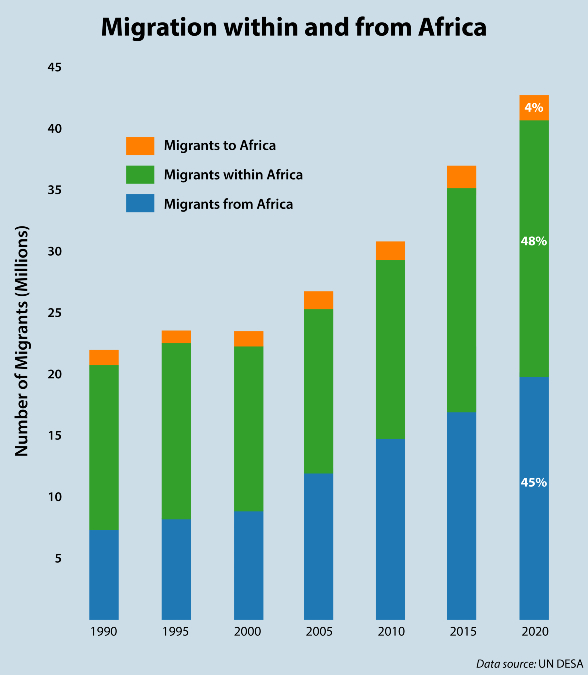

Most African migration is within the continent, involving low-skilled, mostly agricultural workers. That does not rob African countries of their technicians and medical and other professionals.
Offsetting to some extent this growing brain drain is the benefit provided by remittances from African expatriates. Firsing reported as positive news that financial remittances have grown alongside the upward migration numbers.
The UN stipulates that remittances are a “critical source of external finance for Africa, with more than 200 million African family members” relying on this money for survival. Remittance flows to Africa have doubled over the last decade and reached £80 billion (US$105.06 billion) in 2022. This has even surpassed the level of funds received through Official Development Assistance and Foreign Direct Investment. The UN highlights that, in some African countries, remittances represent over 20 percent of gross domestic product.
So the migration situation in complex, offering positives and negatives. However, African nations must get a handle on this matter soon because the desperation of developed nations for skilled workers will only grow as their populations shrink. African governments and institutions must find ways to hold onto their skilled workers or see them go abroad for education and not return.
Gregory Simpkins, a longtime specialist in African policy development, is the Principal of 21st Century Solutions. He consults with organizations on African policy issues generally, especially in relating to the U.S. Government. He further acts as a consultant to the African Merchants Association, where he advises the Association in its efforts to stimulate an increase in trade between several hundred African Diaspora small and medium enterprises and their African partners.