News
Paula Mae Weekes sworn in as President of Trinidad & Tobago
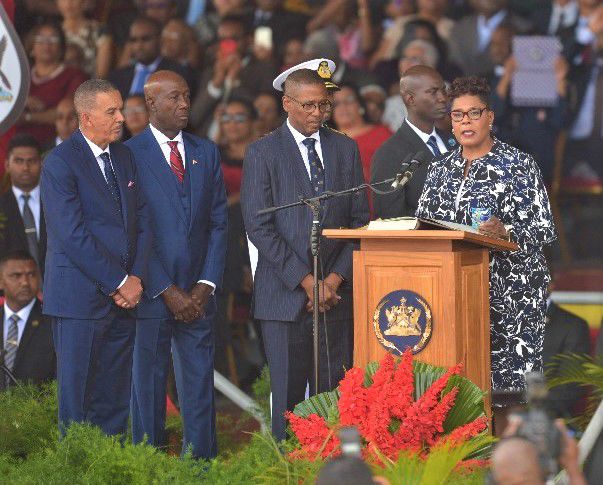
Retired judge, Paula Mae Weekes became the first woman president of Trinidad & Tobago Monday after being elected by the country’s Electoral College in January.
Chief of Justice Ivor Archie swore Weeks in at a ceremony at Queen’s Park Savannah in the capital, Port Spain, replacing Anthony Carmona.
A retired judge from the Appeal Court, Paula Mae Weekes was the only presidential nominee proposed by the government.
Weekes has a remarkable career in both public and private spheres. She was called to the Bar in 1982 and she served the Office of the Director of Public Prosecutions for 11 years. In 1996 she became a judge at the Criminal Division of Trinidad’s High Court before being promoted to the Court of Appeal in 2005. She was then sworn-in as Justice of Appeal in the Turks & Caicos Islands for 3 years.
She was also Chancellor of the Anglican Church and was responsible for their finances. Shortly after being elected, Weekes admitted she felt “completely terrified” about the idea of being president.
“I can tell you that apart from feeling honored and humbled, I felt completely terrified. And that terror has not yet abated,” Weekes said.
In Trinidad & Tobago, the president is the head of state and is responsible for approving bills before they become law, for “casting an eye on the operations and behavior of the Government,” as well as being the head of the armed forces.
Most of the president’s actions in Trinidad & Tobago are implemented in accordance with the advice of the prime minister, the cabinet or the leader of the opposition. Among her constitutional mandates is to appoint the nation’s senators: 16 according to the prime minister’s advice, 6 based on the opposition’s advice, and 9 at her own discretion.
Trinidad & Tobago has a parliamentary system in which the president is elected by an Electoral College, consisting of members of both the House of Representatives and the Senate.
With Weekes inauguration, Trinidad & Tobago becomes the only republic in the Caribbean and Latin America to have a woman head of state after Chile’s Michelle Bachelet left office on March 11.