Opinion
Open Markets, Stalled Trade: AfCFTA’s Trade Finance Gap
Africa’s free-trade area has cut tariffs and eased market access. Without trade finance, many firms still cannot take advantage.


By Danilo Desiderio
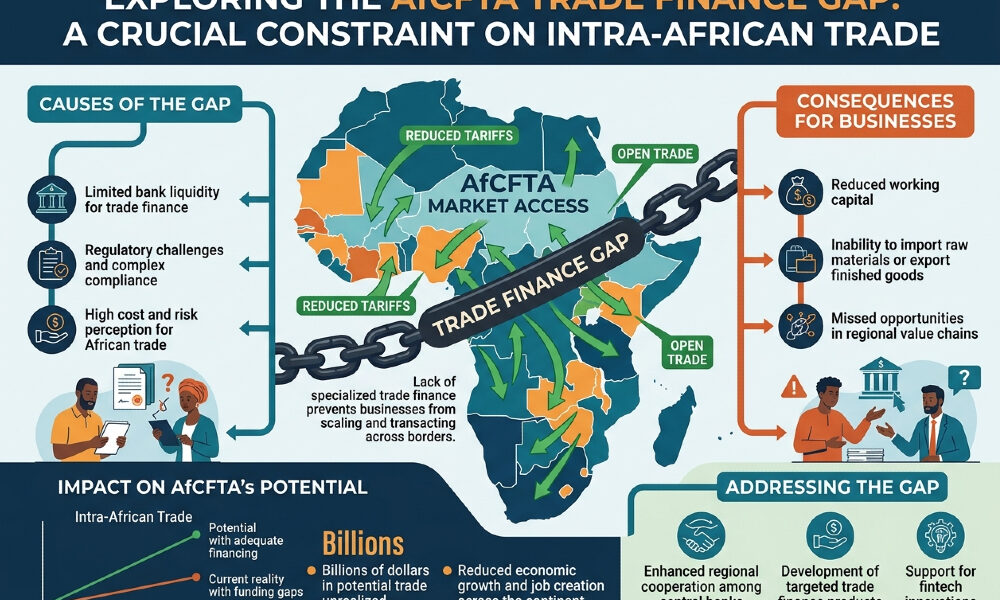
Africa is steadily opening its markets to itself. Yet a stubborn trade finance gap threatens to keep much of the resulting commerce from ever materializing. The African Continental Free Trade Area (AfCFTA) shows the problem clearly. Lower tariffs, preferential access and the dismantling of non-tariff barriers make cross-border trade more attractive. They do nothing, however, to ensure that businesses have the cash to act on the opportunity. Market access creates the conditions for trade, and finance turns those conditions into transactions. Without enough working capital, perfectly viable deals will go unrealized, whatever tariff preference is on offer.
Spending Comes Before Earning
Look at any supply chain and the same pattern appears. A producer must buy inputs and fund production before an order can be filled. A trading company must pay for goods before it can resell them. A distributor carries inventory until sales bring in cash. Logistics providers cover fuel, labor and running costs long before anyone pays them. At every stage, expenditure precedes revenue, and someone must bridge the gap for the transaction to go ahead.
Cross-border trade widens that gap. Transport, customs procedures, paperwork and settlement all stretch the interval between the first outlay and the final payment. A firm may have willing buyers and legal access to a foreign market, yet lack the liquidity to fill an order, hold stock or offer credit to a customer. The missing ingredient is not a market but the means to finance participation in it.
This is the difference between formal access and effective participation. A company may be entitled to sell across a border and still be unable to afford to. Trade liberalization can lengthen the menu of opportunities without giving smaller firms, in particular, the means to order from it.
Financing the Middle of the Chain
Afreximbank’s US$500 million Global Credit Facility agreement with the Africa Trading and Distribution Company (ATDC) hints at one answer. The facility is meant to support the purchase and aggregation of African goods, along with the transport, warehousing, logistics and distribution that go with them. Its importance lies in widening the lens of trade finance from individual producers to the traders and distributors who link production to markets.
That matters because continental integration promises more than cheaper entry into foreign markets. It is supposed to help firms find new customers, pool production across borders and join regional value chains. Each of these depends on transactions repeated again and again: suppliers filling orders, buyers funding purchases and intermediaries keeping goods moving. If finance dries up at a critical moment, deals are delayed, shrunk or abandoned.
Material flows and financial flows are thus intertwined, but they rarely move in step. Money may be needed before goods are made or shipped, while payment arrives only after delivery, on the terms the contract sets. Proceeds from one sale then replenish the working capital for the next. When that cycle breaks, the damage spreads beyond a single firm to the continuity of the supply chain itself.
The Cost of what Goes Unseen
Financing constraints also shape how trade happens. Where formal credit is out of reach, businesses turn to supplier credit, buyer advances, rotating savings groups and other informal networks. These arrangements keep commerce alive, but they leave little trace in official statistics. The finance gap therefore affects not only how much trade takes place but also the channels it travels through, and how well policymakers can see it.
What Policymakers Should Measure
The implication for policy is plain. Judging the AfCFTA’s implementation by tariff cuts, certificates of origin and the removal of non-tariff barriers is necessary but insufficient. Those measures say nothing about whether firms can fund the deals the continental market invites. Attention should also turn to the availability and cost of working capital, inventory finance, trade credit, guarantees, receivables financing and dependable payment systems. Each tackles a different risk at a different stage of the trade cycle, and the right mix will vary with the firm and the value chain.
None of this means finance can stand in for productive capacity, decent infrastructure, reliable logistics or sound regulation. No firm can borrow its way around every obstacle, and extra credit will not conjure competitive production or demand. Finance is an enabling condition, not a cure-all. Its value depends on reaching viable businesses at the moment liquidity is needed, and on a wider trading environment that lets transactions proceed.
The AfCFTA’s implementation agenda should therefore pair market-opening measures with the financial machinery that supports production, procurement, movement and payment. Officials and lenders should ask not just whether firms may trade across borders but whether they can borrow affordably, ride out payment delays and keep operating as goods travel through regional supply chains. Success should be counted not only in markets opened and barriers removed, but in how many firms can build and sustain commercially viable cross-border business.
An integrated market cannot be conjured by legal access alone. It needs businesses able to use that access, backed by the productive, logistical and financial systems that make trade possible. A treaty can open the door. Liquidity carries trade through it.
Danilo Desiderio serves as the CEO of Desiderio Consultants Ltd in Nairobi, Kenya, specializing in African customs, trade, and transport policies and is a senior associate to the Horn Economic and Social Policy Institute (HESPI).