Opinion
Open Markets, Closed Doors: Why Zero Tariffs Are Not Enough for Africa
Africa’s free-trade area has cut the tariff. The test-and-certify bill remains, and it is the next frontier of integration.


By Danilo Desiderio
A zero tariff is a promise. It is not a delivery. That distinction matters enormously for the African Continental Free Trade Area (AfCFTA), whose purpose is to turn open borders into customers for African firms, stimulate intra-African trade and anchor regional value chains. A product can win preferential treatment at customs and still stall before it reaches a shopper in another African country. One of the least visible obstacles is also among the costliest: the refusal to recognize safety and quality testing already done elsewhere on the continent.
Three Gates, Not One
Market access is not a switch. It is a chain of gates, and clearing one guarantees nothing about the next.
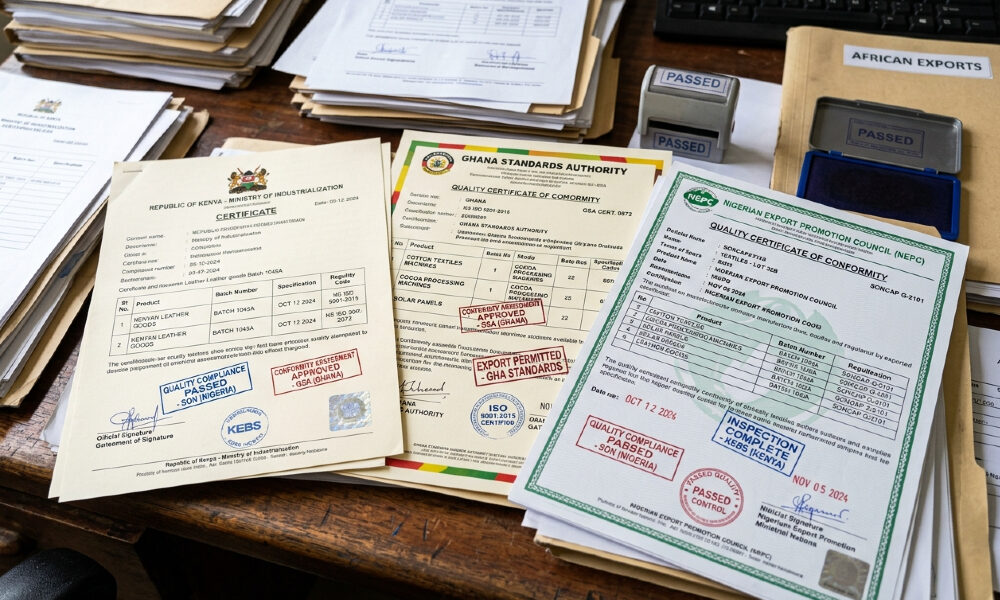
Picture a manufacturer shipping electrical appliances to a neighboring market. If the goods satisfy the AfCFTA’s rules of origin, they may enter at a reduced or zero tariff. But those rules establish only an entitlement to preferential customs treatment. They say nothing about whether the product meets the importing country’s technical regulations. The exporter may still have to test, inspect and certify the product, and secure a national conformity mark. If the destination does not recognize the assessment already performed at home, the same appliance, identical in every respect, must be tested again. The tariff is zero. The regulatory toll is not.
Governments have good reasons to demand technical standards for health, safety, the environment and consumer protection. The trouble begins when compliance must be proved repeatedly, even where requirements are identical or substantially equivalent and a competent body has already done the work.
The logic reduces to three questions:
- Does the product qualify? Rules of origin decide.
- Does it comply? Conformity assessment provides the evidence.
- Can that evidence travel? Mutual recognition decides.
Most of the attention has gone to the first. The third has been neglected, and it is where many African exporters, particularly small ones, quietly lose the game.
A New Bargain on Trust
That gap is what the AfCFTA’s recently adopted Mutual Recognition Agreement on Conformity Assessment aims to close. It does not oblige any country to wave through every certificate stamped in another. The mechanism is more careful than that. State Parties agree to accept results issued by designated conformity-assessment bodies in other member states, provided those bodies meet agreed requirements: demonstrable competence, accreditation or an equivalent proof of ability, and a clearly defined scope of activity. The products, technical requirements, standards and procedures covered must also be spelled out. Where those conditions are met, the importing country must accept the result rather than demand a repeat.
This is mutual recognition, not harmonization. Harmonization aligns the rules themselves, a worthy but slow and politically fraught undertaking. Mutual recognition asks a humbler question: can evidence generated in one regulatory system be trusted in another? Trade does not have to wait for complete alignment to function.
Call it an architecture of regulatory trust. Importers do not accept a certificate because of where it came from. They accept it because the system gives them confidence in the body that issued it, the assessment it performed and the requirements it measured against.
The Tax on the Small
The economics are unforgiving. A manufacturer serving several African markets can face a cumulative compliance burden even after tariffs vanish: laboratory fees, administrative costs, shipped samples, delays and uncertainty, repeated at each destination.
The problem is not that compliance costs money. It is that the same compliance may be bought many times over. Large corporations can absorb that. A small manufacturer in Accra, Nairobi or Lagos often cannot, and for such a firm the bill may decide whether exporting within Africa is viable at all. As each new market adds its own cost, the effective size of the regional market shrinks.
Mutual recognition reverses that arithmetic. If compliance can be demonstrated once and recognized across many markets, the cost of expansion falls as the number of accessible markets rises. A bigger market becomes economically usable without forcing a firm to rebuild its compliance machinery at every frontier. That is how trade facilitation turns into industrial development.
Trust Needs Plumbing
Trust, however, cannot run on goodwill alone. Accredited laboratories, competent certification bodies, precisely defined requirements and procedures, and a way to raise concerns about designated bodies are the plumbing of regulatory trust. Without them, mutual recognition risks becoming a promise on paper with no matching drop in trade costs.
Africa’s standards, accreditation and testing systems have grown along different institutional paths. Integration does not require replacing them with a single continental system. It requires making them interoperable enough that a result produced in one can be used in another.
From Legal Triumph to Commercial Reality
Formal market access exists when the law allows a product in. Usable market access exists when a firm can exploit that right at a reasonable cost and with predictable rules. The AfCFTA’s first phase achieved much of the former. Its next phase must deliver the latter.
Tariff cuts remove a price barrier. Rules of origin establish entitlement. Conformity assessment generates proof. Mutual recognition lets that proof travel with the product instead of being recreated at every border.
Open markets are a legal achievement; usable markets are a commercial one. The next chapter of African trade integration will be written in the space between the two.
Danilo Desiderio serves as the CEO of Desiderio Consultants Ltd in Nairobi, Kenya, specializing in African customs, trade, and transport policies and is a senior associate to the Horn Economic and Social Policy Institute (HESPI).