News
Oil: Territorial dispute between Guyana and Venezuela escalates
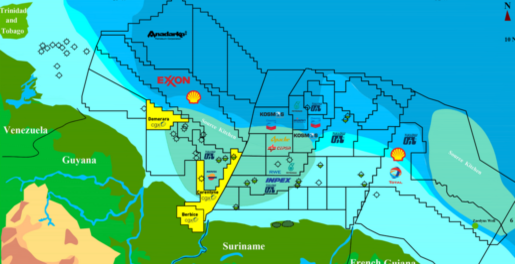
The territorial dispute between Guyana and Venezuela regarding Guyana’s waters where oil was recently discovered has escalated.
Venezuela is recalling its ambassador in Guyana Reyna Margarita Arratia, in addition to reviewing relations with that Caribbean Community (CARICOM) nation, and scaling down embassy staff in Georgetown.
Venezuela’s president Nicolás Maduro sent a strong message to his neighbor that his country would not be backing down from its claims of maritime territory.
Addressing parliament on Monday, Maduro also blasted his Guyanese counterpart, David Granger, accusing him of taking part in a campaign to make Venezuela look bad.
The decision to scale down relations with Guyana comes just a few days after Granger announced that Guyana would continue commercial and cultural relations with Venezuela, despite heightened tension between the two neighbors caused by the rekindled maritime dispute.
Maduro issued a decree on May 25, claiming sovereignty over territorial waters in the Essequibo region of the Atlantic Ocean that encompasses an area equivalent to around two-thirds of Guyanese territory, including a large part of the Stabroek Block, where US oil giant ExxonMobil discovered oil recently.
Guyana says Venezuela agreed to relinquish the Essequibo following a ruling by an international tribunal in 1899, but later backtracked on that decision. Venezuela says the 1899 ruling was unfair and insists the territory is still in dispute.
Venezuela, which has the world’s largest oil reserves, claims the “operating zones”, which intrude upon Colombian and Guyanese waters, are necessary for national security. However, Guyana has insisted the move is illegal and also threatens the offshore territory of other Caribbean states, and has approached the United Nations to settle the border dispute once and for all.
Guyana received the backing of the Commonwealth and then from CARICOM when Heads of Government of the regional grouping met in Barbados last week. Colombia, which is also in a border dispute with Venezuela, condemned that country for its territory grab.
“Venezuela is coming under new forms of assault and aggression. This is a grave, dangerous situation that we must combat with national unity,” said Maduro, who has asked the Community of Latin American and Caribbean States (CELAC) to mediate in the issue.
Accusing Granger of participating in a “grave campaign to promote hatred, distrust, and negative elements regarding the character of the Venezuelan being and his history and the libertarian tradition of the people of Bolívar”, he added: “It takes a lot of patience to process, digest and not vomit when one reads and hears the statements against Venezuela by the current president.”
“There is a political, diplomatic, media, and economic operation against Venezuela to implant in our region a tenacious operation seeking high-intensity conflicts,” he further alleged.
Maduro also claimed that Granger, who he described as a “hostage of Exxon Mobil”, had rebuffed sincere efforts to have discussions on the matter.
Although he ruled out the possibility of armed conflict over the issue, the Venezuela media has reported that Maduro issued a new decree, enabling the Bolivarian National Armed Force to operate in defense of the claims in the earlier decree.
The new decree provides maritime coordinates of the territorial limits of the newly created Integrated Defense Maritime Zones.
In response, Guyana’s Foreign Affairs Minister Carl Greenidge said Maduro’s move seemed to be an attempt to get back at Guyana following CARICOM’s recent pronouncement on the issue and he was “barking up the wrong tree”.
“The CARICOM Heads of Government actually pronounced on the impact of the decree on all of CARICOM, so he needs to go and deal with CARICOM,” he said. -(CMC)