Opinion
Nigeria’s Refining Revolution: Turning Crude Wealth into Industrial Power


By Davida Ademuyiwa
For decades, Nigeria’s oil story read like a cautionary tale of squandered potential. The discovery of crude in Oloibiri in 1956 – by Shell D’Arcy in what is now Bayelsa State – ushered the nation into the global energy spotlight.
By the 1970s, oil had eclipsed agriculture as the engine of Nigeria’s economy. The country joined OPEC in 1971 and established the Nigerian National Petroleum Corporation (NNPC) in 1977, positioning itself as a key player in global hydrocarbon markets.
Yet a paradox festered beneath the surface: despite pumping millions of barrels of crude daily, Nigeria remained dependent on imported refined fuel. Four state-owned refineries – in Port Harcourt (two), Warri, and Kaduna – sat largely idle for decades, victims of chronic underinvestment, mismanagement, and inconsistent policy.
The result? Billions of dollars in lost value each year, as raw crude flowed out while finished products flowed in.
That era may finally be coming to an end.
A New Chapter, Forged in Steel and Strategy
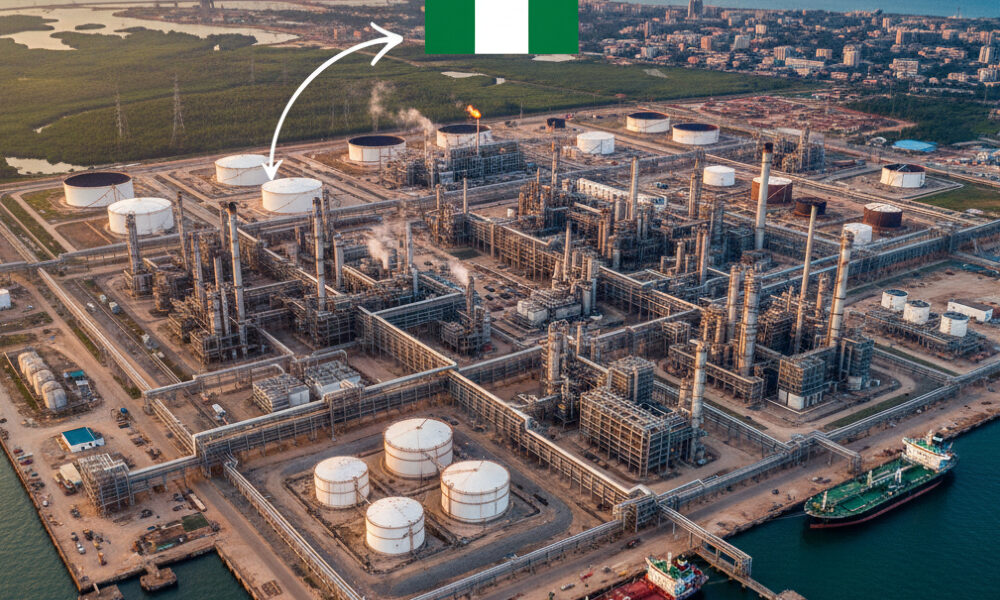
The launch of the Dangote Refinery – a 650,000-barrel-per-day behemoth on the outskirts of Lagos – marks more than a technical achievement. It is a declaration of industrial intent.
As Africa’s largest single-train refinery, it embodies a powerful truth: Nigeria’s economic future lies not in exporting raw materials, but in adding value at home.
Simultaneously, the Nigerian National Petroleum Company Limited (NNPC Ltd), restructured under the landmark 2021 Petroleum Industry Act, is advancing a credible refinery revitalization programme. Strategic partnerships with global engineering and energy firms are breathing new life into the once-moribund Port Harcourt, Warri, and Kaduna facilities.
Early signs suggest these plants could soon contribute meaningfully to domestic fuel supply.
Together, these developments signal a decisive pivot:
- From crude exporter to value creator
- From import dependency to energy sovereignty
- From policy drift to industrial mobilization
Beyond Barrels: The Economics of Refining at Home
Local refining is not merely an energy issue – it is a macroeconomic imperative. Every barrel refined domestically conserves foreign exchange, insulates consumers from global price shocks, and unlocks downstream opportunities in petrochemicals, logistics, and manufacturing.
At full capacity, Nigeria’s refining ecosystem could displace over US$10 billion in annual fuel imports and create tens of thousands of skilled jobs.
This push also repositions Nigeria as a potential refining and distribution hub for West Africa – a region of 400 million people with growing energy demand and limited processing capacity. In an era when many advanced economies are winding down fossil infrastructure, Nigeria is strategically scaling up – but not out of nostalgia.
It is building transitional capacity to fund the energy diversification of tomorrow.
A Continental Lesson in Agency
Nigeria’s refining renaissance offers a broader lesson for resource-rich African nations: natural endowments alone do not guarantee prosperity. What matters is the ability to capture value along the entire chain – from extraction to end use.
The convergence of private-sector ambition (epitomized by Aliko Dangote’s US$19 billion investment) and renewed public-sector competence suggests Nigeria may finally be aligning vision, capital, and execution. The road ahead remains steep – regulatory consistency, product evacuation logistics, and fair pricing mechanisms will be critical – but the direction is clear.
Nigeria’s oil narrative is no longer defined by what leaves its shores. It is being rewritten by what it chooses to build, refine, and retain.
In doing so, Africa’s most populous nation isn’t just securing its own future – it’s redefining what industrial self-reliance looks like on the continent.
The age of exporting raw potential is over. Nigeria is refining opportunity – literally and figuratively.
Davida Ademuyiwa is a UK politician and founder of DaviGlobal International Trade & Investment. She facilitates cross-border investment and connects capital with scalable ventures across the UK, Europe, the Middle East, and Africa. She also serves as Regional Ambassador for the Conservative Policy Forum in the East of England, contributing to grassroots policy dialogue alongside her work in global trade and investment.