Business
Nigerian financial markets post healthy gains, but local investors still wary
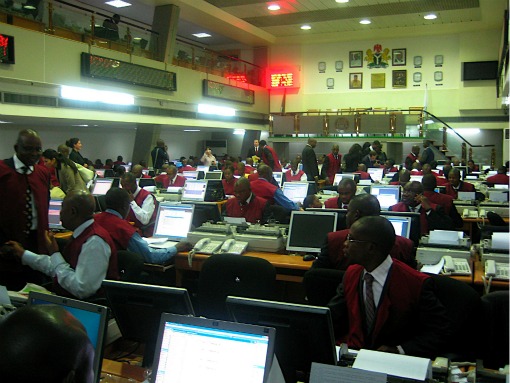
Traders on the floor of the Nigerian Stock exchange. PHOTO/File
Nigeria’s financial markets posted healthy gains in 2013 but 5 years on from the global financial meltdown, local investors are still wary of sinking their money into stocks.
The market capitalization of the nearly 200 listed companies on the Nigeria Stock Exchange (NSE) rose by 41 percent in the 12 months to December 31 to around 13 trillion naira (US$58 billion).
The All-Share Index on west Africa’s leading bourse closed up nearly a third over the year, to 41,329.19 points. The figures indicated that the market appears to have rebounded well from the global meltdown, which saw some 8 trillion naira (US$36 billion) wiped off the value of stocks.
Industry operators said the market has been buoyed by foreign investors looking for bargains.
According to Mukaila Alogba, a stoke broker, foreigners have made Nigeria’s capital market their investment destination as a lot of shares were selling far below their par value following the 2008 financial crash.
Investments from offshore accounted for some 60 percent of total transactions in the stock market in 2013, he added.
Also, the World Bank’s International Finance Corporation, which backs private enterprise, floated 12 billion naira (US$54 billion) in bonds to lure investors into Nigeria’s nascent capital markets, he said.
“The IFC also approached the Securities and Exchange Commission for a naira-dominated medium-term notes program of US$1 billion,” Alogba said.
A US$1.5 billion African Development Bank facility for projects by South African telecoms firm MTN was also driving the market, he added.
However, despite the more optimistic outlook – including for the Nigerian economy as a whole – Nigerians remained wary of sinking their cash into equities. “Local investors cannot forget in a hurry irrational manipulation of share prices which stockbrokerage firms, in connivance with banks, engaged in to cause the market crash,” said one stocks analyst.
Would Rather Forget
Lagos businessman Soji Fadairo would rather forget what happened 5 years ago.
“Each time I tried not to remember, my memory keeps recalling how I lost my entire savings to stock market crisis,” he recalled. “Overnight, my entire investment running to several millions of naira evaporated like air.”
Fadairo’s experience forced him to sell property in the upscale Ikeja neighborhood of Nigeria’s financial hub to offset a 5 million naira (US$31,000) bank loan.
“I will never put my money on stocks again. Experience they say is the best teacher,” he said.
Funke Bello, a 45-year-old civil servant, also lost out but has now dumped stocks for bricks and mortar to assure her long-term financial future. “I used to be active on market with thousands of stocks in blue-chip companies. I was making a lot of money in terms of capital gains until the crisis,” she said.
The losses she suffered forced her to withdraw her son from his school overseas.
Brighter Future
“I will not venture into stocks again. I am now into properties business. If you buy a house or a plot of land today and decide to sell it tomorrow, it will be at a good margin,” she said.
One senior manager at the stock exchange said the future looked brighter for the market on the back of strong economic indicators for the country as a whole. The economy is predicted to grow at a rate of 7 percent, the naira is stable against the US dollar, inflation is at a manageable 7.9 percent and interest rates are favorable for savings and investment.
“A lot has changed since the global recession,” said the official, who requested anonymity. “Investors are also enjoying high returns on investment due to impressive performances of quoted companies,” he said.
The official urged reluctant investors to take advantage of the gains and pointed to new regulations to protect investors. “We are poised to promote good corporate governance as well as prevent inside dealings and abuse in the market,” he said.
Copyright 2014 AFP