Owusu on Africa
Niger and the New Geometry of African Security
Why the Sahel’s most consequential state matters far beyond its borders – and what its volatility signals for the continent.


By Fidel Amakye Owusu
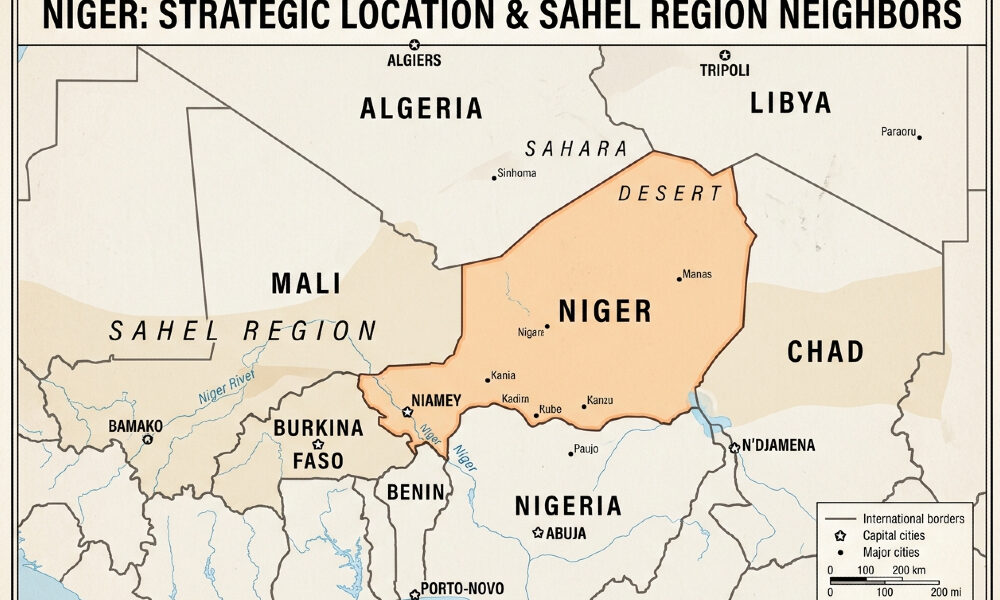
Few countries punch above their weight in global security calculations the way Niger does. Landlocked, vast, and home to the world’s youngest population, this Sahelian state has become a linchpin of stability – or instability – for an entire region. Its recent withdrawal from ECOWAS, alongside Burkina Faso and Mali, has only sharpened the question that Western capitals, regional powers, and investors now confront: What happens when Niger wobbles?
The answer, increasingly, is that much of Africa – and Europe – wobbles with it.
Demographic Time Bomb With a Long Fuse
Niger’s median age hovers around 15. Women bear, on average, seven to eight children – among the highest fertility rates on earth. By 2050, the population is projected to double to roughly 60 million. These are not abstractions. They are the raw material of migration, recruitment pools for extremist groups, and pressure on already fragile institutions.
For a continent already straining to absorb the world’s fastest urban growth, Niger’s demographic trajectory is a warning shot. Across Africa, cities are swelling faster than governments can build schools, create jobs, or extend basic services. When urban growth outpaces opportunity, the result is not simply poverty. It is crime, gang activity, civil unrest, and – most dangerously – a ready supply of recruits for organizations that offer purpose where the state offers none.
Resources, Routes, and Rivalries
Niger sits atop substantial deposits of uranium, oil, gold, and other minerals – many still underexplored. That resource wealth has drawn growing international interest and elevated the country’s strategic profile. But geography compounds geology. Niger borders seven countries, and for decades it has served as a primary transit route for migrants bound for Europe. Agadez, the dusty gateway to the Central Sahara route, has become a byword for the migration crisis. No serious effort to manage that flow can succeed without Niamey’s cooperation.
Ethnic ties add another layer of complexity. The Hausa, Niger’s largest group, are also a major population in northern Nigeria. Such transnational linkages create security, economic, and political dynamics that no border can contain.
The Security Vacuum and the Scramble for Influence
Violent extremism is no longer a distant threat. This year alone, both the Islamic State Sahel Province and Jama’at Nusrat al-Islam wal-Muslimin mounted significant attacks in the capital. Southwestern Niger has become a battleground between the two groups – a grim marker of the country’s deteriorating security environment.
These conditions have turned Niger into an arena for great- and middle-power competition. The junta’s decision to expel U.S. forces and close the American drone base dealt Washington a significant setback. Since then, the United States has sought to reset relations with Niamey. Meanwhile, Russia has expanded its footprint, China continues to deepen economic and strategic engagement, and Turkey has signaled growing interest through diplomatic, economic, and security initiatives. Several European powers retain stakes of their own.
The Broader Warning
Niger’s strategic location, demographic momentum, resource wealth, migration significance, ethnic linkages, security challenges, and geopolitical relevance make it one of Africa’s most consequential states. Its stability affects not only the Sahel but far beyond.
The same lesson applies across the continent. In Chad, an export ban on key cereals – rice, sorghum, millet, and maize – alongside the removal of import duties on those commodities and livestock underscores a hard truth: food security is national security. Chad produced roughly 3 million tonnes of cereals in 2025, yet nearly 1.9 million people still faced acute food insecurity. Climate shocks, displacement, market failures, and poverty do not respect borders – or policy silos.
In Sudan, the war between the Sudanese Armed Forces and the Rapid Support Forces offers a different cautionary tale. As the SAF recaptures territory, the RSF faces defections driven in part by nepotism – the domination of the force by the Dagalo family and their tribesmen. It is a dilemma familiar to rebel leaders and warlords across Africa: keep kinsmen close for loyalty and protection, or build a broader coalition on merit and risk internal rivalry. Either path carries costs, and both can determine the fate of nations.
The Questions That Matter Now
Three questions deserve urgent attention:
- What will Dagalo rely on as he continues to lose men and commanders? The answer will shape not only Sudan’s war but the wider region’s stability.
- What other factors drive defections in the Sudanese theater? Nepotism is a symptom, not the whole disease.
- Are outside actors still willing to back him? Patronage has limits, and patrons have interests of their own.
For policymakers, investors, and security practitioners, the message is blunt: Niger is not a country one can afford to ignore. Nor is the broader pattern it represents. Demographic pressure, resource competition, migration, extremism, and great-power rivalry are converging across the Sahel and beyond. The states that manage these forces will define Africa’s next decade. The ones that fail will export their instability to everyone else.
The world should pay attention – before it has no choice but to.
Fidel Amakye Owusu is an International Relations and Security Analyst. He is an Associate at the Conflict Research Consortium for Africa and has previously hosted an International Affairs program with the Ghana Broadcasting Corporation (GBC). He is passionate about Diplomacy and realizing Africa’s global potential and how the continent should be viewed as part of the global collective.