Opinion
Nestlé’s Cocoa Cut: A Wake-Up Call for Africa’s Chocolate Industry
When a global food giant quietly reformulates its products to strip out the world’s most iconic ingredient, it isn’t just a story about confectionery – it’s a signal about power, dependency, and who captures value in global supply chains.


By Sheena Raikundalia
Nestlé has been quietly doing something that would have once seemed unthinkable: removing cocoa from chocolate.
Across several of its product lines, cocoa content has fallen so sharply that, under United Kingdom and European Union food regulations, those products can no longer legally be called “chocolate.” They must instead be labeled “confectionery” – a category that permits vegetable fats and industrial substitutes to fill the void left by the real thing.
The brand has said little. The shelves look largely the same. Most consumers haven’t noticed.
But they should. And so should Africa.
The Economics of Erasure
The substitution is not a mystery. Cocoa prices have become brutally volatile.
Climate stress and recurring pest infestations are hammering yields across the tropical belt. Crop failures are no longer anomalies – they are a trend.
For multinational food companies operating on thin margins and thick quarterly expectations, the math is straightforward: if you can replicate the texture and sweetness of chocolate without the most expensive ingredient, the boardroom will eventually demand that you try.
The result is a product that looks like chocolate, markets itself as chocolate, and carries the legacy branding of chocolate – but increasingly is not.
For consumers, it is a disappointment. For West Africa, it is an alarm bell.
The Continent That Feeds the World’s Chocolate Habit
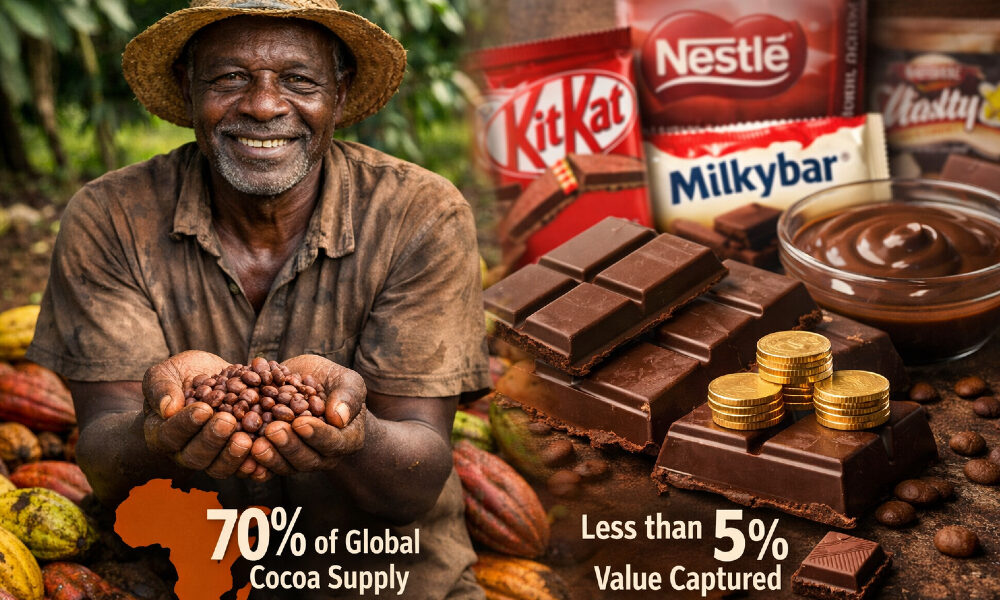
West Africa supplies roughly 70 percent of the world’s cocoa. Ghana alone is home to more than 800,000 smallholder farmers whose livelihoods depend almost entirely on the crop, contributing an estimated US$2 to US$3 billion annually to the national economy.
Côte d’Ivoire (Ivory Coast), Nigeria, and Cameroon account for much of the rest. The region is, in the most literal sense, the foundation upon which the global chocolate industry was built.
And yet, of every US$3 chocolate bar sold in a Western supermarket, the farmer who grew the cocoa receives somewhere between six and ten cents. Traders and exporters capture another five to eight percent.
Industrial grinders and processors – the largely invisible middle layer – take 15 to 20 percent. The brand manufacturer collects 25 to 35 percent. The retailer, who does the least transformation of all, walks away with 30 to 40 percent.
The farmer, who did the hardest work in the worst conditions, gets the smallest share. This is not a market inefficiency. It is the market working exactly as designed.
If the global industry is willing to make chocolate without African cocoa, Africa must become willing to make chocolate without global intermediaries.
The Architecture of Dependency
The companies that dominate the processing layer – Barry Callebaut, Cargill, and ofi (formerly Olam Food Ingredients) – sit at the critical chokepoint between raw beans and finished product. They supply the major brands: Nestlé, Ferrero, Lindt, and others.
Africa provides the raw material. These intermediaries transform it. The brands sell it. The value accumulates far from the farms that made it possible.
This architecture did not emerge by accident. It is, in large part, a legacy of colonial-era commodity extraction that structured African economies around the export of unprocessed raw materials – fast dollars, low leverage, permanent dependency.
Decades of development rhetoric about “increasing farmer incomes” have rarely touched the fundamental question: who controls value addition?
Value addition – the processing, branding, and distribution that transforms a commodity into a consumer product – is where margins live. Ceding that control, even partially, has never been in the interest of those who currently hold it.
A Catalyst for Transformation
Here, then, is the uncomfortable opportunity buried in Nestlé’s reformulation: if the global industry is willing to make chocolate without African cocoa, Africa must become willing to make chocolate without global intermediaries.
The logic is not merely retaliatory. It is strategic. Africa has the ingredient, the knowledge, the growing domestic consumer class, and – critically – a continental trade architecture that did not exist a generation ago.
The African Continental Free Trade Area (AfCFTA) connects 1.3 billion consumers across a combined economy valued at US$3.4 trillion. That is not a secondary market. That is a home market of enormous scale, waiting to be built from within.
The blueprints for a different model already exist, and they were not drawn by consultants in Geneva.
- The Kenya Tea Development Agency – better known as the KTDA – represents 600,000 smallholder tea farmers who collectively own 69 processing factories and more than 50 commercial brands.
- The Oromia Coffee Farmers Cooperative Union in Ethiopia has organized 562,000 farmers into a vertically integrated enterprise that controls its own processing facilities and transport logistics.
- In São Tomé, the CECAB cooperative – representing just 3,000 farmers – built its own certified organic chocolate factory and now sells directly into premium international markets.
These are not pilot projects. They are proof of concept.
The African Chocolate Thesis
What would it look like to build a genuine African chocolate industry – not as an imitation of the Western model, but as something designed from the ground up for African markets, African tastes, and African ingredients?
The opportunity is more distinctive than it might appear. African consumers are not obligated to replicate the Swiss milk chocolate bar.
The continent is home to an extraordinary range of flavors – baobab, hibiscus, moringa, tamarind, groundnut – that the global giants have largely ignored because their product development pipelines are optimized for existing Western preferences. An African chocolate industry built around local ingredients and local palates would not just capture value; it would create a category.
From Accra to Nairobi, a generation of homegrown confectionery entrepreneurs is already proving that this is not wishful thinking. “Made in Africa” is moving from aspiration to commercial reality.
What it needs now is scale – the investment, infrastructure, and institutional support to match its ambition.
The Signal Is Clear
Nestlé’s quiet cocoa substitution is, in isolation, a corporate cost-cutting decision. In context, it is something more revealing: evidence that the companies which built their fortunes on African raw materials feel no particular obligation to those materials – or to the communities that produce them – when economics point elsewhere.
That is not an accusation. It is a description of how commodity markets work. And it is precisely why the response cannot be outrage alone. It must be structural.
Africa does not need to petition for a larger share of someone else’s supply chain. It needs to build its own. The cocoa is there. The consumers are there. The models exist. The trade framework is in place.
The only question is whether this moment – when a global brand chose vegetable fat over cocoa – will be remembered as a quiet corporate footnote, or as the inflection point when Africa decided to stop exporting its raw materials and start owning its finished products.
Sheena Raikundalia is an accomplished entrepreneur, former lawyer, government policy advisor, and angel investor with deep expertise across the legal, financial services, and impact investment sectors in Europe and Africa. She has played a pivotal role in advancing Africa’s technology and innovation ecosystems, leveraging a career that spans top-tier London law firms, leadership as Country Director of the UK-Kenya Tech Hub for the UK Foreign, Commonwealth & Development Office (FCDO), and her current position as Chief Growth Officer at agri-tech company Kuza One. Sheena is recognized for her strategic vision, commitment to fostering innovation, and strong advocacy for Africa’s growth potential in technology, entrepreneurship, and impact investment.