Opinion
Namibia at 36: Independence, Memory, and the Work of Nationhood
Three and a half decades after breaking free from apartheid rule, Namibia’s Independence Day remains a defiant celebration of memory, resilience, and reinvention.


By Mark-Anthony Johnson
Every March 21, the southern African nation of Namibia pauses to remember – and to insist. It insists that the road to sovereignty mattered. That the decades of struggle, suppression, and sacrifice were not in vain. And that a country forged from the wreckage of colonial ambition can, in time, become something worth celebrating.
Thirty-six years on from the moment Namibia stepped into the community of nations, that insistence carries more weight than ever.
A Colony Twice Over
To understand Namibia’s independence is to reckon, first, with the extraordinary depth of its subjugation. In 1884, the territory then known as South West Africa was absorbed into the German Empire – part of the broader “Scramble for Africa” that partitioned a continent among European powers with breathtaking indifference to its inhabitants.
German colonial rule was, by any measure, brutal. The Herero and Nama genocides of 1904–1908, in which tens of thousands of indigenous people were systematically killed, remain among the earliest atrocities of the 20th century – and are still a contested subject of diplomatic reckoning between Namibia and Germany today.
Germany’s defeat in World War I transferred the burden of occupation but did not lift it. The League of Nations awarded South Africa a mandate to administer the territory – a colonial arrangement dressed in the language of international governance.
When the United Nations succeeded the League after World War II and called on South Africa to relinquish control, Pretoria refused. Worse, it extended its apartheid system northward, imposing racial segregation and dispossession on a people who had already endured a generation of foreign rule.
The Long War for Freedom
By 1966, diplomacy had been exhausted. The United Nations formally revoked South Africa’s mandate that year, declaring the occupation illegal – a declaration Pretoria ignored entirely.
In response, the South West Africa People’s Organization (SWAPO) launched an armed insurgency, beginning a conflict that would grind on for nearly a quarter century. Known as the South African Border War, the struggle drew in neighboring Angola, Cuban troops, Cold War proxies, and ultimately the geopolitical pressures that would help unravel apartheid itself.
The toll was immense – in lives, displacement, and the psychological scarring of an entire generation. Yet SWAPO’s persistence, combined with mounting international sanctions against South Africa and the shifting tides of the late Cold War, eventually forced Pretoria to the negotiating table.
United Nations-supervised elections in 1989 paved the way for what followed.
March 21, 1990
On Independence Day, Sam Nujoma – liberation leader, SWAPO founder, and the face of Namibia’s long exile – was sworn in as the nation’s first president before a crowd giddy with a freedom that had seemed, for so long, impossibly remote. The date, March 21, was itself symbolically loaded: it marked the 30th anniversary of the Sharpeville Massacre in South Africa, in which police killed 69 Black protesters.
Namibia’s birth as a nation was, in part, a rebuke of everything Sharpeville represented.
Thirty-Six Years of Nation-Building
Independence, of course, is a beginning – not a conclusion. Namibia’s post-colonial story has been complicated by persistent inequality: the country consistently ranks among the world’s most unequal by income distribution, a legacy of land dispossession and economic structures that independence alone could not immediately dismantle.
Yet it has also been a story of democratic stability notable by any regional standard, of peaceful transfers of power, and of a civil society that remains meaningfully engaged.
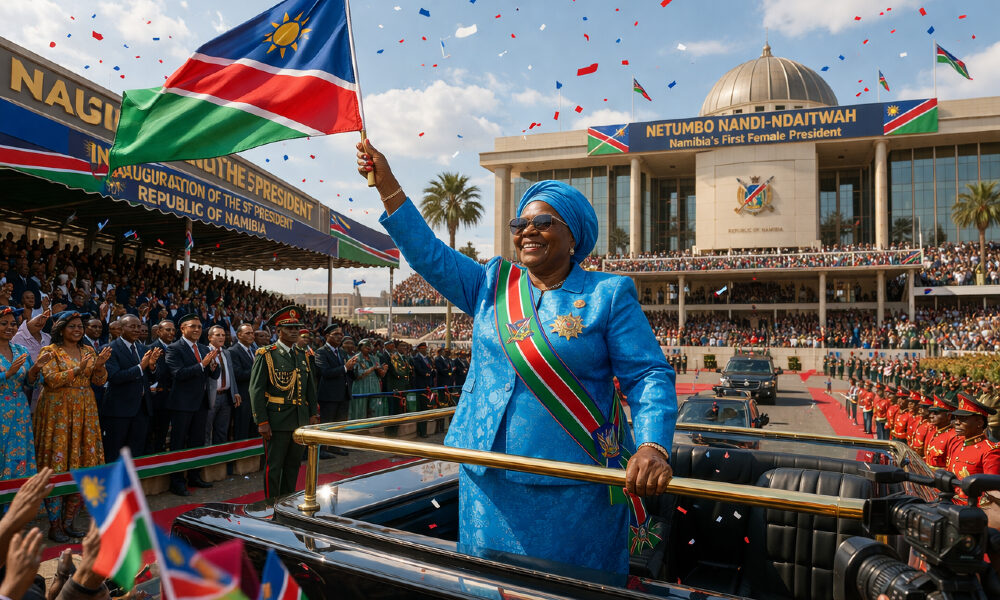
Recent years have brought milestones that speak to both continuity and change. In February 2024, President Hage Geingob died in office – a solemn moment for a generation that had known only SWAPO-led governance. Nangolo Mbumba was swiftly sworn in as his successor, honoring constitutional order. Then, in March 2025, the 35th anniversary of independence delivered a milestone of its own: Netumbo Nandi-Ndaitwah was inaugurated as Namibia’s first female president, a historic achievement for a country – and a region – where women’s political leadership has too often been deferred rather than realized.
What Independence Day Means Now
The celebrations on March 21 follow a familiar and beloved script: military parades, traditional dance performances, addresses from political leaders, and the sort of collective pride that no amount of national complexity can fully suppress. But Independence Day in Namibia is more than pageantry. It is a deliberate act of memory in a country that understands, viscerally, what erasure looks like.
For younger Namibians – the majority of a population born entirely in the post-independence era – March 21 is less a day of personal liberation than an inherited responsibility: to understand what was endured on their behalf and to ask, honestly, whether the promise of 1990 is being fulfilled. That is not a comfortable question. But it is the right one for a democracy to keep asking of itself.
Thirty-six years on, Namibia is neither a cautionary tale nor an uncomplicated success story. It is something rarer and more interesting: a country still in honest negotiation with its own history – and still, defiantly, celebrating the fact that it gets to have that conversation at all.
Mark-Anthony Johnson is the founder and CEO of JIC Holdings, a global asset and investment management firm founded in 2009. With over 30 years of experience and strong ties to Africa, his investments span mining, infrastructure, power, shipping, commodities, agriculture, and fisheries. He is currently focused on developing farms across Africa, aiming to position the continent as the world’s breadbasket.