Opinion
Mind over Matter: Why Africa’s Growth is a Question of Psychology


By Daki Nkanyane
There is a quiet truth we rarely confront honestly: no continent can rise higher than the inner world of its people. Empires, economies, technologies, and institutions are not born first in the soil – they are born in the mind.
Long before roads are built and markets opened, a people must first believe, imagine, and remember themselves into existence.
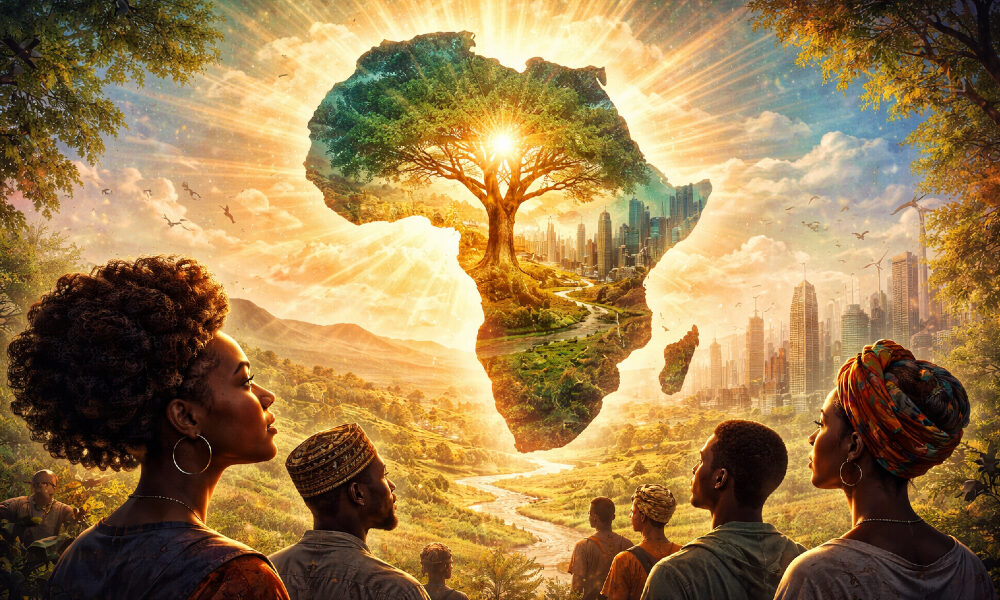
Africa stands today between two powerful forces: memory and modernity. One pulls inward toward who Africans have always been; the other pulls forward toward who they are becoming.
This tension is not a weakness. It is a sacred space, one that demands deep inner work if the continent’s awakening is to be more than cosmetic.
If Africa is indeed the sleeping giant, then consciousness is the giant’s spine. Without it, no matter how impressive the outward movement, the rise will be fragile.
Africa does not suffer from a lack of resources; it suffers from a disrupted sense of self.
The Long Shadow of Survival
For generations, Africa has lived in survival mode. Colonialism did not only extract resources – it interrupted identity.
It reshaped aspiration. It taught entire populations to measure success through someone else’s yardstick.
Survival became the dominant language: survival of dignity, survival of culture, survival of livelihood. And survival thinking, while necessary in moments of crisis, becomes dangerous when it becomes permanent.
A people shaped primarily by survival struggle to dream freely. They learn to manage scarcity rather than imagine abundance, to seek permission rather than exercise agency.
Over time, imagination is replaced by caution, and ambition by validation.
This is why Africa’s greatest challenge is not poverty or politics – it is the unfinished work of consciousness.
Post-Survival Consciousness: The Work of This Generation
Africa is now entering what can only be described as a post-survival phase – a moment when the continent must unlearn the reflex of merely surviving and rediscover the discipline of dreaming.
Post-survival consciousness is the shift from endurance to intention, from resilience to imagination, from coping to creating. It is the psychological and cultural transition required when a people who have survived history must now design the future.
This transition is not automatic. It requires deliberate inner recalibration of values, aspirations, leadership models, and self-image.
Without this shift, modernity becomes mimicry. With it, modernity becomes expression.
Modernity Without Consciousness Is Imitation
Africa’s relationship with modernity has often been externally defined: development models imported wholesale, governance systems copied without cultural translation, economic success measured by foreign approval, innovation framed as replication rather than invention.
The danger here is subtle but profound. Modernity without consciousness produces imitation, not transformation.
A continent that does not interrogate its own assumptions risks becoming technologically advanced but spiritually hollow, economically active but ideologically dependent.
True development is not about catching up.
It is about standing up – rooted, self-aware, and self-defining.
A Mirror We Must Hold to Ourselves
If you are African, whether on the continent or in the diaspora, you recognize this tension intimately.
You feel it when you succeed abroad but ache for home. When you build something new but hear old doubts echoing in your mind.
When you are proud of who you are, yet quietly wonder whether the world sees you the same way. When you celebrate progress but sense that something deeper still needs healing.
This is not weakness. It is the residue of interrupted identity. And it is precisely where the real work begins.
Between Memory and Modernity Lies Choice
Africa today is not confused – it is choosing. Choosing whether to measure success by imitation or originality.
Choosing whether to trade cultural depth for speed. Choosing whether to build institutions that look impressive or ones that are rooted and resilient. Choosing whether leadership is about control or consciousness.
This choice is not made once. It is made daily, in classrooms, boardrooms, parliaments, homes, churches, mosques, studios, and startups.
Every choice either deepens consciousness or dilutes it.
Why Consciousness Precedes Power
History is clear: power without consciousness is unstable. Economic growth without identity produces inequality.
Technology without ethics produces exploitation. Political authority without legitimacy produces fragility.
Africa’s opportunity is not simply to rise – it is to rise differently.
To build economies that reflect communal values. To design technologies that respect human dignity.
To cultivate leadership cultures grounded in service, not spectacle. This requires inner alignment before outward expansion.
A Continent Becoming Conscious
Between memory and modernity lies Africa’s most important work: becoming conscious of itself again.
Not as a victim. Not as a charity case. Not as a late arrival. But as a civilization re-entering the global conversation with wisdom earned, scars acknowledged, and purpose intact.
Africa’s future will not be decided by markets or meetings. It will be decided by memory, imagination, and courage.
The work of this generation is not only to build, but to remember who is building.
Daki Nkanyane is a South African – born Pan-African thought leader, entrepreneur, keynote speaker, and strategist with over 25 years of experience driving innovation, identity, and development across Africa. He is the Founder & CEO of Interflex Capital, AfrisoftLive, QonnectedAfrica, and iThinkAfrica, where he focuses on youth empowerment, entrepreneurial ecosystems, and Africa’s economic and ideological renewal. His work spans technology, digital transformation, major international events, and strategic advisory for future-ready African institutions. As a contributing writer for The Habari Network, Daki covers African innovation, leadership, human capital, economics, entrepreneurship, and Africa–Caribbean relations through cultural, philosophical, and developmental perspectives. His mission is to help shape a new African consciousness rooted in pride, possibility, and self-determination for Africans on the continent and in the diaspora. He can also be reached on Facebook and X.