Opinion
Market Access Has an Expiration Date: Build, Don’t Just Ship
Africa’s preferential market access has an end date. The question is whether the continent will use the ticking clock to build industrial capacity, or merely watch the doors close.


By Gregory September
Generosity in trade policy is rarely what it seems. Africa’s two largest external partners have each opened their markets to African goods, and both offers come with a catch: they expire.
Consider the terms. Access under both regimes runs for roughly two years. Both are discretionary, both are tied to political conditions, and both can be withdrawn by the party that granted them. Zero tariffs sound like a gift. In practice they are a lease, and a lease gives its holder the right to use something, not to keep it.
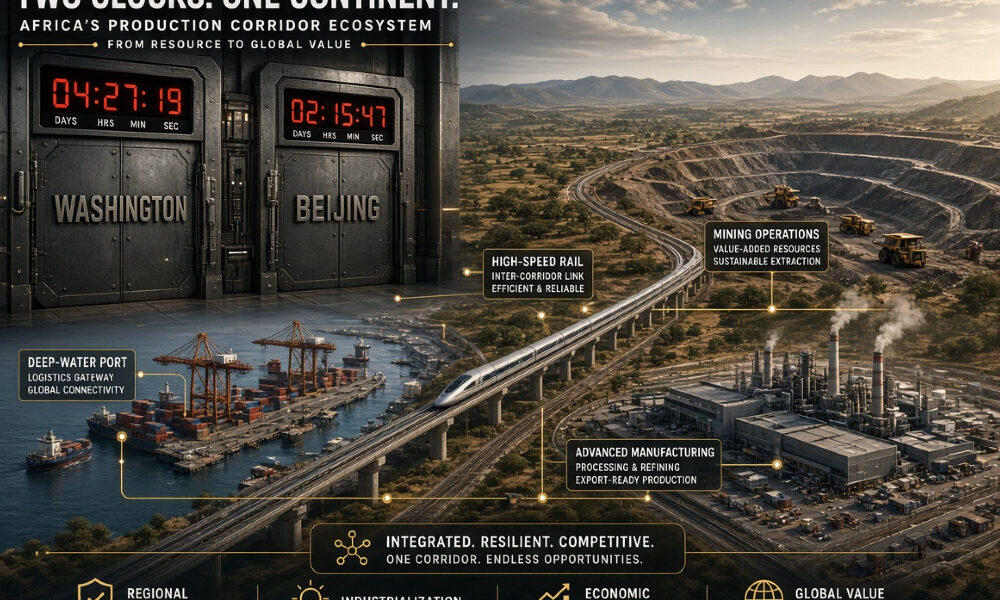
Two Doors, One Clock
Washington’s offer is the better known. Eligibility under the African Growth and Opportunity Act (AGOA) is reviewed every year, and 33 countries qualified in 2026. A country that qualifies today can be dropped tomorrow, depending on a political judgment made in Washington.
Beijing’s scheme is broader in coverage and no less conditional. It reaches 53 African countries, which is to say every one that maintains diplomatic ties with China. The eligibility test is political before it is commercial, and the key sits in a different capital.
The asymmetry behind the Chinese offer is worth stating plainly. In 2025, China-Africa trade reached US$348 billion. China imported US$123 billion of goods from Africa, which means Chinese exports to the continent came to about US$225 billion. Africa’s deficit with China is therefore around US$102 billion. A zero-tariff offer from a partner that already sells Africa nearly twice what it buys is welcome, but it does not by itself close the gap.
The pattern across both regimes is consistent. Africa’s trade policy has become a rolling renewal exercise, in which governments spend much of their diplomatic capital lobbying to keep what they were given, and little of it on building what would make the giving beside the point.
Use the Window
If access is leased, the sensible response is to treat the lease period as an investment window rather than a windfall. Both regimes, tellingly, reward processed goods more than raw ones. An exporter shipping unrefined commodities captures the thinnest slice of value, and is the easiest to replace if a door closes. An exporter of finished or semi-finished goods, with a plant, a workforce and customers, is far harder to dislodge.
That makes the strategy simple to state and hard to execute: build value-added capacity while the tariffs are at zero. The exporters who use the next two years to install processing lines, not merely to ship more raw material, will hold a position that survives the next policy review.
The stakes extend well beyond trade statistics. Factory jobs, the heart of SDG 8 on decent work and economic growth, depend on access that businesses can trust. Predictable rules, central to SDG 9 on industry and infrastructure, are what persuade firms to commit capital to plants rather than spot contracts. And SDG 17 is a reminder that fair partnerships rest on terms that last. An end date undermines all three.
The Corridor Question
Here the argument turns from policy to physical infrastructure, because the factories need somewhere to stand and something to connect them to.
Africa’s 2026 infrastructure report makes a pointed claim: “the biggest opportunity lies in integrated systems; corridors that connect energy, transport, industry and digital layers together.” Ports, rail and factories, it argues, should be built together rather than separately.
That is at odds with how most corridor financing works today. Projects are typically judged as pure transit infrastructure, measured in tonnage moved and hours saved. On that logic, a road is a road, and its value is the speed at which things pass over it.
The report proposes a different test. A corridor’s investment case strengthens when it is designed as a production ecosystem, with a mine, a factory and a port feeding one another rather than a road standing alone. The distinction changes how corridors are financed, how they are evaluated, and which projects are bankable at all.
Put simply, there are two models. A transit corridor is financed on speed and volume, so its returns depend on traffic that someone else generates. A production-ecosystem corridor is financed on the industry built around it, so its returns come from activity the corridor itself makes possible. The second model tends to attract longer-term, more durable capital, because its revenue does not depend on a single customer or a single trade policy.
Connecting the Two Arguments
The two arguments meet at a single point. A corridor built as a production ecosystem is exactly the kind of infrastructure that lets African exporters move up the value chain while the tariff windows are open. Cheap energy, a working port and a nearby processing plant convert zero-tariff access from a temporary favor into a lasting commercial position. A transit road alone does the opposite: it speeds raw goods toward markets that can change the rules.
The point is sharper for governments than for investors. Integrated corridors require coordination between ministries that rarely coordinate, namely transport, energy, industry and digital. They also require partnerships among governments, developers and industry, in the spirit of SDG 17. The reward is that the capital such projects attract is patient, and patience is what a two-year lease cannot offer.
A Gift or a Deadline?
The framing matters. A government that treats trade access as a gift will spend the window celebrating it and then lobbying for an extension. A government that treats it as a deadline will spend the window building the plants, the power supply and the corridors that make the next renewal less critical.
Both Washington and Beijing have shown they will grant access on terms they can revoke. The question for Africa is whether it will keep renegotiating the lease or, over the next two years, begin to build something it owns.
So which should it be: a gift to be thanked for, or a deadline to be beaten? And which of Africa’s major corridors is closest to becoming a real production ecosystem rather than just a transit route?
Gregory September is a South African academic, author, and geopolitical analyst with extensive experience in government and Parliament. He is the founder and CEO of SAUP (Sustainability Awareness and Upliftment Projects NPC), which focuses on sustainability education and community development. He previously served as Head of Research and Development for the Parliament of South Africa. His work centers on sustainability, African geopolitics, and economic development, and he regularly contributes to analysis of global political and economic affairs.