Zina’s Youth View on Africa
Map Redrawn, Mindset Reimagined: Why Africa’s True Size Matters


By Godfred Zina
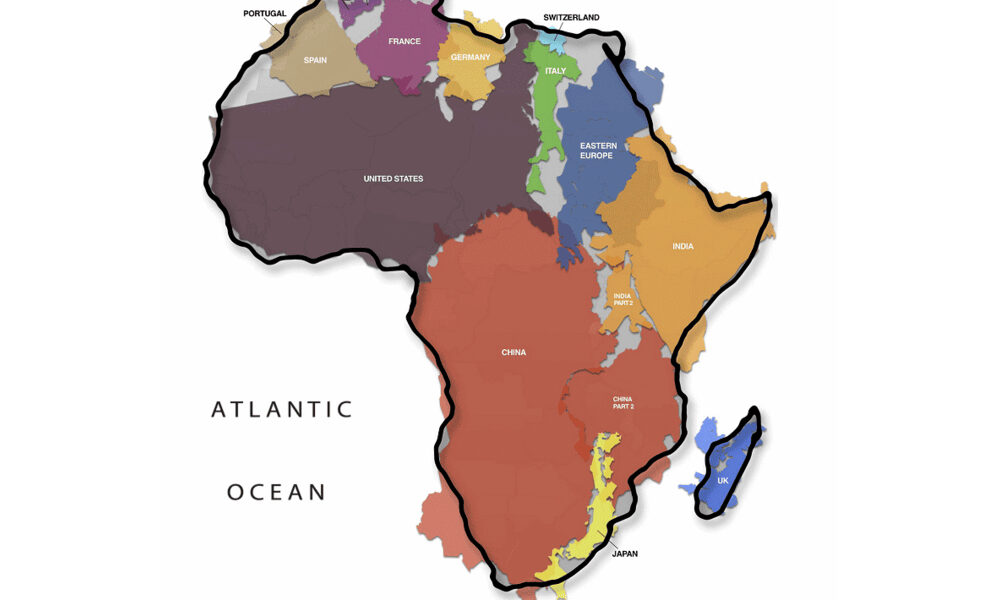
For centuries, the world has seen Africa through a distorted lens – one shaped not by geography, but by colonial legacy. The Mercator projection, introduced in 1569 by Flemish cartographer Gerardus Mercator, was designed for navigation, not education.
Yet it has dominated classrooms, media, and global discourse for generations, presenting a warped image of our planet: inflating the size of northern nations while shrinking the African continent to a misleading fraction of its true scale.
Now, a powerful movement is challenging this cartographic injustice. The African Union (AU) has officially endorsed the “Correct The Map” campaign, advocating for the adoption of the Equal Earth projection – a modern, scientifically accurate map that fairly represents the size and shape of all continents.
This shift is not merely about cartography; it’s about correcting a centuries-old narrative that has diminished Africa’s stature on the world stage.
The Cartographic Legacy of Colonial Bias
The Mercator projection notoriously distorts size. Greenland appears nearly as large as Africa – though in reality, Africa is 14 times bigger. This visual deception has quietly reinforced outdated hierarchies, subtly suggesting that regions near the equator are smaller, less significant, and peripheral to global power.
Such misrepresentation has had real-world consequences, shaping perceptions in geopolitics, economics, and education.
By embracing the Equal Earth map, the AU is reclaiming Africa’s spatial and symbolic prominence. This initiative is part of a broader, growing wave of decolonization – from curriculum reform to cultural reclamation and reparations advocacy.
It’s a call to confront not just how we see the world, but how we understand power, history, and identity.
Education as Liberation: Reshaping How Africa Sees Itself
The campaign’s goals are both practical and profound. Advocacy groups across Africa and the Caribbean are pushing to integrate the Equal Earth projection into national school curricula.
Imagine a generation of African students seeing their continent not as a shrunken landmass, but as the vast, diverse, and pivotal region it truly is – home to 54 countries, over 1.4 billion people, and immense natural and cultural wealth. This visual correction can reshape self-perception, instill pride, and inspire ambition among young learners.
Moreover, accurate mapping strengthens Africa’s voice in global institutions. When world leaders gather at the United Nations, G20, or World Bank, the maps they consult influence how they perceive regional importance.
Adopting the Equal Earth projection as a global standard would signal a commitment to equity, accuracy, and inclusion – values that these institutions claim to uphold.
A Global Standard for a Fairer World
This is not about erasing history, but about expanding it. The Mercator map served a purpose in its time, but its continued use in educational and political contexts perpetuates outdated worldviews.
The Equal Earth projection, developed in 2018 by cartographers seeking fairness and precision, offers a balanced alternative that respects the true proportions of our planet.
The AU must now lead a coordinated international effort—lobbying global bodies, engaging educators, and partnering with media outlets to normalize accurate representation. Support from the Caribbean, which shares a history of colonial distortion and cultural erasure, underscores the campaign’s relevance beyond Africa’s borders.
Ultimately, this is more than a map correction. It’s a statement: Africa has always been large – not just in landmass, but in contribution, resilience, and potential.
Correcting the map is a vital step toward correcting the record.
The world should not only support this effort – it should adopt it. In an age of misinformation, truth in representation matters.
Let us teach our children the real size of Africa, and in doing so, help them imagine a future without limits.
Godfred Zina is a freelance journalist and an associate at DefSEC Analytics Africa, a consultancy specializing in data and risk assessments on security, politics, investment, and trade across Africa. He also serves as a contributing analyst for Riley Risk, which supports international commercial and humanitarian operations in high-risk environments. He is based in Accra, Ghana.