A Diaspora View of Africa
Is France Being Run Out of Africa?


By Gregory Simpkins
France, one of the European colonial powers that divided up the African continent at the infamous Belin Conference of 1885, is on the verge of losing its hold on Francophone countries at a time when internal turmoil is causing a major shuffle in the government that could limit France’s ability to make successful moves to reverse the accumulated resentment leaders and citizens in French-speaking Africa have felt for nearly 140 years.
Evidently reading the signs on the continent, France revealed a plan in June discussed with African partners by which France was planning to drastically reduce its so-called “pre-positioned” forces in Africa, three sources told French news agency AFP. The shift had begun in February 2023, when French President Emmanuel Macron announced a “noticeable reduction” of French troop presence in Africa, at a time when anti-French sentiment was running high in some former colonies.
According to two sources close to the government and a military source, who all asked not to be named, France will keep only around 100 troops in Gabon in Central Africa, down from 350 and around 100 in Senegal.
Paris planned to keep around 100 troops in Ivory Coast (Côte d’Ivoire) on the southern coast of West Africa down from 600 troops, and around 300 personnel in Chad in north-central Africa, down from 1,000. The reduced presence could be periodically expanded based on the needs of local partners, the three sources said, but several African countries had different ideas on the French military presence.
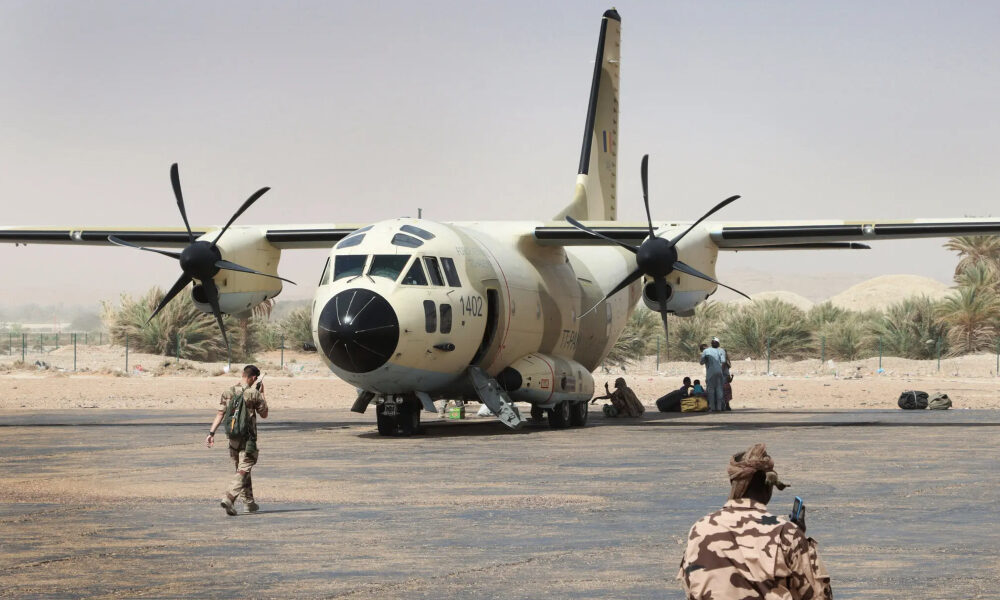
On November 28, Chad declared the termination of its defense agreement with France, while Senegal announced its decision to no longer host French troops on its territory. Both countries share similar motivations for requesting the closure of military bases that had been maintained since their independence in 1960.
The time has come for Chad to “assert its full and complete sovereignty,” declared the authorities in N’Djamena. While, in an interview with the French newspaper Le Monde, Senegalese President Bassirou Diomaye Faye, asserted: “Why should there be French soldiers in Senegal? This doesn’t correspond to our conception of sovereignty and independence.”
Le Monde reported that the announcement by Chad just after a visit by French Foreign Minister Jean-Noël Barrot took Paris by surprise. The blow is particularly severe in Chad, the first colony to join Free France.
It has been used as a veritable French “aircraft carrier” in Africa for decades, and some 1,000 French troops are stationed there, compared to around the 350 in Dakar. After the forced departure of French troops from Mali in 2022, and from Burkina Faso and Niger in 2023, this is another serious setback for Paris.
While Chad and Senegal have very different modes of government – an authoritarian military regime in N’Djamena and a democracy led by an “anti-system” pan-Africanist one in Dakar – the opposition to the French military presence is based on the same context: its rejection by a large part of the public, particularly young people, and the many offers of service (American, but also Russian, Chinese, Turkish, Saudi and Israeli) now being made to African heads of state.
Diomaye Faye’s statement genuinely caught France by surprise, Le Monde said. The Senegalese decision was issued just as President Emmanuel Macron was making a memorial gesture toward Senegal, by officially acknowledging that French colonial forces had committed a “massacre” of Senegalese troops who had fought on the side of France during World War II at Thiaroye, near Dakar, on December 1 1944, a moment in history that had been largely overlooked.
France takes about 440 billion euros (US$480 billion) a year from African governments. However, one must ask how much infrastructure France built in these countries, which are still poor after all this time and lacking in roads, power generation and transportation options.
Francophone grievances against France
Apparently, France overestimated the palliative effect of their admission. It was just one of many outrages Francophone Africans felt about their experiences as citizens in a French colony.
They included such petty actions as selling Guinea-Conakry a “new” telephone system that consisted of repainted telephones that still linked all international calls through France – even those to another African country.
That I saw firsthand as told to me by Guinean officials. But that was only one of the minor outrages France committed. A more major outrage still exists…for now.
As I wrote in an earlier article, in the 1950s and 60s, France realized that its African colonies would eventually become independent. Although the Paris government accepted formal declarations of independence, it called on African countries to sign what some have called the “Pact for the Continuation of Colonization” or similar titles.
That may not be its proper name, and some have doubted its actual existence, but the Government of Mali has just announced that it will no longer abide by this agreement, whatever it is called. The governments at that point in time agreed to introduce the French colonial currency FCFA (“Franc for the French colonies in Africa”), to maintain the French schools and military system and to establish French as an official language.
The CFA franc is today the common currency of 14 African countries members of the Franc zone. This currency, which hampered the economic independence of these countries, was created in 1945, when France ratified the Bretton Woods agreements and proceeded to implement its first declaration of parity to the International Monetary Fund (IMF). This has been recognized by the international community since then.
Under this arrangement, the 14 African countries are still obliged to store about 85 percent of their foreign exchange reserves at the Banque de France in Paris, where they are under the direct control of the French Treasury. The countries concerned do not have open access to this part of their reserves.
Obviously, 15 percent of reserves are insufficient for their needs, so they must borrow additional funds from the French Treasury at market prices. Since 1961, Paris has controlled the foreign exchange reserves in Benin, Burkina Faso, Guinea-Bissau, Côte d’Ivoire, Mali, Niger, Senegal, Togo, Cameroon, Central African Republic, Chad, Congo, Equatorial Guinea and Gabon.
Moreover, these countries must each year transfer funds to pay their “colonial debt” for infrastructure built in these countries by France during colonial times to Paris as the website Silicon Africa has reported in detail. France takes about 440 billion euros (US$480 billion) a year from African governments.
However, one must ask how much infrastructure France built in these countries, which are still poor after all this time and lacking in roads, power generation and transportation options. More than seven decades later, how long will it take to repay France for whatever it says did to provide infrastructure in its former colonies?
The government in Paris also has a right of first refusal on all newly discovered natural resources in African countries. Finally, French companies must have priority in awarding contracts in former colonies.
As a result, most African assets in the fields of supply, finance, transport, energy and agriculture remain in the hands of French companies.
Read: How France became a pariah in Africa
Two declared independent African banks – Banque des Etats de l’Afrique Centrale (BEAC) and Banque Centrale des Etats de l’Afrique de l’Ouest (BEACO) have in practice no monetary policies of their own. The countries themselves reportedly have not known, nor have they been told, how much of the pool of foreign reserves held by the French Treasury belongs to them as a group or individually.
I cannot confirm these policies firsthand, but I can say that I saw a direct confirmation of the lack of independence by an African financial institution. During a meeting with the head of the Bank of Africa in Bamako, Mali, in 2003, the US delegation I was on, discussed how Mali institutions could be structured to take greater advantage of the African Growth and Opportunity Act (AGOA).
The bank president listened carefully and then excused himself to go into another room for consultations. We found out later that he felt it necessary to discuss the matter with a French “counselor” who had not been publicly introduced as being influential in bank business.
Apparently, it was preferred that he operate behind the scenes.
Internal Government Turmoil
France is now undergoing a measure of political turmoil. In his analysis of the French elections at a recent conference on Europe in Africa, our colleague Fidel Owusu wrote on our site that the process that took place in the European Union’s second-largest economy and second-most populous country, produced interesting and surprising results.
The left triumphed while the right took third place. The expectation that the latter was going to sweep to victory and perhaps form the next government was dashed.
The far right, despite its “unstoppable” rise, is not there yet.
Owusu wrote that while the focus of the discussions was on the elections, some issues emerged that brought to the fore interesting ironies and convergence on some concepts that need the attention of Afro-European observers. First, was the idea that centrist policies are obsolete and retrogressive.
To the two French citizens and a conservative American on the panel with him, Europe’s center has failed. They also believed centrists had exploited Africa.
But will a more rightward French government serve Africa’s interests better? Perhaps not, but we may find out for certain soon.
The more right-leaning elements of the French legislature are bent on forcing out the Prime Minister, and some even are calling for Macron to resign. Should they wield greater power and influence, what will that mean for La Francophonie, the French association of former colonies?
Whatever government is in place when the political dust settles, it will be highly unlikely that any would voluntarily dissolve their controversial Africa banking scheme, especially given the financial importance in has for the French economy. Yet tensions may force a confrontation sooner rather than later, just as the French proposal of troop decreases became complete rejection within months.
Thus, France faces a difficult future in Africa and at home.
Gregory Simpkins, a longtime specialist in African policy development, is the Principal of 21st Century Solutions. He consults with organizations on African policy issues generally, especially in relating to the U.S. Government. He further acts as a consultant to the African Merchants Association, where he advises the Association in its efforts to stimulate an increase in trade between several hundred African Diaspora small and medium enterprises and their African partners.