A Diaspora View of Africa
Is Africa in the Crosshairs Due to Middle East Conflict?


By Gregory Simpkins
Global conflicts and policy shifts inevitably affect Africa and its Diaspora. In the current expanding conflict in the Middle East, economist Kasirim Nwuke, writing in a March 2 article in New African magazine, says a Middle East war would have significant economic and humanitarian impacts on Africa.
For example, escalating conflicts in the Middle East would disrupt global oil supplies, leading to higher energy prices and increased inflationary pressures in Africa. Nwuke writes that Africa’s net oil and gas importers will be hit extremely hard.
With overseas development assistance and all forms of aid largely cut off and the debt crisis a constant threat, Africa’s net oil-importing countries – with little or no fiscal space – could be pushed into exceedingly difficult conditions. Countries like South Africa, which rely heavily on imported fuel, might face significant economic challenges.
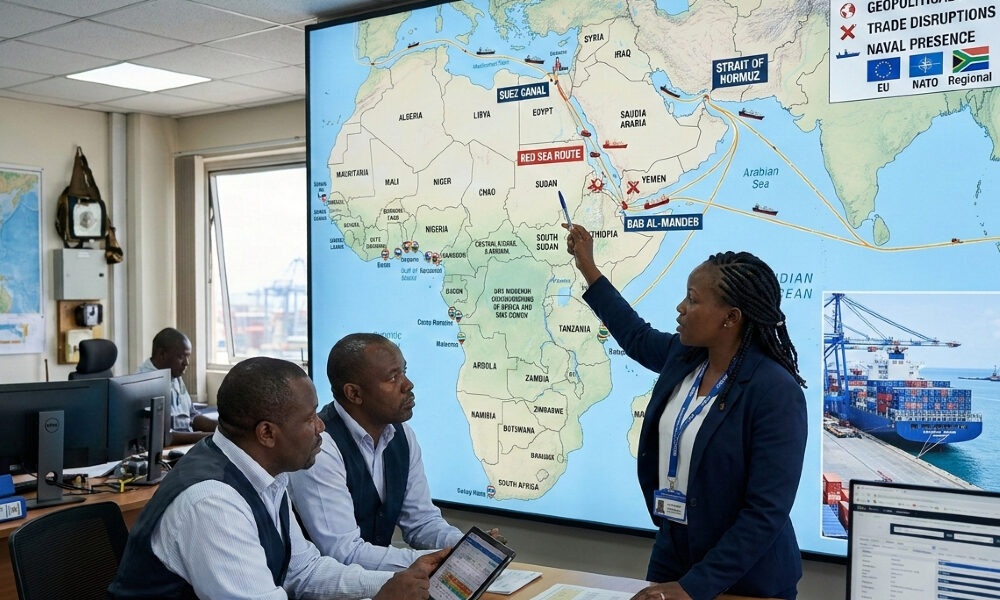
Africa’s trade with the Middle East and Europe would be severely impacted, particularly if shipping routes through the Suez Canal or the Strait of Hormuz were disrupted. This could lead to higher costs for imports and exports, affecting countries like Djibouti, Somalia and Ethiopia.
Iran is able to threaten the closing of the Strait because it is not a signatory to the United Nations Convention on the Law of the Sea.
Oman, which controls the southern part of the Strait, is. According to the same report, by March 1 more than 70 percent of shipping had been suspended or rerouted from the Hormuz.
This was not because Iran had laid mines or blockaded the Strait, Nwuke writes; it was simply a result of an assessment of risk by shippers and insurers. Most found the risk unacceptable.
Insurance premiums may go up based on perceptions of actuarial risk; an increase in premiums could result in withdrawal of insurance cover for ships that cannot afford to pay. Ships have been rerouting via the Cape of Good Hope, South Africa, because Iran’s allies, the Yemeni Houthis, have announced that they will close the Bab el-Mandeb Strait in the Red Sea to US and Israeli ships.
That threat has not been closed down as of this writing despite US-Israeli claims of having decimated the Iranian naval presence.
Humanitarian Crisis and Food Security Fears Mount
Africa is already hosting millions of displaced people, and a Middle East war could exacerbate the situation. More than 239 million people across the continent now require humanitarian assistance, with many facing acute malnutrition and hunger, particularly in countries experiencing conflict such as Sudan, South Sudan and the Democratic Republic of Congo (DR Congo).
These crises are often exacerbated by climate shocks and economic fragility.
Humanitarian organizations are struggling to secure funding to meet existing needs in Africa, with many appeals, including the DR Congo’s, severely underfunded (only 22 percent funded). Countries like Sudan, Ethiopia and Somalia might face increased refugee inflows, straining their resources and infrastructure.
New Middle Eastern humanitarian needs would only deplete available aid to African nations.
Rising food and fuel prices could worsen food insecurity in countries like Somalia, Sudan and Ethiopia, where millions of people already face hunger and malnutrition. In addition, shipping blockages could block food supplies as well.
Nwuke recalls that President Trump, soon after Venezuela, signaled unequivocally that other countries are on the menu to receive the Nicolás Maduro treatment – decapitation.
Will African Nations Get the Maduro Treatment?
President Donald Trump has issued grandiose statements about US control after arresting the Venezuelan leader and now about his need to be involved in the selection of Iran’s next leader. Nwuke recalls that President Trump, soon after Venezuela, signaled unequivocally that other countries are on the menu to receive the Nicolás Maduro treatment – decapitation.
Cuba is probably next, Nwuke believes. But the armada assembled against Iran must find a new location, he postulates – a new object of interest.
Nwuke predicts that South Africa will be next, citing a blog post by Grant Arthur Gochin, Emeritus Special Envoy for Diaspora Affairs for the African Union, that appeared in the Times of Israel on January 2, but largely ignored by African media. Gochin’s post proposed that Africa should be further fragmented, beginning with South Africa.
With a US base in Botswana, South Africa probably has truly little chance of countering any combined US-Israeli aggression, Nwuke warns. Its internal divisions are deep, especially along racial lines.
White secessionists in Orania, the Cape Independence Movement and the Boervolk of the Orange Free State present opportunities, he believes. And the country’s fairly long coastline, a resource and a blessing, will be difficult to defend.
However, despite the recent animus between President Trump and the South African government and his encouragement of white South African emigration to the United States, any such effort to dismantle South Africa would have dire global consequences due to the country’s natural resources and its economic impact on the southern Africa region. Throwing the generally peaceful region into chaos would have no conceivably positive impact – an obvious fact even to anti-South African government advisors to Trump.
Why Africa Has Little to Fear From US-Israeli Military Action
Nigeria, weakened by unfathomable levels of corruption and dishonest conversations on her internal contradictions, Nwuke writes, has already surrendered, without firing a shot in defense of her sovereignty or uttering a whimper in protest in allowing US military intervention in pursuit of Islamist extremists. His view ignores the longstanding cooperation between the US and Nigeria in this regard that includes the first Trump administration.
No previous US military assistance has gone beyond limits set by the Nigerians, who most certainly would object to encroachment on their sovereignty if they felt it was under threat.
Somalia and Somaliland may be a brief stop on the way to South Africa, Nwuke says, as neither Türkiye nor Egypt will come to Somalia’s aid if the US and Israel station a small part of the armada off the coast of Mogadishu to force Hassan Sheikh Mohamud and his friends in Villa Somalia to recognize the independence of Somaliland. The United States and most other Western countries have long avoided recognizing Somaliland as an independent country.
During my time as a staff member in Congress, we were discouraged from spending time in Somaliland apart from brief meetings. Israel’s intentions toward recognizing Somaliland do not necessarily bring the United States along with it.
Nwuke is sending an alarm to African leaders to beware of US-Israeli military action.
“Africa’s response should be simple: begin now to ‘scream’ at the top of her voice to mobilize African public opinion. Seek concrete alliances with Russia and China and get under their nuclear umbrella if they have sufficient spare room to accommodate us. And above all, consolidate, merge, form larger countries,” he writes. “Fifty-four Europe-created countries are too many. Small is beautiful.”
There is no recent history of the United States militarily encroaching on African territory. In fact, a resolution I helped to prepare while working in the US House of Representatives several years ago calling for American participation in a peacekeeping effort in the Republic of the Congo received a negative response once the rumor spread that it would mean US troops on the ground.
While that was never the intent, the resolution had to be altered to specifically forego US ground troops being involved in peacekeeping to succeed. Such US troop involvement has long been a sensitive topic for Congress.
President Trump may issue expansive statements about being in control of foreign nations, but attempting such control in Africa would be more than a step too far. At a time when the administration is attempting to negotiate rights to African critical minerals in competition with China, any outright belligerence would be counterproductive to that effort, and they surely know that.
Moreover, costly adventurism outside areas of direct interest or threat to the United States would have to receive funding from Congress, and even though the Trump administration’s war powers have not been curbed, Congressional support for expansive foreign engagements would be highly unlikely.
As for Israel, they are concerned with the Middle East and their security within the region. They have an interest in North Africa and the Horn and have developed relations in sub-Saharan Africa, but military moves to unseat governments on the continent would undo all their previous efforts.
Thus, they are unlikely to upset years of diplomacy to overreach by trying to place governments more in their favor in power.
It is understandable that President Trump’s expansive public statements create concern among some that the experiences in Venezuela and Iran might be repeated, but as leaders in Nigeria, Mexico and elsewhere have found, what Trump says in public is more belligerent than what they discuss in direct discussions. Many have learned to ignore the bluster and engage in more fruitful private discussions, recognizing that Trump uses hyperbole to bring leaders to the negotiating table.
Once there, the belligerence usually fades away.
Gregory Simpkins, a longtime specialist in African policy development, is the Principal of 21st Century Solutions. He consults with organizations on African policy issues generally, especially in relating to the U.S. Government. He further acts as a consultant to the African Merchants Association, where he advises the Association in its efforts to stimulate an increase in trade between several hundred African Diaspora small and medium enterprises and their African partners.