Opinion
Integrating Africa: From Threads to Hubs – A Blueprint the Continent Has Been Waiting For
A landmark World Bank report challenges the orthodoxy of African trade policy – and the timing could not be more consequential.


By Danilo Desiderio
For decades, the debate over African economic integration has circled the same weary terrain: trade barriers, tariff schedules, and the slow ratification of treaties that too often gather dust on ministerial shelves. A new World Bank report, Integrating Africa: From Threads to Hubs, breaks decisively from that tradition. It is not merely a policy document. It is, potentially, a reorientation of how the continent thinks about its own economic future.
That is a bold claim – but this is a report that earns it.
The diagnosis is honest, and that matters
The report’s most immediate strength is its willingness to say plainly what practitioners have long known but rarely put in writing at this level: Africa’s existing trade agreements are chronically underutilized. The African Continental Free Trade Area (AfCFTA), for all its historic promise, has not yet translated ambition into outcomes.
Agreements have multiplied across the continent; implementation has lagged far behind.
Crucially, the report does not locate the problem where it is easiest to look. Tariffs and non-tariff barriers, long treated as the primary villains in the integration story, are no longer the central obstacle.
The deeper constraints are structural: regulatory fragmentation across jurisdictions, underdeveloped logistics networks, and infrastructure gaps so severe that economies sharing a land border can remain, in practical terms, worlds apart. The report captures this with a phrase that deserves to be quoted widely – neighboring countries rendered “economically distant” despite their geographic proximity.
This is precise, honest diagnostics. Policymakers and development partners who have grown comfortable behind the language of “trade facilitation” will find little shelter here.
From threads to hubs: a conceptual shift that changes everything
The report’s most original and consequential contribution is not empirical – it is conceptual. It introduces a framework that reframes the entire integration project.
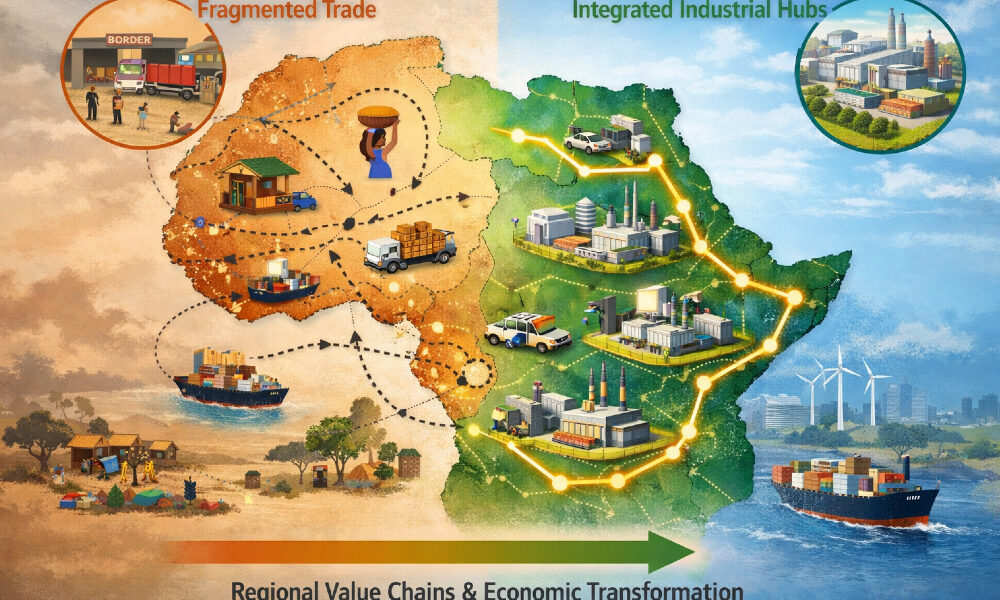
For too long, African integration has been imagined as a network of threads: bilateral links, corridor agreements, and cross-border flows of goods. What the report argues, compellingly and with considerable analytical rigor, is that threads are not enough.
The goal must be hubs – dense, coordinated production ecosystems organized across national boundaries, leveraging complementarities between countries to build genuine regional value chains.
This distinction is not cosmetic. It redefines what success looks like. Under the “threads” model, progress is measured in signed agreements and reduced border wait times.
Under the “hubs” model, progress means industrialization, job creation, and structural economic transformation. These are not the same thing, and conflating them has cost the continent decades of misaligned effort.
The report’s central proposition – that production precedes trade, not the other way around – is a direct challenge to the assumptions embedded in mainstream trade liberalization policy. You cannot trade what you do not produce. You cannot build regional value chains without first building the productive capacity to fill them.
Integration, on this reading, is fundamentally an industrial and spatial policy challenge, not a customs and compliance exercise.
Why this moment matters
The AfCFTA has created a rare political window. Fifty-four countries have signed on to a framework that, in principle, could create the world’s largest single market by number of participating nations. The risk, now, is that this political achievement becomes another entry in the long ledger of well-intentioned African agreements that failed at the implementation stage.
Integrating Africa: From Threads to Hubs offers a path away from that outcome – but only if its deeper logic is absorbed, not merely cited. The report does not propose tweaks to existing policies. It redefines the problem itself. That is rare in development economics, where the pressure to offer incremental, fundable recommendations often crowds out the harder work of diagnostic clarity.
A framework, not just a report
What ultimately distinguishes this publication is its potential longevity. The best policy documents do not age with the political cycle that produced them. They become reference frameworks – intellectual anchors that researchers, policymakers, and investors return to as they navigate shifting conditions.
This report has that quality. Its conceptual architecture is robust enough to outlast any particular trade negotiation or infrastructure funding cycle.
The World Bank deserves credit for creating the conditions in which thinking of this caliber could be produced and published. The voices it chose to include – including practitioners who have long argued that production must lead integration, not follow it – lend the work both credibility and urgency.
Africa is not short of ambition. It is not short of agreements, strategies, or frameworks. What it has sometimes lacked is a clear-eyed account of why previous efforts fell short, and a rigorous alternative vision of what genuine integration would actually require.
On both counts, Integrating Africa: From Threads to Hubs delivers.
Danilo Desiderio serves as the CEO of Desiderio Consultants Ltd in Nairobi, Kenya, specializing in African customs, trade, and transport policies. He is a customs and trade expert at the World Bank and a senior associate to the Horn Economic and Social Policy Institute (HESPI).