Opinion
India: The BRICS Market Africa Still Underestimates


By Jacqueléne Coetzer
Africa and India have been trading together since time immemorial. This pattern was disrupted by colonialism and it is time that it be restored.
India is one of the most important markets in the BRICS architecture – and Africa is still not exploiting the opportunity anywhere near its potential. India is not simply a vast consumer market. It is a manufacturing powerhouse, a technology leader, a major pharmaceutical producer, an enormous agricultural and food market and one of the world’s fastest-growing major economies. Its commercial relationship with Africa is already substantial, but the relationship remains heavily concentrated in commodities, energy and conventional trade.
Today, that relationship has the potential to become something considerably larger.
India is already one of Africa’s largest trading partners and a major buyer of African oil, coal, copper, gold, pulses, cashews, tea, coffee, cocoa and other agricultural products. Indian companies are active across pharmaceuticals, ICT, manufacturing, steel, healthcare and agriculture. Yet despite this history and commercial depth, India remains one of the most misunderstood markets available to African businesses.
India is not simply another large emerging economy in the BRICS grouping. It is one of the world’s largest consumer markets, one of the fastest-growing major economies and a country whose commercial relationship with Africa can potentially move well beyond the traditional model of Africa exporting raw materials and importing finished goods.
From Raw Materials to Value-Added Trade
The opportunity lies precisely there.
India wants Africa’s resources – but it also increasingly wants African value-added products. Coffee, cocoa, tea, spices, botanicals, natural ingredients, cosmetics, wellness products, fresh fruit, medical consumables and specialty agricultural products all have potential. India’s enormous FMCG, healthcare, wellness and consumer markets create opportunities for African producers capable of meeting the required standards, volumes and price points.
India Is Not One Market – It Is Many
But Africa’s biggest mistake would be to approach India as though it were simply one enormous market. It is not.
India is effectively a collection of highly differentiated markets operating within one country – 28 states, eight union territories, multiple languages, distinct consumer cultures and enormous regional differences. Mumbai and Pune offer financial, FMCG and distribution opportunities; Gujarat provides deep trading networks and major ports; Tamil Nadu is a manufacturing and automotive powerhouse; Karnataka combines technology and high-value consumers; Delhi offers government and commercial visibility; while Kerala has particularly strong connections to Africa, spices, natural products and the diaspora.
The African exporter who says, “I want to enter India,” has not yet developed a market-entry strategy and has done no research. The better question is: “Which Indian market, which consumer, which state, which distributor and which product?”
India is also a market where relationships matter. Price matters, but price alone does not win. Trust, consistency, cultural intelligence, patience and respect for hierarchy matter enormously. Family-owned businesses remain influential, and one successful relationship can sometimes open an entire distribution network. A foreign company that arrives expecting an immediate transaction may find India frustrating. A company prepared to invest in the relationship may find an extraordinarily loyal long-term partner.
BRICS as Commercial Architecture, Not Just Geopolitics
This is where the BRICS relationship becomes particularly interesting.
Africa has spent years discussing BRICS in terms of geopolitics, de-dollarization and the shifting balance of global power. Those discussions are important. But BRICS also needs to be understood as a commercial architecture — a network through which African businesses can begin thinking differently about where they source, where they sell, where they invest and with whom they build long-term partnerships.
India should be at the centre of that conversation.
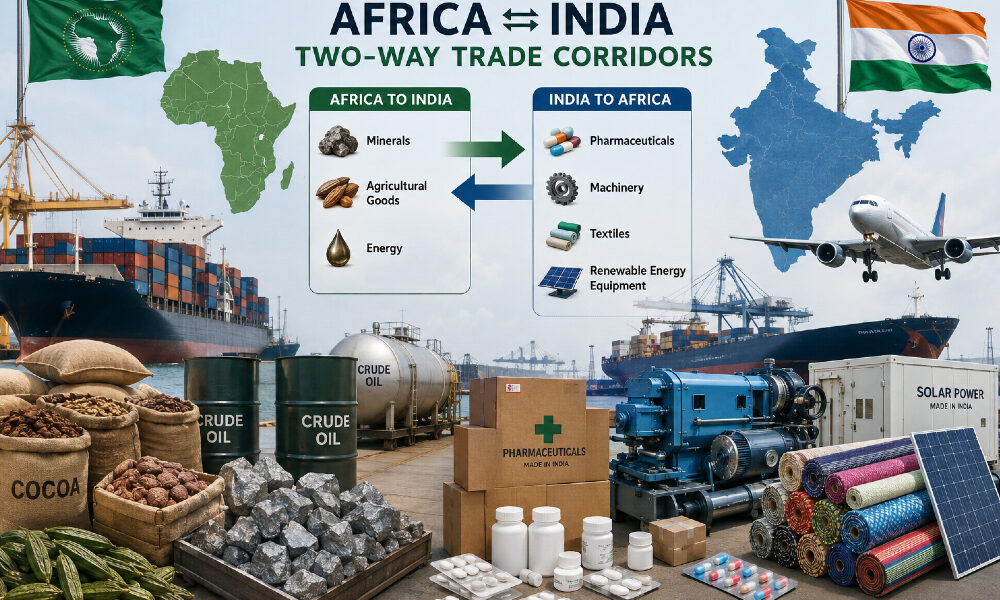
The opportunity is not merely to export more African commodities to India. It is to build two-way commercial corridors.
India exports pharmaceuticals, machinery, automobiles and components, processed foods, textiles, technology and renewable-energy equipment into African markets. Africa supplies India with resources, agricultural products, minerals, energy and increasingly differentiated consumer goods.
That is not simply trade. It is the foundation for industrial cooperation.
And there is another reason India deserves considerably more attention from African businesses – scale. India’s enormous consumer base means that a product that succeeds in one carefully selected regional market can potentially scale dramatically. But that scale should never be confused with simplicity. India rewards companies that understand its complexity and punishes those that underestimate it.
The same principle applies to BRICS itself. Africa does not need another collection of grand declarations about South-South cooperation. It needs companies actually doing business across these markets. It needs African producers meeting Indian buyers. Indian manufacturers investing in African production. African businesses using Indian technology and expertise. Joint ventures. Distribution networks. Processing facilities. Agricultural partnerships. Healthcare cooperation. Logistics corridors. Investment.
The opportunity is sitting there. The question is whether African businesses are prepared to approach it strategically.
India does not need Africa merely as a supplier of raw materials. Africa does not need India merely as another source of imported manufactured goods.
The much more interesting proposition is what happens when Africa and India begin building value together. That is where the real BRICS opportunity begins.
Jacqueléne Coetzer is a strategic trade and market analyst specialising in African and emerging markets. Her work focuses on structuring cross-border commercial relationships, connecting buyers and sellers, and facilitating trade across key sectors including commodities, diagnostics, and premium agricultural products. Her writing explores the realities behind global trade architecture, BRICS, and African economic development – not from a theoretical lens, but from active market engagement and transaction-level insight.