Opinion
Independence Redefined: Builders, Identity, and the Intelligence Era (Part 3)


By Victory Azimih
The artificial intelligence revolution offers African nations a historic opportunity – but only if they transform education into industrial power.
In Parts 1 and 2, we established that genuine sovereignty requires both hard infrastructure and cultural-institutional alignment. We argued that Africa’s future depends on integrated systems spanning transportation networks, industrial capacity, digital platforms, and narrative legitimacy.
We maintained that cultural coherence is not ornamental but strategic – the resilience capital determining whether infrastructure investments generate compounding returns or become stranded assets.
This brings us to the most decisive yet overlooked dimension of African sovereignty: the architecture of education and its convergence with artificial intelligence.
Beyond Infrastructure: The Education Imperative
Infrastructure builds capacity. Industry builds output. But education builds continuity – the ability of societies to renew themselves across generations without external dependency.
A society that produces graduates without producing builders becomes structurally dependent, regardless of capital inflows. When educational systems award credentials disconnected from industrial needs, they create degree inflation rather than productivity growth.
The result is a familiar paradox across developing economies: rising educational attainment alongside persistent unemployment and continued reliance on imported expertise.
True independence requires educational systems engineered to produce engineers, manufacturers, software developers, logistics architects, policy technicians, and institutional stewards – not merely certificate holders navigating credentialist rituals divorced from productive capacity.
The distinction matters profoundly. Certificate systems produce job seekers. Builder systems produce job creators.
This observation extends our earlier framework. We identified sovereignty gaps in trade corridors, energy systems, and digital infrastructure.
We noted that capital flows into weak systems leak rather than compound. Now we must recognize that educational systems disconnected from industrial ecosystems represent the most fundamental leak of all – they waste human potential at scale.
Cultural Memory as Strategic Asset
Cultural preservation is frequently dismissed as nostalgic sentimentalism, a retreat from modernity. This misunderstands its function. Cultural coherence serves as strategic memory – the institutional and psychological foundation that answers three essential questions of sovereignty:
Who are we? What are we building? What are we willing to defend?
These questions are not abstract. They determine whether societies take the risks necessary for innovation and whether they sustain long-term projects across political cycles.
Identity produces confidence. Confidence enables risk-taking. Risk-taking drives innovation. Innovation generates power.
Without identity coherence, artificial intelligence becomes merely imported tooling – another technology dependency. With identity coherence, AI becomes a force multiplier for indigenous development.
This reframes our earlier assertion that “building requires both steel and song.” The integration is not metaphorical but mechanical. Educational systems that divorce technical training from cultural context produce technicians without purpose – skilled labor awaiting external direction rather than builders capable of autonomous development.
The AI Inflection Point
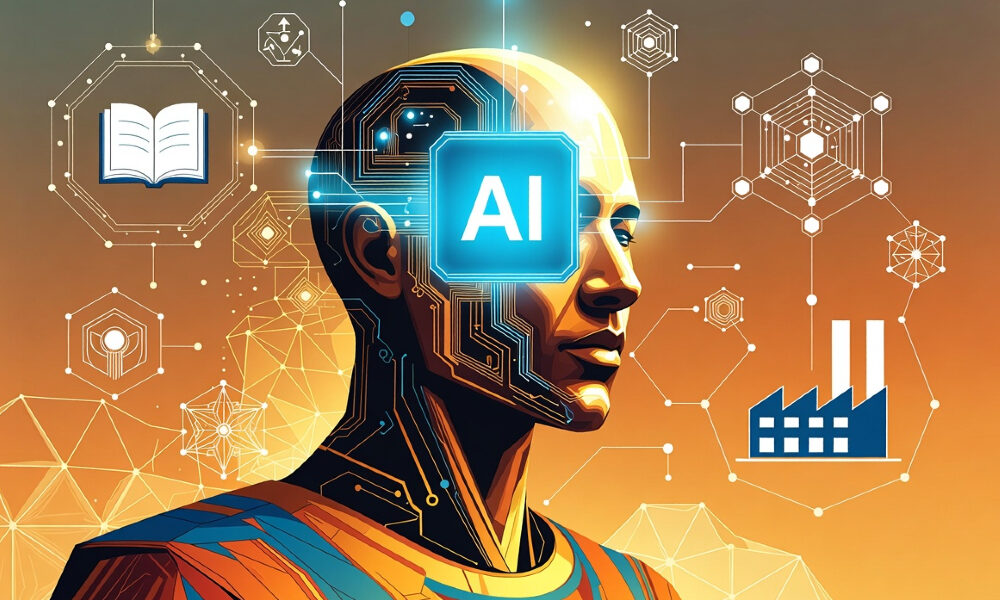
We stand at a historic convergence: the AI revolution intersects with Africa’s demographic surge and expanding digital infrastructure. This confluence will prove either a sovereignty accelerator or a dependency trap.
There is little middle ground.
If African nations digitize consumption patterns without digitizing production capabilities, they will deepen external control. Digital colonialism will replace its analog predecessor – more sophisticated, more comprehensive, more difficult to reverse.
If, however, Africa leverages AI to accelerate engineering education, applied manufacturing, agricultural optimization, logistics intelligence, and governance systems, the continent could compress what would otherwise require 50 years of industrial development into a 15-year transformation.
The choice is not predetermined. It depends on institutional design.
Previously, we emphasized that Africa’s opportunity lies in absorbing population growth productively – transforming latent pressure into the largest production engine of the 21st century. AI amplifies this opportunity exponentially.
Machine learning can personalize technical education at scale. Computer vision can optimize agricultural yields across millions of smallholder farms.
Natural language processing can democratize access to legal, financial, and administrative services previously restricted by language barriers or geographic distance.
But these capabilities only translate into sovereignty if they are deployed to strengthen indigenous systems rather than bypass them. AI-powered education platforms owned by foreign corporations create dependency.
AI-enabled agricultural systems owned by multinational agribusiness extract value. AI-driven financial services controlled by external fintech companies accumulate data wealth offshore.
The pattern we identified earlier repeats: infrastructure without ownership becomes extraction infrastructure.
From Rhetoric to System Design
Leadership must evolve from aspirational rhetoric to systematic implementation. The mandate focuses on concrete system design across three integrated pillars:
Education-to-Industry Pipelines: Creating direct channels connecting universities, technical institutes, and industrial corridors so talent flows immediately into production ecosystems rather than unemployment queues.
Digital Infrastructure and Applied Intelligence Platforms: Deploying AI, data systems, and educational technology specifically to train builders and problem-solvers, not passive consumers of foreign content.
Narrative and Institutional Cohesion: Convening policymakers, capital allocators, academic institutions, and enterprises around long-horizon industrial independence strategies that transcend electoral cycles.
These pillars are mutually reinforcing. Education without industry creates frustrated ambition. Industry without education imports expertise.
Both without narrative coherence produce fragmented efforts incapable of achieving scale.
This operational framework directly implements the strategic thesis developed across our previous discussions. We argued that the most durable African strategies would integrate hard infrastructure, industrial capacity, digital platforms, and cultural-institutional alignment.
These three pillars operationalize that integration – they transform conceptual framework into implementable architecture.
The Layered Nature of Sovereignty
Genuine sovereignty operates across multiple interconnected layers: hard infrastructure, industrial capacity, human capital, and cultural coherence. Remove any single layer and the entire system weakens.
Africa’s future will not be determined by aspirational slogans about youth potential. It will be decided by whether that youth is systematically integrated into production systems capable of competing globally.
The mathematics are unforgiving. The world’s largest population growth without industrial absorption becomes instability – unemployment, migration, and social fragmentation.
The same population equipped with aligned education, AI-enabled productivity, and infrastructure integration becomes the century’s largest value-creation engine.
We previously noted that nations maintaining narrative continuity – even under occupation or material scarcity – retained the capacity to regenerate power when circumstances changed. This principle now manifests concretely: educational systems that encode values, instill discipline, and ensure civilizational continuity produce populations capable of sustaining long-term development projects across political transitions.
The evidence supports this framework. South Korea’s educational rigor preceded its industrial transformation. Singapore’s cultural emphasis on meritocracy and discipline enabled its financial sector development.
Rwanda’s educational reforms reinforced its national narrative of reconciliation, creating stability that attracted investment governance metrics alone could not explain.
The Civilizational Long Game
The stakes transcend quarterly earnings or five-year development plans. This is civilizational strategy.
The objective is raising a generation that remembers its history, understands its identity, commands modern technology, and builds institutions durable enough to outlive political cycles. That represents independence redefined – not symbolic freedom, but systemic power.
The question is no longer whether Africa possesses potential. Demographics and resources settle that debate. The question is whether African nations will design institutions worthy of that potential – educational systems that produce builders, industrial policies that enable production, cultural frameworks that sustain long-term commitment, and governance structures that outlast individual leaders.
We framed independence as the capacity to design, finance, build, own, govern, and protect strategic systems. We added that it is also the capacity to remember, narrate, and self-determine cultural identity across generations.
Now we conclude: it is ultimately the capacity to educate – to systematically reproduce technical competence, institutional memory, and civilizational purpose across generations without external dependency.
The answer will determine not just Africa’s trajectory but the global balance of power in the coming decades. In an AI-driven world, the societies that combine technological mastery with cultural coherence will shape the future.
Those that import both technology and identity will be shaped by it.
We stated previously that this is not a call for aid but a call for statecraft, capital discipline, and construction at scale. The AI era intensifies this imperative.
The technologies emerging now will either accelerate sovereignty or entrench dependency. The window for strategic positioning is measured in years, not decades.
The choice, as always, belongs to the builders – those who understand that true independence is constructed, not declared. Those who recognize that in the intelligence era, sovereignty flows from the systematic integration of infrastructure, industry, education, and identity.
Those prepared to invest not merely in projects but in nations – underwriting the construction of durable competitive advantages that transcend commodity cycles and political transitions.
The era of extraction is ending. The era of system builders has begun. The question remains: who understands that building requires steel, song, and now – above all – systematic education engineered to produce not job seekers, but the architects of the next century?
Victory Azimih is a visionary entrepreneur and global investment consultant specializing in Africa’s economic growth and industrial transformation. As the CEO and founder of Azeemi Global, he leads a pioneering firm dedicated to accelerating the continent’s development through cutting-edge technology and infrastructure solutions. Under his leadership, Azeemi Global focuses on harnessing the potential of artificial intelligence, blockchain, and smart infrastructure to unlock sustainable investment opportunities across Africa. Based in Lagos, Nigeria, Azimih is at the forefront of driving Africa’s future as a hub of innovation and industrialization.