Business
Increased investments help propel African agriculture growth
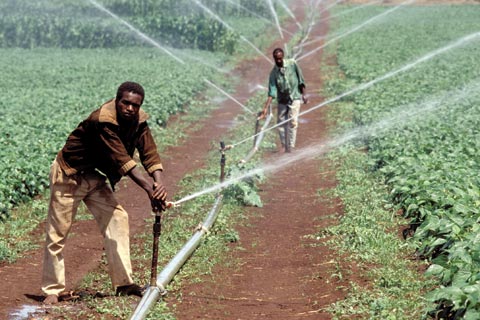

Irrigated farming in Tanzania. PHOTO/Peter Arnold, Inc./Ron Giling
Good technologies generated from agricultural research in Africa have been beneficial in improving crop yield and economic growth on the continent, says Professor Monty Jones, the Executive Director of the Forum for Agricultural Research in Africa (FARA).
He mentioned the New Rice for Africa (NERICA Rice), the tissue culture of banana and drought tolerant and striga-resistant corn varieties as examples of technologies which has earned Africa the world food prize.
“Had it not been for research, the yields that we register today which compared to other regions of the world are very low, our yield would have been reduced by 39 percent”.
FARA is the lead institution co-ordinating the implementation of the Comprehensive Africa Agriculture Development Programme (CAADP) Pillar IV: agricultural research, technology dissemination and adoption.
CAADP is an initiative of the New Partnership for Africa’s Development (NEPAD), working to boost agricultural productivity on the continent.
According to Prof. Jones, governments in Africa are beginning to increase their investments in agriculture, stating “that willingness to want to support agriculture is much better today than ever before”.
The 2004 winner of the World Food Prize observed that countries on the continent are on the right path to achieve the targeted six percent agricultural productivity growth rate.
Prof. Monty Jones however observed that “All these good technologies that we’ve developed unfortunately are doing well only in isolated areas. We’ve not been able to translate these into continent-wide impact and that is the problem that we encounter”.
He therefore believes the media has a role to play to disseminate agricultural knowledge and information to farmers and other interest groups to achieve the desired impact.
FARA, in collaboration with the Technical Center for Agricultural and Rural Cooperation (CTA), held a press conference in Accra, Ghana on “Strengthening research and media partnerships in an effort to help feed 1 billion Africans”.
Samuel Mikenga of the CTA emphasized that knowledge circulation is critical for the adoption of new agricultural technologies in order to attain the goals under the CAADP IV.
He said the CTA looking at “the whole knowledge circulation system” in its partnerships to strengthen capacity to advance food and nutritional security.