A Diaspora View of Africa
Ignoring History Is a Dangerous Practice


By Gregory Simpkins
The implementation of Diversity, Equity and Inclusion (DEI) was supposed to encourage a mindset of broadening opportunities for all people in America. Instead, too many used it as a tool to portray black and other minority groups as victims and whites (particularly males) as oppressors.
While that is not a completely untrue characterization in some instances, the portrayal was too generalized. It is, then, not unexpected that a counter-trend would develop to combat this generalization, but it too appears to be overstated.
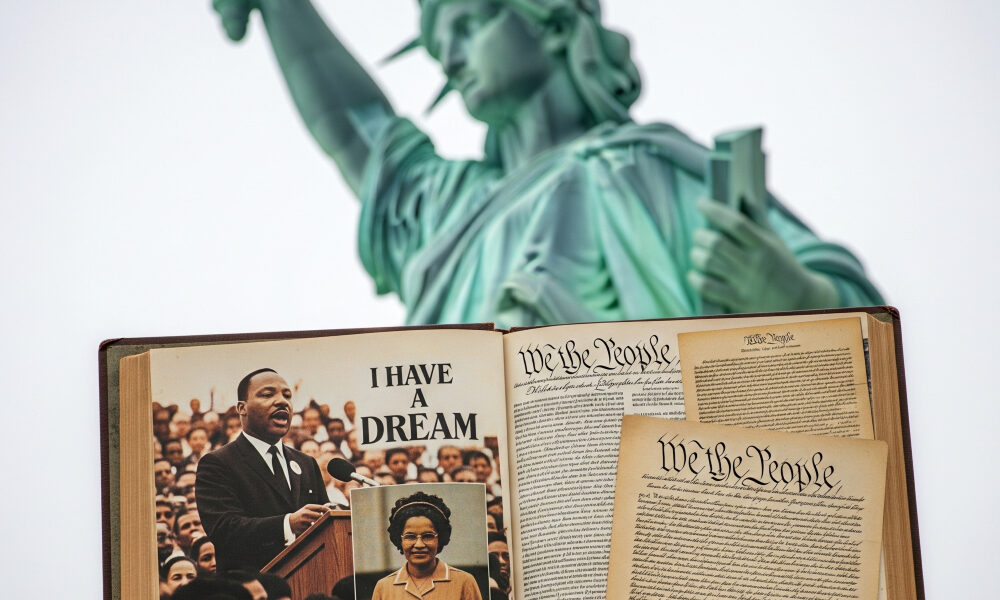
The Trump administration has made several efforts to censor history and discussions around certain topics, particularly those related to DEI, systemic racism, and climate change. These efforts can be seen in the following areas:
Executive Orders 14151, 14168, and 14173 aim to shut down governmental DEI programs, targeting initiatives that promote diversity and inclusion in the federal government. These orders also rescind affirmative action policies and aim to restore “merit-based opportunity.”
The administration has reportedly told federal agencies to stop using certain words and phrases linked to diversity, climate change and social justice. This list includes terms like “climate change,” “diversity,” “equity,” “Native American,” “disability” and “elderly.”
The administration has attempted to restrict discussions about race and gender in schools, with some lawmakers introducing bills to ban the teaching of “divisive concepts” in K-12 public schools and universities.
Federal agencies, such as the National Park Service and the Department of Defense, have altered or removed content related to LGBTQ+ individuals, women, and racial minorities from their websites and exhibits.
Critics argue that these efforts limit speech within the government itself, reducing the ability to address important social issues like workplace discrimination and environmental challenges. These actions have been met with criticism from organizations like the American Civil Liberties Union (ACLU), which has vowed to challenge these efforts in court and defend programs that promote racial equality and civil rights.
The Rise and Fallout of the 1776 Report
The Trump administration’s “1776 Report” has been criticized for promoting a dystopian vision that demonizes discussions about systemic racism and social justice. This report is a document released by the President’s Advisory 1776 Commission, established in the first Trump term to promote patriotic education.
The report emphasizes the importance of the Declaration of Independence and the Constitution, highlighting the principles of individual rights and human equality.
The report asserts that the Declaration of Independence is the foundation of American history, emphasizing the idea that “all men are created equal” and are endowed with certain unalienable rights, such as life, liberty and the pursuit of happiness.
How many white people and even Black people are unaware of the many Black inventors and scientists that helped us to reach the technological advancements we enjoy today?
The commission recommends teaching a patriotic education that focuses on the enduring and unifying principles of the American founding, rather than a skewed narrative that fits a particular political agenda. Historians have criticized the report for its lack of scholarship, factual inaccuracies and partisan politics.
The American Historical Association and other historical societies have condemned the report, stating that it is “plagued by procedural deficiencies” and “not a work of serious scholarship”.
The report suggests promoting positive stories and images of America’s founders in schools and the arts, and encouraging a renewed focus on American history and civics education.
Despite the commission being disbanded by President Joe Biden, its legacy continues, with some states passing laws promoting “patriotic education” and restricting the teaching of critical race theory. The 1776 Commission’s work has also inspired a 501(c)(4) group, 1776 Action, which promotes patriotic education and combats “anti-American indoctrination”.
Confronting Painful Truths in American History
But is it really anti-American to acknowledge the violence against minorities such as African Americans? The saying” “Those who ignore history are doomed to repeat it” applies here.
Of course, it is understandable that many white people would shrink from having discussion of massacres such as those in Tulsa, OK; Colfax, LA, or Rosewood, FL, not to mention the numerous lynchings of black people in various states.
States like Florida have attempted to bring out a silver lining on slavery by mentioning the skills slave acquired. True though that may be, the fact that human beings were imprisoned in an enslaved status, denied education and freedom of speech and other freedoms in the first place must never be downplayed.
Even though it is highly unlikely that we could return to such conditions, it is part of the history of America that led us to where we are today.
We have largely overcome overt racism, although not the sly, passive-aggressive kind. I believe that is largely because US history books don’t adequately record the numerous accomplishments of black people in this country to go along with the depredations our ancestors had to endure.
Reclaiming the Full Narrative of Black Excellence
On the one hand, all young people are denied accurate understanding of what our people went through in history, but also not how many of our best and brightest shined in spite of being held back and/or ignored.
How many white people and even Black people are unaware of the many Black inventors and scientists that helped us to reach the technological advancements we enjoy today:
George Washington Carver was the agricultural chemist who discovered more than 300 uses for peanuts, soybeans and sweet potatoes. His work revolutionized farming and soil restoration.
Percy Julian was the chemist known for synthesizing cortisone, steroids and birth control. He was a pioneer in his field and overcame racial barriers to achieve success.
Charles R. Drew was the physician and surgeon who developed the concept of blood banks and improved blood plasma storage.
Gladys West was the mathematician who contributed to the development of the Global Positioning System (GPS).
Granville Woods was an inventor with more than 50 patents, including the Synchronous Multiplex Railway Telegraph and the telegraphony.
Garrett Morgan was the inventor of the gas mask and the three-color traffic light system.
There are many others who developed major technological or scientific advances or even everyday items we take for granted, such as the ironing board (Sarah Boone) or the Murphy fold-out bed (Sarah Good).
We must not pretend that the bad memories from our joint history didn’t occur, but we also must not forget the many accomplishments that Black people, Hispanics, Asians and Native Americans have contributed throughout our history. We all need to know what horrors we have overcome as well as what positive legacies have been accumulated.
Erasing the bad and ignoring the good will keep us all trapped in the twilight zone of misinformation, outright lies and disrespect in which we find ourselves mired. So, we must balance the desire to coat history with the honeyed view of what has gone on in the past while declining to use the disinfectant of truth to clean our view of history.
Gregory Simpkins, a longtime specialist in African policy development, is the Principal of 21st Century Solutions. He consults with organizations on African policy issues generally, especially in relating to the U.S. Government. He further acts as a consultant to the African Merchants Association, where he advises the Association in its efforts to stimulate an increase in trade between several hundred African Diaspora small and medium enterprises and their African partners.