Business
Hurdles in Africa’s grand plan
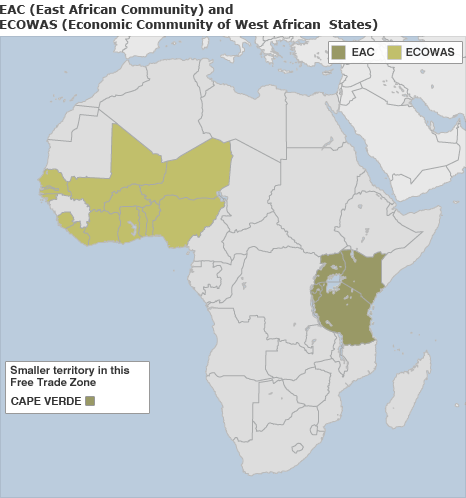
Across Africa, free trade zones are being set up between countries and even at individual locations.
They claim to offer a cheaper and easier way to buy and sell goods and services, thus, boosting economies.
The free trade zone from the Cape to Cairo would benefit some countris on the African continent, but Africa’s track record doesn’t inspire confidence and many countries might actually lose.
At the Chirundu border, along the north-south transport corridor between Zimbabwe and Zambia, commercial trucks used to wait five days to get clearance. Now, they can get through in a matter of hours.
In the first one-stop border post in Africa, a common control zone has been created so that the two countries’ border agencies can share one facility to eliminate duplication. The project is one of the first successes under the auspices of the Tripartite Free Trade Area (FTA) — a grand plan to establish a free trade zone from Cape Town to Cairo.
Initiated by the participating governments in 2008, the Tripartite plan seeks to create an FTA involving the 26 countries of the Southern African Development Community (SADC), the Common Market for Eastern and Southern Africa (Comesa) and the East African Community, a market of 530m people with a combined GDP of US$840-billion.
It is the most ambitious regional integration undertaking Africa has proposed yet. Politicians see it as one of the building blocks in creating a single African economic and monetary area (with a single currency and central bank, like the European Union) by 2025.
Africa currently accounts for less than 3% of global trade and only 10% of Africa’s trade is with countries within the continent. This despite African governments concluding a large number of regional integration arrangements.
The intention behind the Tripartite FTA is to allow the duty-free, quota-free flow of goods and services, and the free movement of business people by 2016.
The hope is that positioning half of Africa as one large common market will allow it to benefit far more from global trade flows, as well as attracting greater investment and large scale production.
But trade analysts will be forgiven for their cynicism. “If past experience is anything to go by, the prospects for a successful Tripartite FTA are minimal,” says Trade Law Centre for Southern Africa (Tralac) researcher Taku Fundira. In Comesa, for example, some members have yet to adopt the common external tariff, while some SADC members have still not complied with their free trade obligations long after deadlines lapsed.
Colin McCarthy, professor emeritus in economics at Stellenbosch University, is equally sceptical. “After more than 40 years of rhetoric on grand integration schemes and ambitious road maps along the linear route to economic union, real integration on the continent remains an evanescent goal.”
Indeed, the idea in Tripartite FTA’s 2008 founding documents that the FTA would be the first step towards merging all 26 countries into a single customs union seems to have been dropped in their most recent June 2011 communiqué. Sobriety has set in.
Does this mean the 2025 goal of an African monetary union is less likely to be attained? “One would hope so,” says Peter Draper, senior research fellow at the South Africa Institute of International Affairs.
While he believes the FTA is a good idea , in practice it’s proving quite challenging to create. Initially, the planners thought it would be a relatively simple task to extend the existing FTAs in Comesa, the EAC and the SADC, but they have subsequently found that the FTAs are riddled with exclusion clauses for sensitive products. Comesa and the SADC also have different philosophies for dealing with rules of origin.
Also, all the countries are wary of opening their markets to products from South Africa, the largest and most diversified economy in the region. As the main producer of goods and services in sub- Saharan Africa, South Africa has ostensibly the most to gain from the proposed Tripartite FTA. South Africa’s trade negotiators are according the project top priority this year, confirms the department of trade and industry’s Xavier Carrim.
However, a computer analysis described in a recent Tralac publication, “Cape to Cairo: An Assessment of the Tripartite FTA”, finds that there will be more losers than winners if the project is fully implemented. Though the researchers say their results using the latest Global Trade Analysis Project modelling technique are only indicative, they believe they offer “a very realistic view of the final outcome”.
They find that only South Africa and Mozambique stand to gain a lot. Mozambique gains by US$60-million. But South Africa’s welfare stands to increase by a whopping US$1.3-billion thanks to the boost sugar and manufactured exports would get as a result of improved access to East African countries, especially Kenya.
Most other tripartite partners gain marginally or lose marginally since most already have multiple membership of overlapping FTAs.
Despite this, there is strong political backing for the Tripartite FTA from the rest of the continent. Their support is due partly to the idea that the project furthers the African political dream of a single monetary and economic union, but leaders also see it as key to unlocking the next phase of the region’s development. That’s because the project is not just about reducing tariff barriers. Its other pillars involve transport, and development of infrastructure and industry.
It is widely accepted that if Africa is to develop economically it will need to not only rehabilitate existing infrastructure but also build new infrastructure. Severe logistical constraints, especially in energy and transport, hammer Africa’s economic competitiveness, rendering its average export costs 78% higher than in the Organization for Economic Cooperation and Development (OECD) countries, according to some studies.
The idea behind the Tripartite FTA is to integrate the three blocs by linking infrastructure. The first flagship programme is the creation of a north-south corridor from the Democratic Republic of Congo (DRC) to Durba. While these developments are positive, achieving regional integration will require sustained infrastructure spending of US$5.5-billion/year , says the World Bank.
Why have they become so popular in Africa?
Economists argue that free trade zones are particularly suited to African countries which were created under colonial occupation when land was divided up, often with little regard for the economic sustainability of the newly created units (countries).
Plus, post-independence conflict in Africa has left much of the continent with a legacy of poor governance and a lack of political integration which free trade zones aim to address.
For example, landlocked Uganda was almost ruined by the Ugandan-Tanzanian War (1978-79). Today it remains dependent for the supply of finished goods on its wealthier neighbour Kenya, with its international seaports.
The two countries entered into the East Africa Community Customs Union, EAC, in March 2004, along with Tanzania.
However, these trading blocs are not always tariff free. Kenya continued to pay export duties to Tanzania and Uganda for five years after the EAC union began, to compensate for the fact that it was a more prosperous, diversified economy.
Free trade zones can also cover individual areas within a country. The Lekki free trade zone in Nigeria’s former capital, Lagos, aims to create a new commercial hub by removing tariffs for international investors. Eritrea plans a similar arrangement at its port at Massawa on the Red Sea coast.
What do free trade zones claim to offer?
The hope is that free trade zones will boost both trade and Africa’s economic independence.
Babatunde Raji Fashola, governor of Lagos state, told Africa Business Report: “At airports, Nigerians are the people you see with excess luggage and it comprises mainly of household goods, clothing.
“Every time we import goods, we invariably, without knowing it, export jobs because we keep those industries offshore.”
World trade experts also believe in the future, more of the world’s big multi national deals will be “South-to-South”, ie between Southern Hemisphere nations.
A recent example is a plan by India’s mobile phone giant, Bharti Airtel, to take a controlling stake in South Africa’s MTN. Free trade zones can greatly boost the attraction of such deals.
Is there any evidence they work?
Some critics claim that free trade zones give an unfair advantage to multinational corporations, who are able to manufacture in a low-cost base and export around the world, rather than indigenous firms.
These companies are often given other incentives to locate in developing economies, such as grants to help with set-up costs and lax employment legislation, which trade unions and some charities claim are open to abuse.
Free trade zones can also take a long time to set up while member countries agree terms. The East African EAC bloc took six years to come into being, even though it was replacing a previous similar arrangement which collapsed in the 1970s.
The fear is that the dominant economy will set the agenda for the bloc as a whole – a criticism levelled at the SADC (as idicated above), which contains South Africa, the continent’s only G20 member country.
But supporters say free trade zones are ultimately one of the fairest ways for developing world economies so that they can begin to compete on a global scale. They could even be extended to encompass other financial unions, such as pan-regional banks and a common currency.
Source: Financial Mail; BBC