A Diaspora View of Africa
How will Africa’s population growth affect the rest of the world?



By Gregory Simpkins
The South China Morning Post reported on March 29, 2024 that by 2050, it is projected that only a quarter of countries in the world will have above-replacement fertility rates; by 2100 there will be just six: Chad, Niger, Somalia, Samoa, Tonga and Tajikistan. While many see upsides to a smaller global population, these demographic shifts will reconfigure the world economy and require societies to be reorganized.
Birthrates are tumbling in richer nations, creating anxiety about how to care for, and pay for, their aging societies. But Africa’s baby boom continues apace, fueling the youngest, fastest growing population on earth.
The uncertainty of African statistical information notwithstanding, population growth is extremely rapid, with all countries growing at annual rates of over 3 percent, according to the National Institute of Health as relayed by its PubMed communications platform. The natural increase rate even shows some signs of increasing slightly in the next decade or so, their report stated.
Africa’s population was estimated at 220 million in 1950, 650 million currently and is projected at 1.5 billion by 2025. Africans represented 9 percent of the world population in 1960 but will increase to 19 percent around 2025.
The 10 most populous African countries currently are: Nigeria (224 million), Ethiopia (127 million), Egypt (112 million), The percent (102 million), Tanzania (67 million), South Africa (59 million), Kenya (55 million), Uganda (49 million), Sudan (48 million) and Algeria (46 million).

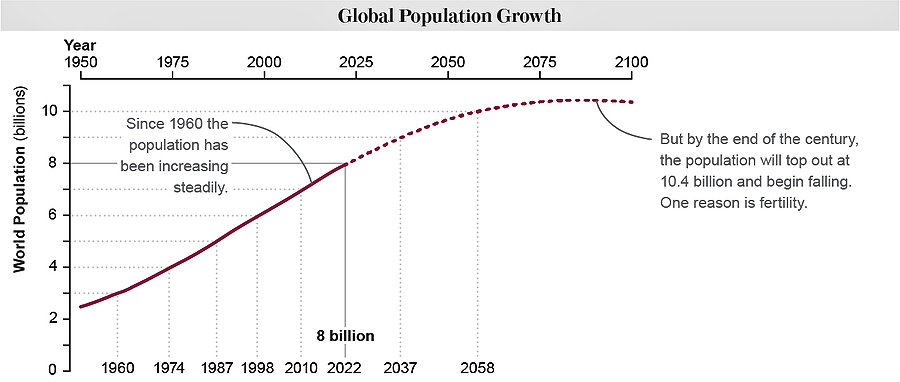
Credit: Katie Peek; Source: World Population Prospects 2022, United Nations Population Division
The rapid population growth is the result of declining mortality since the 1950s, unmatched by changes in fertility. There are significant socioeconomic and rural-urban mortality differentials in Africa, but as yet only highly educated urbanites have measurably reduced their family size. Two consequences of this rapid growth are the youth of the population, with almost 50 percent under 20 years, and its high density in some areas.
By 2025, the PubMed report estimated that 18 countries will have densities of more than 100 persons per sq. km. Almost everywhere in Africa, family sizes are at least 6 children per woman. Three factors explaining this high level of fertility are the earliness and universality of marriage, rates of contraceptive usage of only 4-10 percent in most countries and declining durations of breast feeding and sexual abstinence, which traditionally served as brakes on fertility.
As a rule, women marry young and remain married until the end of their reproductive years. Divorce and widowhood are common, but remarriage is usually rapid if the woman is still of reproductive age.
One other traditional brake on population growth traditionally has been a higher level of education.
The more educated a nation becomes – especially its females – the smaller the family size, as the scientific web site Geographical reported on March 14, 2024. However, Nigeria is an exception to this rule as birthrates have declined by only fractions of a percent even as education rates have increased.
One reason the Geographical report speculated could be a quirk in state funding in Nigeria in which national revenue is allocated to each of the 36 states depending on population size. Consequently, the largest ethnic groups in states do not want to lose the competition for funding that would occur with a decline in population.
Factors in Africa population growth
Life expectancy at birth in sub-Saharan Africa has increased from some 36 years around 1950 to 50 years currently. Progress in control of mortality, and especially infant mortality, has been slower than expected, but Africa still has by far the lowest life expectancy of any major region.
Regional, rural-urban and socioeconomic mortality differentials are considerable and sometimes increasing. In some countries the gaps in life expectancy between rural and urban residents or between social classes are as high as 15 or 20 years.
In contrast, eight of the ten countries that witnessed the largest increase in the use of modern contraception methods between 1990 and 2021 were in sub-Saharan Africa: Ethiopia, Eswatini, Guinea-Bissau, Madagascar, Malawi, Rwanda, Uganda and Zambia, according to the United Nations Department of Economic and Social Affairs. So, we shall see how significant an effect on population growth this increase in contraception will have in these countries.
Africa is experiencing huge pressure triggered by lightning-fast change, most evident in urbanization. Africa’s urban population is expected to triple in the next 50 years, according to the UN, which has set the goal of ensuring that everyone has access to adequate, safe and affordable housing and basic services by 2030. Yet a study by the London School of Hygiene and Tropical Medicine found that 47 percent of people in urban sub-Saharan Africa still live in slum-like housing.
This means that “population growth in and of itself is not what drives whether or not we achieve the Sustainable Development Goals,” says Thoai Ngo, VP of social and behavioral scientific research at the Population Council.
“Population dynamics such as increasing urbanization and migration are reshaping where people live – and why – and impacting the resiliency of communities. Economic, health and social inequities are multi-faceted and mutually reinforcing,” Ngo says.
In an Altamar podcast on July 19, 2022, Jakkie Cilliers, the founder of the Institute for Security Studies in South Africa, said he and his team had identified 11 critical structural interventions that need to happen to trigger a growth revolution. These range from better stability, better governance, an agricultural revolution and so forth, but even with a growing demographic and abundant natural resources, many countries in Africa have had trouble reaching their full potential.
“Africa’s challenges are rooted in the way in which the African state was created. … You have an imposed state, and that imposed framework was held in place by the Cold War. … But because you have an imposed state formation process in Africa, this process of creating national identities – countries – takes years,” Cilliers said.
This at least partially explains why applying African solutions to African problems has been so difficult.
The New York Times reported on October 28, 2023 that the median age on the African continent is 19. In India, the world’s most populous country, it is 28. In China and the United States, it is 38.
The implications of this “youthquake,” as some call it, are immense yet uncertain and likely to vary greatly across Africa, a continent of myriad cultures and some 54 countries that covers an area larger than China, Europe, India and the United States combined. But its first signs are already here, the newspaper stated.
With the demand for labor – skilled or unskilled – rising in the developed world, the pull for Africans to leave the continent will increase. The relative lack of infrastructure, especially energy, and the lure of increased earnings elsewhere likely will accelerate the current rate of brain drain from Africa. Much like the removal of millions of healthy, young Africans during the trans-Atlantic slave trade, this will undoubtedly retard development on the continent, even as it spreads African culture abroad.
The ultimate impact of this situation is indeed unknown at this point, but it surely will have both positive and negative results.
Gregory Simpkins, a longtime specialist in African policy development, is the Principal of 21st Century Solutions. He consults with organizations on African policy issues generally, especially in relating to the U.S. Government. He further acts as a consultant to the African Merchants Association, where he advises the Association in its efforts to stimulate an increase in trade between several hundred African Diaspora small and medium enterprises and their African partners.