Editorial
How Uganda Can Contribute to East Africa’s Development

Almost all prominent or successful business people in the Great Lakes Region [loosely Sudan, the Democratic Republic of Congo, East Africa including Kenya, Uganda, Tanzania, Rwanda and Burundi] consider Dubai the Mecca for all kinds of trade and commerce. This even smaller piece of land within the tiny United Arab Emirates has a gross domestic product (GDP) of approximately US$ 80 billion.
Contextually, this emirate that sits on less than 4,500 square kilometers has an economy that is about six times that of Uganda; about thrice Kenya’s and probably four times that one of Tanzania.
Granted, the economy has a major infusion of oil revenues which could distort figures for just about anything. However, real estate and construction contributes about 22.6 percent and trade brings in 16 percent of this huge figure.
Dubai’s top exporting destinations include India, Switzerland and Saudi Arabia [US$ 5.8 billion, US$ 2.37 billion and US$ 0.57 billion respectively] but what is even more impressive, though, are the re-export figures of US$ 6.53 billion to India, US$ 5.8 billion to Iran and US$ 2.8 billion to Iraq. Dubai alone imports over US$ 12.55 billion worth of goods from India, about US$ 11.52 billion from China and not to be left out, about US$ 7.57 billion from the United States.
At this juncture, this paper does not, under any circumstances, begrudge the United Arab Emirates or its sections of Abu Dhabi or Dubai. Instead, these small areas have renewed earlier efforts to push for an economic development model based on special economic zones [SEZs].
According to the International Finance Corporation, SEZs are limited areas that offer incentives like duty-free importing and streamlined customs procedures to businesses within a specified zone.
Basically, what Dubai is currently offering its neighbors and all these businessmen from Africa can be, technically and easily, done by Uganda. Not only does the country have the perfect candidate for this kind of thing: it also has a willing implementer that just requires the support of a region that can wholesomely benefit from a project of this magnitude.
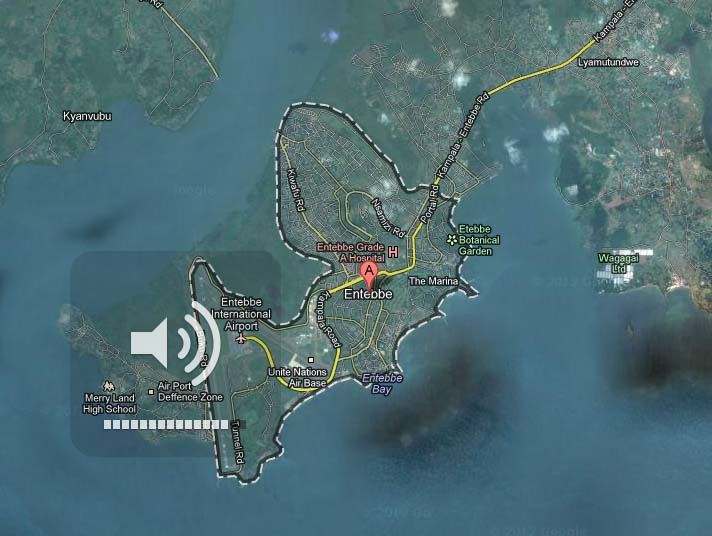
Enter Entebbe, Uganda and the Civil Aviation Authority: As home to Uganda’s international airport, the town of Entebbe is a peninsula jutting out into Lake Victoria. The airport, itself, occupies a sizeable portion of this land and the Civil Aviation Authority practically manages this section of the country.
A closer look at Entebbe from Google Earth shows that Entebbe could be the Dubai of East, Central and Southern Africa.
But just think: A special economic zone in the heart of Africa! A place where Sudanese businessmen can come to purchase brand new computers for their new offices in Juba; an area that could hold thousands of brand new or reconditioned cars from Japan; an export processing zone that could allow traders from Angola and Namibia to buy freshly cut roses from refrigerated facilities at the airport. Of course, how can we not think of Dubaiesque shopping malls that would allow countless business people from Rwanda, Kenya, Tanzania, Ethiopia, Sudan, The Congo – and even as far as Ghana to purchase goods that will enhance their lifestyles. In simple terms, instead of flying all the way to Dubai, people could go to Uganda and find their dreams.
Under the circumstances, it would be easy to assert that this paper is just making the xenophobic case for employment and development in Uganda. Yes – a plausible case could be made since three of this rag’s leaders are from the East African region. However, that would not take away the fact that Uganda, “the Pearl of Africa” has a natural advantage over the other countries of the Great Lakes Region: Not only is it landlocked: It also has an existential relationship with Lake Victoria, the world’s second largest fresh water lake.
This water body connects the countries of Kenya, Tanzania and Uganda. To the East of Entebbe on the lake shore is Kisumu in Kenya. To the South is Mwanza in Tanzania. Although Kisumu does not have one, a ferry operates between the latter Tanzanian port completing the journey goods make from Dar-es-Salaam. This means that cars can be shipped to Tanzania and make their way to Entebbe through Mwanza by both rail and ferry. Computers can be flown into the airport from either Nairobi or Namibia.
Central to anything is a gargantuan task. The country would have to invest close to US$ 2.5 billion dollars in a new inland port, warehouses, processing facilities, new landing strips and of course, in constructing as many buildings as possible. And yet there is also another way: Private investors could simply be sought to get this project on the road. Thousands of businesses in the West are looking for an excellent product to invest in. Many countries are starting the process of offering infrastructure bonds to their countrymen in the Diaspora. Lastly, the world is looking towards emerging markets for their next big deal. There are rumors that Africa could be that diamond in the rough. Why can’t Uganda lead the way?
Dennis Matanda,
Editor – Editor@thehabarinetwork.com
Disclosure: In 2005, I worked with Uganda’s Civil Aviation Authority on a mini project to sell the potential of a project like this. These 6 or so years later, this project is yet to take off. Right now, the COMESA website advertises that this project could cost about US$ 2.5 billion. What this project lacks is exemplars to sell it to all those who want to see progress in Africa. From this special economic zone could come linkages to Southern Sudan and to Burundi.