Opinion
How Uganda Brewed a $2.4 Billion Coffee Boom
Africa’s new coffee champion got there through policy, not luck. The harder test is capturing the value beyond the farm gate.


By Wilbert Chaniwa
In the 12 months to April 2026, Uganda shipped 8.8 million bags of coffee abroad and earned US$2.4 billion for them. Seven years ago, the annual haul was about US$550 million. Uganda has since overtaken Ethiopia, the birthplace of coffee, to become Africa’s largest coffee exporter.
Nobody should mistake this for luck. Weather helped and prices were kind for a while, but neither explains a fourfold rise in earnings. Policy does.
Five Moves That Built a Coffee Powerhouse
First, a funded plan. Uganda set a national roadmap and paid for the inputs behind it. Between 2015 and 2021, the government distributed more than 1.1 billion seedlings, and production nearly doubled. Many African governments publish ambitious agricultural targets. Few buy the seedlings.
Second, data before demand. The National Coffee Act of 2021 made farmer registration mandatory, a dull piece of administration with a handsome payoff. When the European Union’s deforestation regulation (EUDR) began demanding proof of origin, Uganda already held the registry that buyers wanted. Compliance became a competitive edge rather than a crisis.
Third, credit that reaches the village. Under the Parish Development Model, loans at 6 percent go directly to parishes, the smallest administrative unit, bypassing district offices where money has a habit of evaporating.
Fourth, one roof. Regulation, extension services and export promotion, once scattered across agencies, were folded into the Ministry of Agriculture. Fewer agencies mean fewer turf wars.
Fifth, new customers. Uganda courted buyers well beyond its traditional European markets, from China to Morocco, India and Sudan, reducing its dependence on any one set of importers.
The Unfinished Revolution
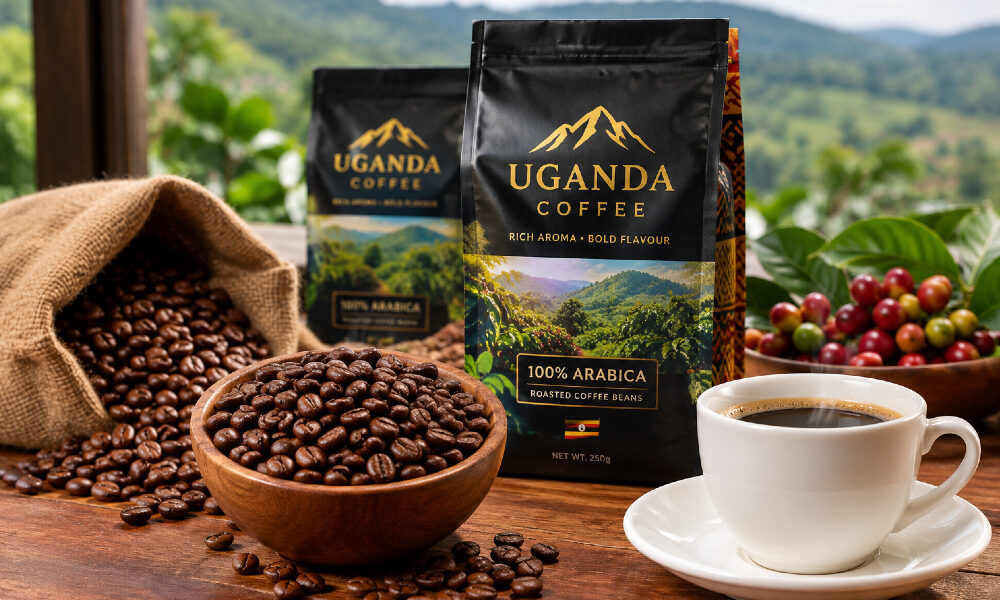
The trouble is that more than 98 percent of Uganda’s coffee still leaves the country as green beans, which is the least lucrative form in which to sell it. The real money lies in roasting, packaging and branding, and those profits accrue mostly in Europe and North America.
The state is now trying to change that. At the Africa Coffee Park in Ntungamo, the government has committed 60 billion Ugandan shillings (about US$14.7 million), and the park plans to use freeze-drying technology to produce 15,000 metric tons of finished coffee a year. A second park, in Luweero, is being built with Saudi Arabia. Meanwhile, NUCAFE’s Farmer Ownership Model is helping more than 1.5 million smallholders keep a larger share of the value through cooperatives. In 2025, Uganda dispatched its first large-scale shipment of roasted, retail-ready coffee, bound for Serbia.
These are early steps, but they point the right way.
The Risks Are Real
The good times are fading. Since mid-2024, farm-gate prices have fallen from Ush24,000 to Ush13,000 (US$5.89 to US$3.19) per kilogram. Drought and theft are eating into harvests, and rising robusta supply from Asia is squeezing margins further. A boom built on green beans is exposed to every swing in global commodity prices. Value addition is the hedge.
What Other Governments and Investors Should Learn
Governments elsewhere in Africa can borrow the essentials:
- Set quantified targets, and fund the inputs needed to hit them.
- Legislate for data before markets demand it.
- Route credit to the village, not the capital.
- Phase in value addition rather than decreeing it. Export bans on raw produce tend to punish farmers before they help factories.
Investors should note where the opportunities lie:
- The processing gap is the opportunity.
- Traceability is now a commercial asset, not a compliance burden.
- Cooperatives are the most efficient way to aggregate supply.
- Domestic and intra-African consumers are a growing market worth building for.
- Business models should be stress-tested at today’s lower prices, not last year’s.
The Verdict
Uganda has shown that coherent policy can double a smallholder sector in a decade. The next test is harder: capturing value beyond the farm gate, where margins are fatter and prices are steadier. If Kampala passes it, the world’s coffee drinkers will be paying for a Ugandan brand rather than merely a Ugandan bean.
The formula is simple to state and hard to execute: plant, register, finance, process.
Wilbert Chaniwa is an entrepreneur, corporate consultant, and author specializing in African agribusiness, investment advisory, and agri-food value chains. He is the Founder and CEO of RIC Brands, a UK–Africa agribusiness and hospitality company operating in the United Kingdom and Rwanda. His work focuses on food and soil sovereignty, reducing import dependency, restoring soil health, and scaling domestic food production. He also advances indigenous crop commercialization – such as fonio, moringa, baobab, teff, and bambara groundnut – while promoting knowledge transfer, market access, and agri-CPG trade across Africa.