Opinion
How tech is upgrading traditional mobility services in Africa
Applying modern e-hailing technology to private mass transport could produce mobility solutions that reduce congestion and car usage.
By David Taylor
In the international arena, the buzzword ‘mobility’ conjures images of high-tech mass-rapid-transit systems in international cities, linked with entrepreneurial, tech-driven start-ups such as e-hailing companies, micro solutions like e-scooters and share bike programmes linking efficient, high speed rail and air solutions modernized to meet our contemporary transport needs.
In South Africa, however, ‘mobility’ denotes the urban transport imperative that is integral to our economic activity, an informal modality all but void of innovation, propped up and supported by our often ominous minibus taxi industry.
The minibus taxi is an often colourful 14-16 seater minivan, loved and hated by both the 15 million passengers who use them daily, and by those who share the roads with them.
These taxis operated illegally from 1977 until they were formally legalized in 1987, carrying passengers from outlying areas dedicated by the Apartheid Government’s spatial planning regime into racially exclusive city centers and economic hubs. Road-favoring transport policy, lack of government funding and a lack of reinvestment in the extensive rail infrastructure have led to a situation where minibus taxis are able to punch above their weight by offering provincial commuters a nimble solution to their transport needs – in a country that possesses 75 percent of the African continent’s track, and where, therefore, rail should be untouchable. The resulting environment is one in which minibus taxis are responsible for 25 percent of South Africa’s passenger transport mix, placed between private car use (38 percent) and walking (21 percent), whereas rail is responsible for only 4 percent of the market.

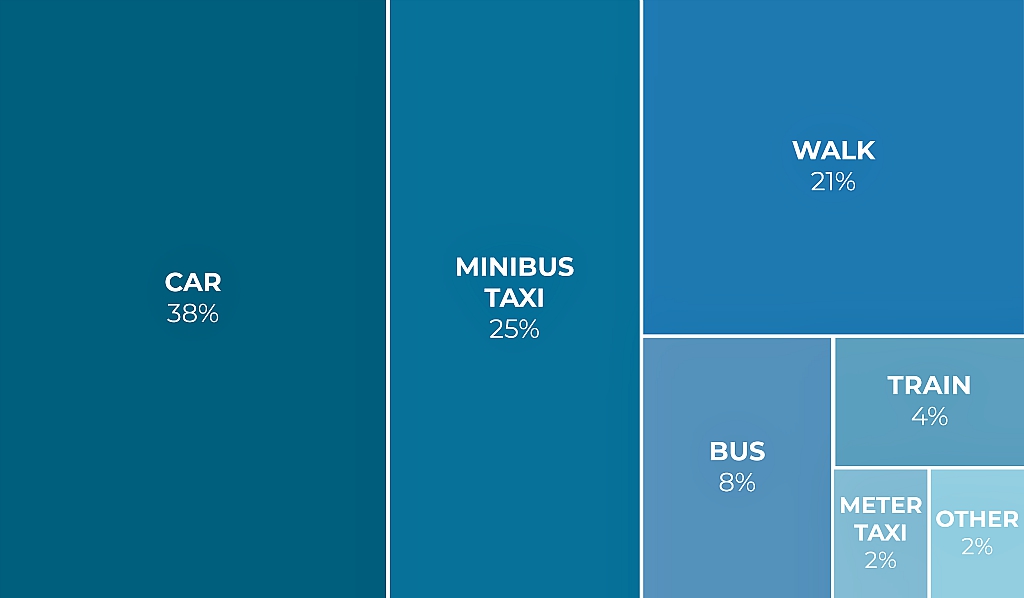
Transport usage by type in South Africa
IMAGE: Transaction Capital
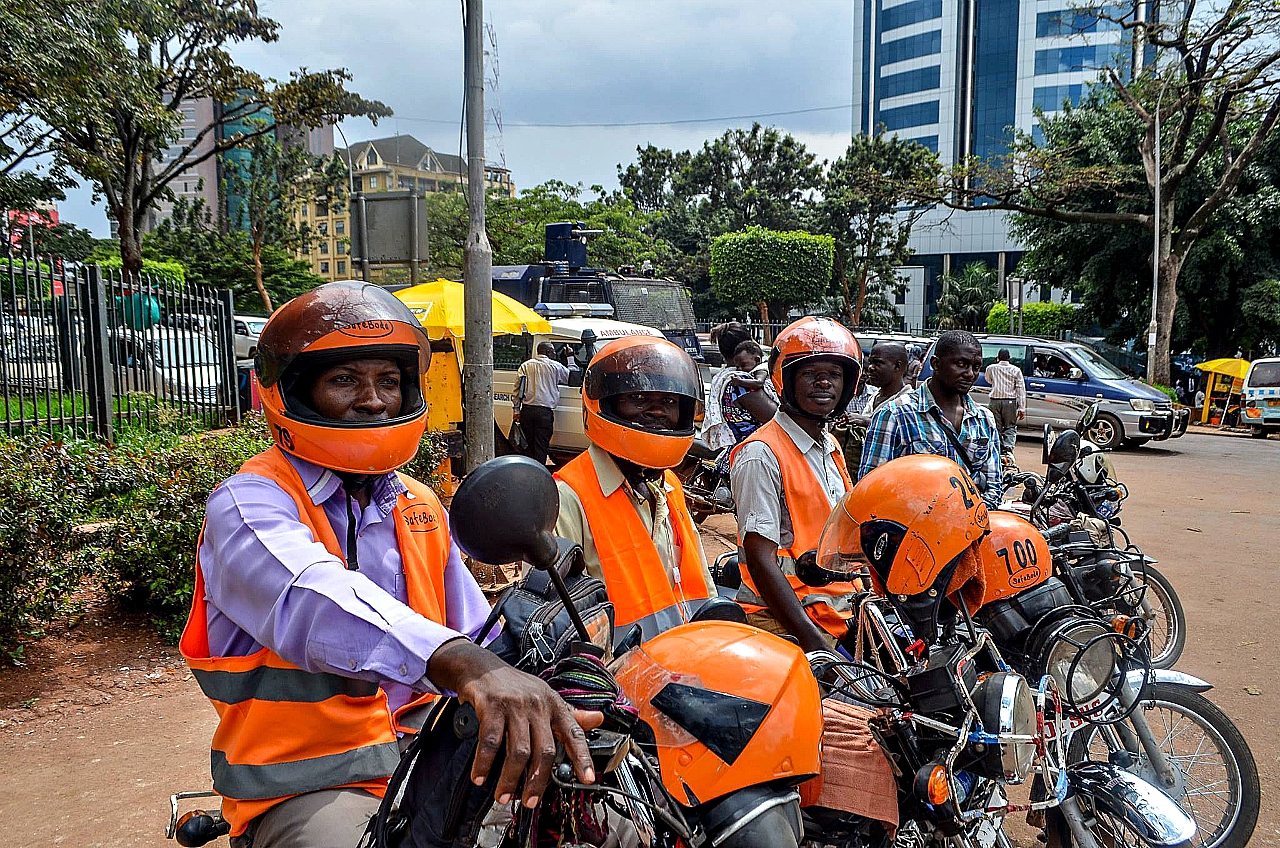
Beyond South Africa, other nations on the continent rely on similar mobility systems. East Africa’s minibus taxi equivalent is the matatu, which is possibly even more colorful and erratic than its southern counterpart, and which enjoys an even stronger position in the transport mix of the average East African. Where East Africa differs is in the use of motorcycles, known as boda-bodas, to address micro-mobility requirements. In South Africa, once again, the minibus taxi addresses this segment.
Applying Africa’s unique transport system to international mobility trends, we see an interesting convergence. Global cities are focusing policy frameworks and public mandates on reducing emissions and congestion by reducing the number of vehicles on their roads, with goals such as the Mayor of London’s transport strategy, which aims for 80 percent of all trips in London to be made by bicycle, walking or public transport by 2041. Cities are encouraging modality shift (people replacing their cars) through modal densification with the use of innovative tech-driven solutions.
Uber’s chief executive, Travis Kalanick, famously said that his company’s service would lead to a decrease in congestion in our cities, however the Wall Street Journal has pointed out that ride-hailing solutions have made congestion worse. Although e-hailing may have increased congestion, it has also paved the way for entrepreneurial entities to innovate. Applying the e-hailing solution to systems designed to efficiently increase mobility such as privatized mass transport, you have an ideal currently sought by many global cities.
David Taylor is a Business Development Manager with Cape Town-based TayloRail. This article is republished from The World Economic Forum under a Creative Commons license. Read the original article.