Owusu on Africa
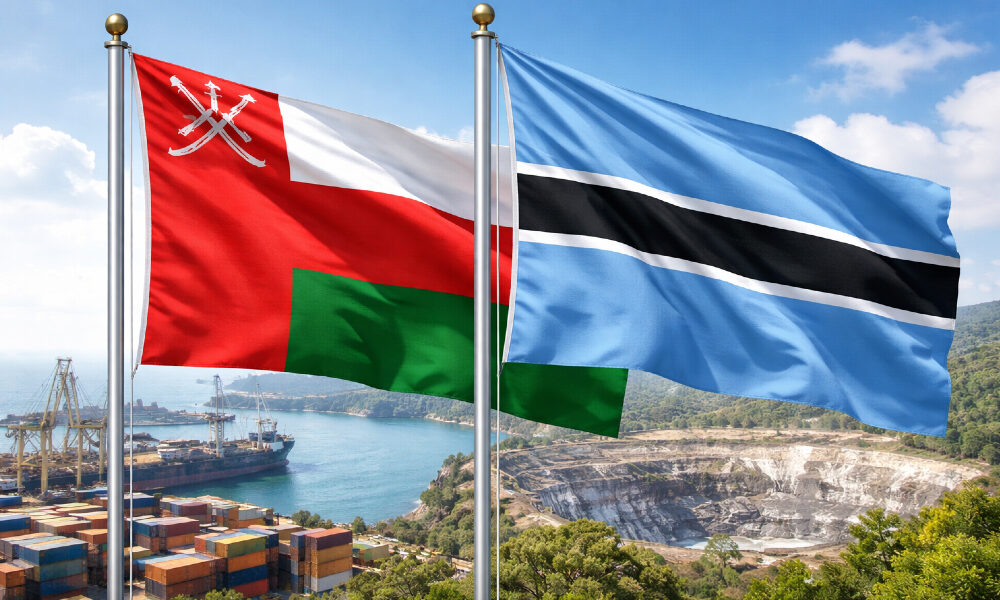
How Oman and Botswana Could Redefine South-South Ties
Two nations defined by studied neutrality and resource wealth have more in common than geography would suggest – and both stand to gain from a closer embrace.


By Fidel Amakye Owusu
While missiles and drones have reshaped the Middle East’s political landscape over the past year, one Gulf state has watched the conflagration from an almost enviable remove. Oman has not been struck by American or Israeli forces, nor by Iran.
At the very moment the first Israeli strikes landed on Iranian soil, Omani diplomats were quietly shuttling between the two antagonists, as they have done for decades. In a neighborhood defined by brinkmanship, Oman has made a philosophy out of being nobody’s enemy.
That studied neutrality, combined with an ambitious economic diversification agenda, is now pointing Oman in a surprising direction: southward, toward the African continent – and toward one country in particular.
Africa’s Most Stable Diamond State
Botswana occupies a similarly distinctive position in its own region. Landlocked in southern Africa, it has enjoyed remarkable political stability since independence in 1966 – a record that stands in sharp contrast to the turmoil that engulfed many of its neighbors in the decades that followed.
Blessed with some of the world’s richest diamond deposits, it turned mineral wealth into a functioning democracy and a middle-income economy. But that same dependence on diamonds has become a vulnerability, as a global glut weighs on prices and erodes fiscal headroom.
Both countries have built their identities around pragmatism, resource stewardship, and a conspicuous avoidance of regional conflict.
The parallels with Oman are striking. Both countries have built their identities around pragmatism, resource stewardship, and a conspicuous avoidance of regional conflict. Both are now confronting the same existential question: what comes after the commodity that made them prosperous?
Diversification On Two Fronts
For Oman, the answer is encoded in its headline reform program, Vision 2040. The sultanate is actively seeking to cultivate new economic pillars – mining, green energy, logistics, and tourism among them – leveraging its strategic position along the western rim of the Indian Ocean.
Historically, Oman’s maritime reach extended deep into East Africa; its cultural and commercial influence shaped coastal communities from Zanzibar to Mozambique for centuries. A renewed southward orientation, therefore, is less a departure than a homecoming.
For Botswana, diversification means capitalizing on what lies beneath the surface beyond diamonds. Its territory is believed to hold substantial reserves of critical minerals – the lithium, cobalt, and uranium that a decarbonizing world will increasingly need.
France’s recent approach to Botswana, following its loss of uranium supply from Niger, is a telling signal: major powers are already recalibrating their African mineral strategies, and Botswana is near the top of many shortlists.
The Case For South-South Partnership
This is where Oman’s positioning becomes genuinely interesting. Unlike China, the United States, or the Gulf states that have pursued African resources with varying degrees of geopolitical baggage, Oman carries no military footprint on the continent.
It has never sought bases, proxy relationships, or spheres of influence in Africa. Its brand – to the extent that a nation can be said to have one – is that of a patient, principled commercial partner.
In a continent still scarred by the extractive dynamics of the colonial era and wary of new forms of dependency, that distinction matters enormously.
An Omani investment presence in Botswana’s mining sector, or a logistics corridor linking landlocked southern Africa to Omani ports, would likely be received with far less suspicion than equivalent initiatives from Beijing or Washington. South-South cooperation, when it is genuinely mutual, has a legitimacy that North-South arrangements often struggle to claim.
None of this is to suggest that a partnership between Muscat and Gaborone is imminent, or that the structural and logistical barriers are trivial. Geographic distance, limited existing trade ties, and the bandwidth constraints of two relatively small bureaucracies all present real obstacles.
But the alignment of incentives is unusually clean. Oman wants investment destinations that yield long-term returns without political entanglement. Botswana wants capital and expertise that respects its sovereignty. Both want a more diversified economic future.
In an era when most international relationships are freighted with strategic competition, ideological rivalry, or historical grievance, that kind of uncomplicated mutual interest is rarer than it should be. Oman and Botswana – two quiet countries that have made prudence their comparative advantage – may be better placed than most to make something of it.
Fidel Amakye Owusu is an International Relations and Security Analyst. He is an Associate at the Conflict Research Consortium for Africa and has previously hosted an International Affairs program with the Ghana Broadcasting Corporation (GBC). He is passionate about Diplomacy and realizing Africa’s global potential and how the continent should be viewed as part of the global collective.