Opinion
How Colonial Borders Still Shape African Business in 2025


By John Kourkoutas
In 1880, roughly 90 percent of Africa remained “unclaimed” by European colonial powers. A map from that year shows a continent mostly in red – vast, interconnected, and governed by indigenous political and economic systems.
Just 5 years later, the Berlin Conference of 1884–85 would ignite the so-called “Scramble for Africa.” By 1914, only Ethiopia and Liberia retained their independence.
The rest had been partitioned – often with rulers in London, Paris, or Berlin drawing borders on maps they had never visited, guided by imperial rivalries rather than geography, culture, or commerce.
That historical legacy isn’t just a footnote. It’s a live wire running through every cross-border deal, supply chain, and market entry strategy on the continent today.
Colonial Borders vs. Economic Reality
The borders imposed during the Scramble for Africa bore little relation to the continent’s natural trade corridors, ethnic landscapes, or resource flows. Entire communities were split.
Vital trade routes – some centuries old – were severed overnight. Economically coherent regions were fragmented into separate colonies, each shaped for extraction, not integration.
Fast-forward to 2025, and the consequences endure:
- The Democratic Republic of the Congo sits atop one of the world’s richest troves of critical minerals – cobalt, copper, lithium – essential for the global energy transition. Yet its infrastructure and internal logistics still reflect colonial logic: designed to move resources out, not connect regions within.
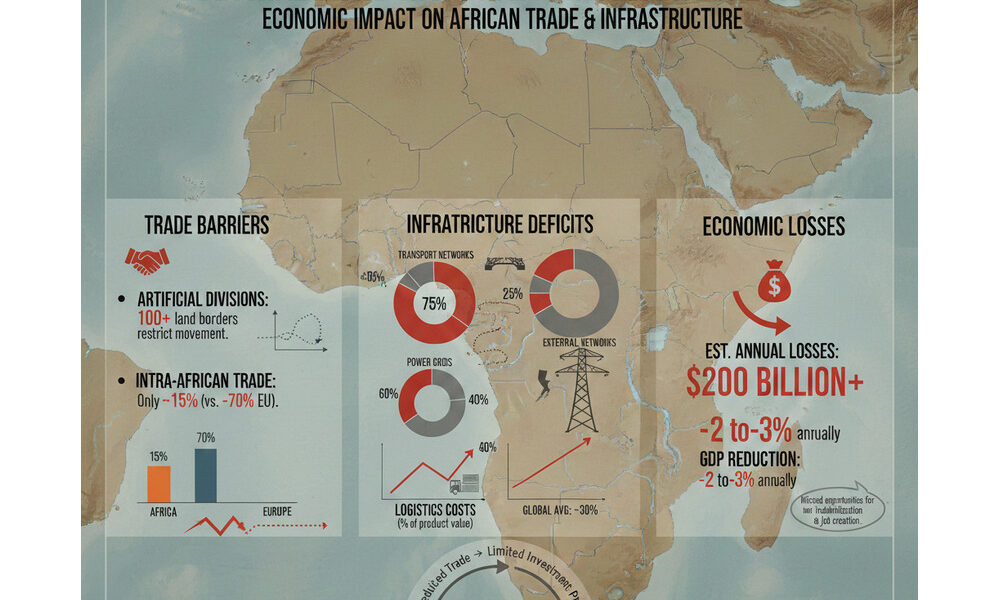
- Countries that share language, culture, and supply chains – like those in the Sahel or the Great Lakes region – face bureaucratic, fiscal, and logistical hurdles at borders that make little economic sense.
For foreign firms, especially those from Europe, this history is often overlooked. Too many still approach Africa as a collection of 54 discrete nation-states, rather than a mosaic of overlapping economic zones that predate colonialism by millennia.
The Field Knows Better
In practice, the disconnect is stark. I have led over 100 projects across more than 24 African countries, and time and again, we have found that the “neighboring” country on a political map can be less accessible – commercially, culturally, logistically – than a market thousands of kilometers away.
Why? Because colonial borders ignored the organic arteries of trade that had flourished for generations.
The smartest operators aren’t memorizing post-colonial boundaries; they are mapping pre-colonial networks.


Map of Africa in 1880 highlighting unclaimed (red) and colonized (gray) areas, showing how colonial borders disregarded trade routes and ethnic regions – key to understanding modern African trade challenges and AfCFTA opportunities.
A New Architecture of Integration
Fortunately, Africa is reclaiming its economic geography. Regional blocs like the Economic Community of West African States (ECOWAS), the East African Community (EAC), and the Southern African Development Community (SADC) are laying the groundwork for deeper integration.
But the real game-changer is the African Continental Free Trade Area (AfCFTA) – the world’s largest free trade zone by number of participating countries.
AfCFTA isn’t just a trade pact. It’s a corrective.
It acknowledges that prosperity in Africa won’t come from reinforcing colonial silos, but from reconnecting natural markets, harmonizing regulations, and rebuilding infrastructure along economic – not imperial – lines.
Companies that align with this shift are winning. They invest in local presence.
They understand that trust, delivery, and networks matter more than glossy branding. They recognize that African markets reward readiness, not just reports.
The Bottom Line
History doesn’t repeat, but it echoes – especially in business. The decisions made in a Berlin conference room 140 years ago still influence where trucks get stopped, which currencies fluctuate, and why cross-border transactions can feel like navigating a labyrinth.
But for those who see beyond the map’s lines, opportunity abounds. The future of African commerce belongs to those who understand how the continent’s markets were truly made – and who build strategies grounded in economic reality, not colonial accident.
What’s your experience navigating cross-border trade in Africa? How do historical borders shape your strategy today?
John Kourkoutas is business development expert that specializes in helping companies, export teams, and business leaders succeed in Africa’s dynamic and emerging markets.