Opinion
How Agricultural Drones Are Powering Africa’s Food Security Revolution


By Jean Claude Niyomugabo
Did you know that Africa’s agricultural productivity remains roughly 50 percent below the global average – despite the continent holding 60 percent of the world’s uncultivated arable land? This stark gap represents not just a challenge, but a historic opportunity.
With the right tools and technologies, Africa can transform its agricultural sector, feed its growing population of over 1.4 billion, and become a global leader in sustainable food systems.
Enter precision agriculture – and at its forefront, agricultural drones.
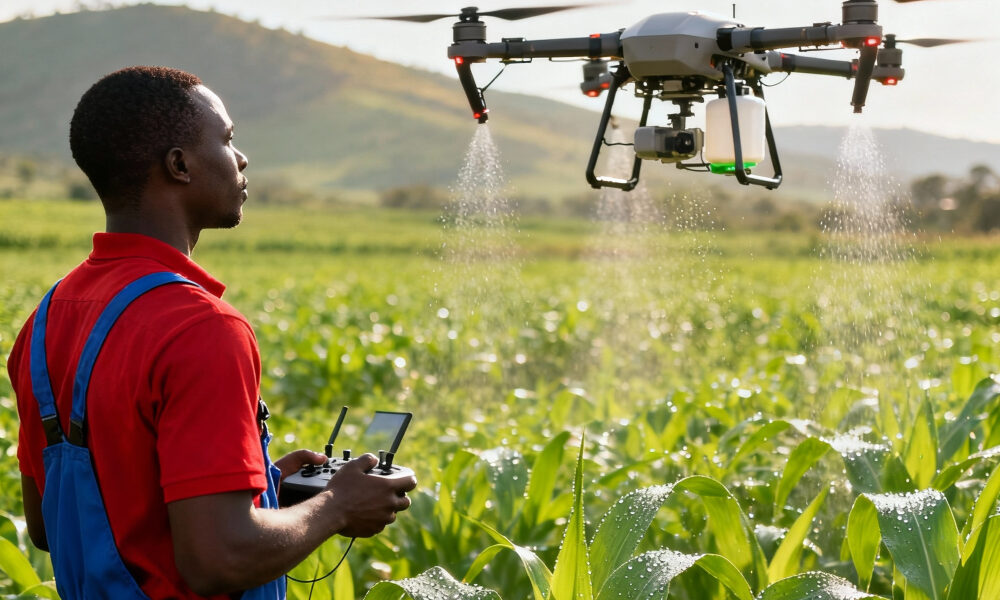
Far from being mere high-tech novelties, drones are emerging as indispensable allies for smallholder and commercial farmers alike. Across Nigeria, Kenya, and beyond, drone-enabled farming is delivering measurable gains: up to 70 percent higher yields, 30 percent reductions in water use, and significant cuts in post-harvest losses – all while slashing chemical inputs and protecting fragile ecosystems.
Precision from the Sky
Modern agricultural drones are equipped with multispectral sensors, GPS mapping, and AI-powered analytics that allow farmers to monitor crop health, assess soil conditions, and apply fertilizers or pesticides with surgical precision. What once required hours – or even days – of manual scouting can now be accomplished in minutes with a single drone flight.
In Nigeria, rice farmers using drone-based spraying systems have reported up to 30 percent savings on agrochemicals and improved yields thanks to uniform application and early disease detection. In Kenya, drone service startups are partnering with cooperatives to offer affordable, on-demand aerial imaging – giving small-scale farmers insights previously reserved for large agribusinesses.
Beyond Spraying: Smarter Land and Water Management
Drones aren’t just changing how crops are treated – they are reshaping how land itself is managed. High-resolution aerial mapping enables precise irrigation planning, erosion control, and land-use optimization.
For a continent where water scarcity and climate volatility threaten food security, this level of data-driven decision-making is transformative.
Moreover, by reducing over-application of inputs and minimizing soil compaction (unlike heavy machinery), drone technology supports regenerative farming practices that enhance long-term sustainability.
Tech-Driven Agricultural Renaissance
Africa’s agricultural future won’t be defined by bigger tractors – but by smarter decisions. With AI, real-time data, and scalable drone solutions, the continent is poised to leapfrog traditional farming models and build resilient, inclusive food systems.
The implications extend beyond the farm gate: increased productivity means higher rural incomes, stronger local economies, and reduced reliance on food imports. According to the African Development Bank, closing the continent’s agricultural productivity gap could add US$1 trillion to Africa’s economy by 2030.
The Path Forward
To fully harness this potential, stakeholders must invest in digital infrastructure, farmer training, and supportive regulatory frameworks. Governments, private sector innovators, and development partners all have a role to play in scaling these technologies equitably – ensuring that even the smallest farms can benefit.
The revolution in African agriculture is already airborne. With every drone flight, farmers gain not just efficiency and yield – but hope, resilience, and a stake in the future of food.
Jean Claude Niyomugabo is an entrepreneur and digital communication specialist with a strong passion for Africa’s development. He is dedicated to harnessing the power of social media to drive positive change and enhance livelihoods. With diverse interests and a strategic approach to digital engagement, he strives to create meaningful impact through innovation and connectivity.