Owusu on Africa
Houthi Missiles and the Risk of Middle East Conflict Spilling Into Africa via the Red Sea
Israel’s gamble on Somaliland was always about the Houthis. Now the Houthis are making it look prescient – and perilous.


By Fidel Amakye Owusu
When Israel unilaterally recognized Somaliland as a sovereign state on December 26, 2025, the reaction from almost everyone else was bewilderment, then condemnation. The African Union, Egypt, Türkiye, the six-member Gulf Cooperation Council, and the Saudi-based Organization of Islamic Cooperation all objected. The European Union and the U.S. State Department both insisted that Somalia’s territorial integrity be respected. Washington, notably, kept its distance from a move made by its closest ally.
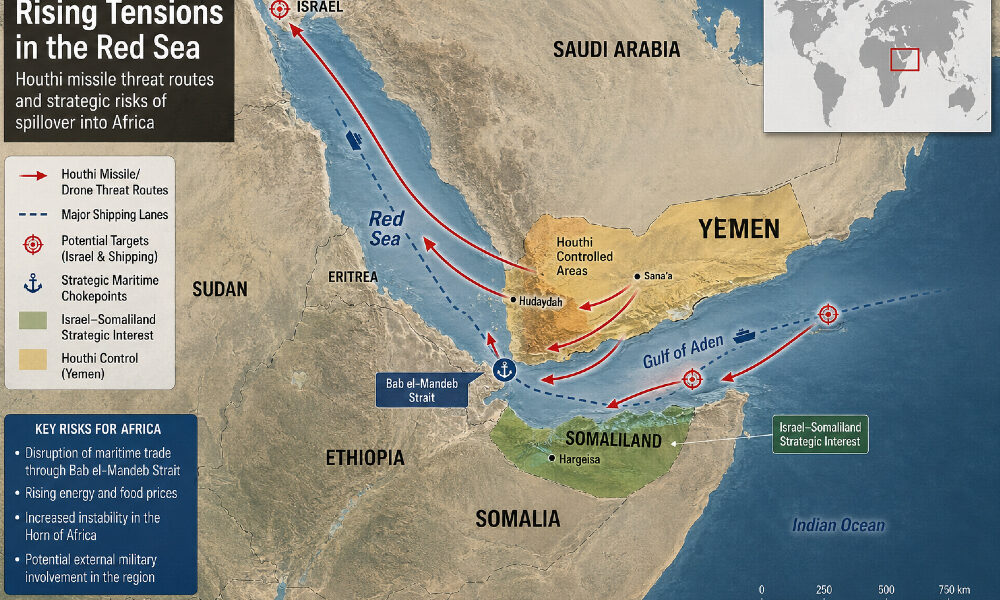
At the time, the puzzle was why Israel would spend diplomatic capital on a breakaway region that most of the world still refuses to acknowledge. Türkiye’s deepening footprint in Somalia was part of the answer. So was the promise of a listening post on the Gulf of Aden. But the real driver sat two hundred miles across the water in Yemen: the Houthis, the last active front of what Tehran calls its “axis of resistance,” and the one actor that had shown it could hit Israeli soil and choke a global trade route at the same time.
Eight months later, that bet reads less like speculation and more like foresight.
From Ceasefire To Relapse
For a few months, it looked like the Houthi threat might simply fade. A Gaza ceasefire in October 2025 brought a lull; the group held its fire, and Israel stopped striking Yemen in return. That calm broke on February 28, 2026, when the United States and Israel opened a new air campaign against Iran. The Houthis waited a month, then rejoined the war outright – firing ballistic missiles at Beersheba on March 28, the group’s first strikes on Israel since the truce, and warning they would keep firing “until the aggression on all resistance fronts stops.”
A shaky ceasefire with Iran in early April bought a few more weeks of quiet. It didn’t last. On June 8, as Israeli and Iranian forces traded fire again following a strike on Hezbollah targets in Beirut, the Houthis launched missiles toward the Tel Aviv area and declared a blockade of Israeli vessels in the Red Sea. By mid-July, Yemen’s own defense ministry was warning that its patience with Iranian and Houthi use of its airspace had “run out” – a sign that even the Houthis’ nominal government is losing its grip on the conflict playing out over its territory.
None of this is abstract for global markets. Every escalation has rattled oil prices and shipping insurers, because the Houthis sit astride the Bab el-Mandeb Strait, the chokepoint through which a huge share of Europe-Asia trade passes. They proved during the Gaza war that they could disrupt that traffic almost at will. They are now demonstrating they can do it again, on demand, whenever the wider war with Iran flares.
Somaliland’s Quiet Activation
This is precisely the scenario Israel’s recognition of Somaliland was built for. Somaliland sits close enough to Yemen to offer real-time monitoring of Houthi launches and, potentially, a base from which to intercept missiles and drones before they reach Israeli airspace – giving Israel strategic depth in the Bab el-Mandeb region it currently lacks. Two Somaliland officials told Bloomberg in March that their government would allow Israel to gather intelligence on, and conduct operations against, the Houthis, even as Hargeisa publicly denies that any formal basing deal exists.
The Houthis have noticed. Within days of Israel’s recognition announcement, the group’s leader, Abdul-Malik al-Houthi, declared that any Israeli presence in Somaliland would be treated as a legitimate military target, framing it as aggression against both Somalia and Yemen. Analysts at Israel’s Institute for National Security Studies have since warned that the arrangement cuts both ways: aligning with Israel against the Houthis could expose Somaliland – a territory with minimal defense capacity and no international recognition beyond Israel – to direct retaliation, and could undermine the very recognition campaign it was supposed to reward.
That is the trade Hargeisa has made. In exchange for becoming the first (and so far only) country to recognize its statehood, Somaliland has effectively volunteered to sit inside the blast radius of someone else’s war.
Why This Should Worry Africa, Not Just the Middle East
It is tempting to file all of this under “Middle East affairs” and move on. That would be a mistake. The Horn of Africa does not have the luxury of treating this as background noise.
The region is already absorbing conflict in Sudan, instability in Somalia proper, and friction along Ethiopia’s borders. Layering an Israeli-Houthi confrontation onto that terrain – one that could draw in Somaliland, and by extension complicate Somalia’s already fragile sovereignty claims – adds a combustible new variable to a part of the world that has little capacity to absorb it. A blockade or sustained disruption of Red Sea shipping would also hit African economies directly, through higher fuel and food import costs, at a moment when many are still clawing back gains lost to the pandemic and to Sudan’s civil war. Reversing a decade of development progress is not a hypothetical risk here; it has already started.
There is also a harder strategic question lurking underneath the humanitarian one. The UAE, which reportedly helped broker Israel’s recognition of Somaliland and has poured hundreds of millions of dollars into modernizing Somaliland’s port at Berbera, has its own interests in how this plays out. So does Turkey, which has bet heavily on Somalia’s federal government and views Israel’s move as a direct challenge to its influence in Mogadishu. The Horn of Africa risks becoming a proxy arena for rivalries that have nothing to do with its own people.
What Regional Leaders Should Do Now
None of this is irreversible yet. Somaliland’s officials have been notably cautious about turning quiet cooperation into a visible military footprint, aware of exactly how much Houthi firepower and geographic proximity they would be inviting. That caution is worth reinforcing, not undermining.
Ethiopia, Egypt, and Kenya – the three states with the most at stake in Horn of Africa stability – have an interest in making sure this caution holds. That means coordinated diplomacy aimed at keeping Somaliland’s territory out of anyone’s war plans, sustained pressure through the African Union to prevent the dispute from hardening into a proxy conflict, and contingency planning for the economic shock a prolonged Red Sea disruption would bring. The alternative is a continent that gets pulled into someone else’s fight by accident, one intelligence-sharing arrangement and one retaliatory strike at a time.
The war between Israel and the Houthis was never going to stay confined to the Red Sea’s waterline. The only real question was how much of Africa’s shoreline it would eventually touch.
Fidel Amakye Owusu is an International Relations and Security Analyst. He is an Associate at the Conflict Research Consortium for Africa and has previously hosted an International Affairs program with the Ghana Broadcasting Corporation (GBC). He is passionate about Diplomacy and realizing Africa’s global potential and how the continent should be viewed as part of the global collective.