Opinion
HBCUs doing more with less to ensure student access
Any discussion of HBCUs and money must begin with a simple fact: HBCUs have less in the way of financial resources than do colleges in general.
Historically Black colleges and universities (HBCUs) have been supplying leaders to the nation and to communities for nearly 200 years. Martin Luther King Jr. is surely the most famous HBCU alumnus, having entered Morehouse College at age 15 and graduating at 19. And, of course, the next vice president of the United States, Kamala Harris, is a 1986 graduate of Howard University. Brookings has covered HBCU topics a number of times, notably in articles by Andre Perry.
Today I want to provide some background on HBCUs by discussing some data about these critical institutions, as I suspect there is much that is not widely known—at least outside the Black community. The simple message in the numbers is that HBCUs work their magic with very little money.
To keep things comparable, I will limit my numbers to public and nonprofit HBCUs that offer a 4-year degree or more. And as a warning, because accounting definitions vary from one government source to another, definitions of the variables I look at are not perfectly consistent across sources, though any consequent errors should be quite small.
Gallup compared life outcomes for Black college graduates of HBCUs to outcomes for Black alumni of other colleges. In making the comparisons, Gallup controlled for parents’ education, decade of graduation, and the level of student loans. While HBCU grads had, on average, better outcomes on all of Gallup’s measures, here are the three where the HBCU advantage was largest.
| Percent of Black college graduates who are thriving in elements of well-being | ||
| HBCU | Non-HBCU | |
| Financial Well-Being (Managing your economic life to reduce stress and increase security) |
40 | 29 |
| Purpose Well-Being (Liking what you do each day; being motivated to achieve your goals) |
51 | 43 |
| Social Well-Being (Having strong and supportive relationships and love in your life) |
54 | 48 |
| Source: Gallup | ||
I find the report of better financial well-being especially interesting, as below we will see that HBCUs particularly attract students from low-income families.
Gallup also asked graduates what happened in college that made a difference to them. Black HBCU alumni reported more favorable experiences in all categories. Here are the 3 biggest.
| Percent of Black college graduates who strongly agree | ||
| HBCU | Non-HBCU | |
| My professors at My University cared about me as a person | 58 | 25 |
| Felt support | 35 | 12 |
| While attending My University, I had a mentor who encouraged me to pursue my goals and dreams | 54 | 48 |
| Source: Gallup | ||
In other words, HBCUs really do take care of their students. As another example showing that HBCUs produce successful students, work by Rhonda Vonshay Sharpe shows that HBCUs produce undergraduate science and engineering degrees using fewer NSF grant dollars then do other schools.
The main message in what follows is that the success of HBCUs comes about despite HBCUs having relatively fewer financial resources. Before we start talking about details, I do want to point out that HBCUs don’t serve just Black students. Per the National Postsecondary Student Aid Study, about 13 percent of HBCU students are not Black – including 4.5 percent identifying as “more than one race” – while about 13 percent of students at non-HBCU schools are Black. In other words, while HBCUs are certainly focused on Black students, they are not monolithic.
Any discussion of HBCUs and money must begin with a simple fact: HBCUs have less in the way of financial resources than do colleges in general. Here’s a picture.
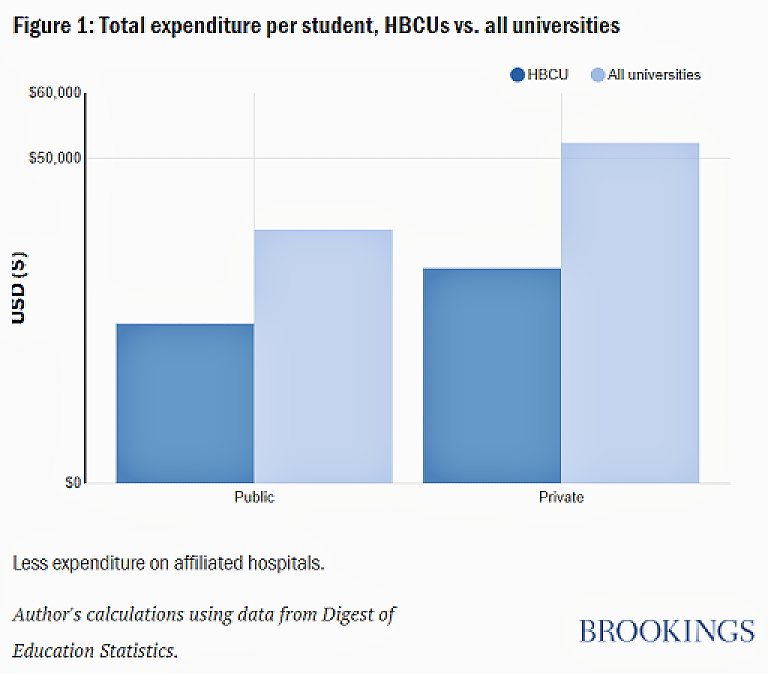

HBCUs are able to spend about two-thirds the revenue per student than do colleges in general. Despite this, HBCUs produce about 1 out of 8 bachelor’s degrees earned by Black students.
Part of the reason HBCUs do not have much money – and something important to know about their mission – is that HBCU students typically come from much lower-income families than do students at non-HBCUs. Below, I have put together data from the National Postsecondary Student Aid Study for both Black and non-Black students.
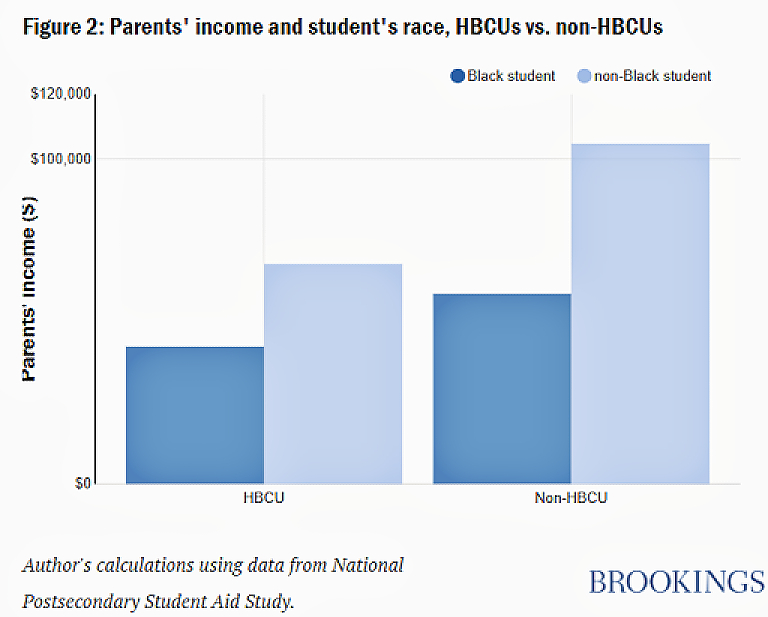

The HBCU bars are a lot lower, indicating that students at HBCUs come from lower-income families. One might think this simply reflects the fact that Black families in America still have much lower incomes than do white families. But compare the heights of the bars above for HBCUs to the bars for non-HBCUs. Parental income of Black students is almost 40 percent higher at other schools than it is at HBCUs. The gap for non-Black students is even larger.
Central to the financial aid process for colleges is the idea of “expected family contribution” (EFC). The EFC is computed by a formula that takes into account income, assets, family size, and other characteristics. The formula is set by law, so it’s the same at all schools. EFC is much, much lower at HBCUs, which is another way of seeing that HBCUs serve students whose families just don’t have much money. The difference is very large, as this next chart exhibits.
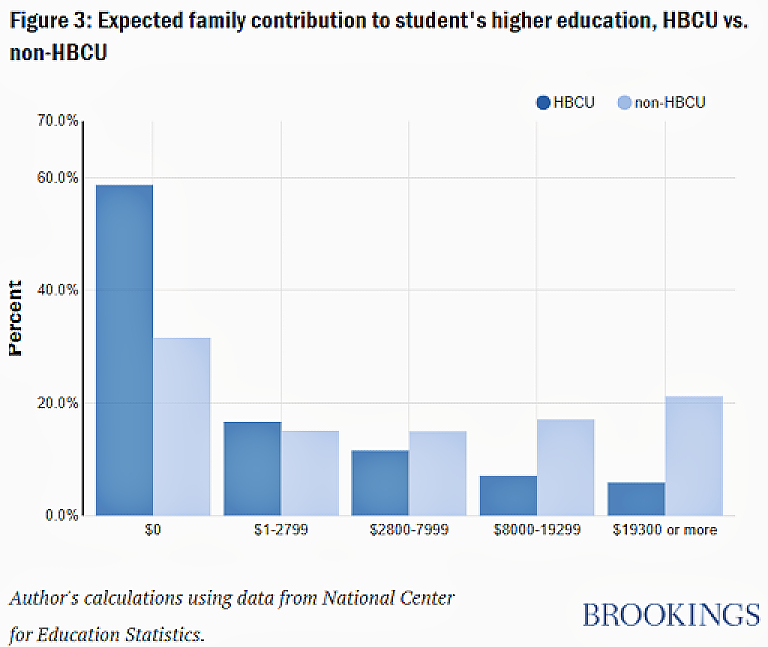

The fraction of families expected to make no contribution is almost twice as high outside HBCUs as it is at HBCUs; about 60 percent of HBCU families have too little in the way of income and assets to be expected to help pay for college. Similarly, the fraction in the highest contribution level is over three times as high outside HBCUs.
HBCUs receive much less revenue from tuition than do other schools; perhaps this is unsurprising given their service to low-income families. At non-HBCU public schools, tuition revenue per student is about US$6,700 – as compared to only US$4,900 at HBCUs. Similarly, at private non – HBCU schools, the average is US$17,000 as compared to US$10,400 at private HBCUs.
One might think that, given the elite reputation of some of the HBCUs, at least some of them would have substantial endowments. While a few of the best-known HBCUs have endowments large enough to help, in general their endowments do not compare to well-off non-HBCUs. Around 100 universities have endowments above US$1 billion. No HBCU makes that list.
Compare the “HUs”: Harvard University vs. Howard University. It is worth noting that Howard is occasionally called the Harvard of HBCUs.
Harvard’s endowment is about US$42 billion. Howard does have a solid endowment, around US$700 million – but that’s less than a 50th of Harvard’s endowment.
Dr. King’s alma mater, Morehouse College, has an endowment of US$145 million – more than a quarter of that coming from a recent donation from Netflix co-founder Reed Hastings.
While HBCUs work their magic with limited resources, it is worth remembering that the nation has made a modest commitment to support HBCUs – currently a few hundred million dollars a year – as part of the federal government’s Higher Education Act of 1965. The plan for higher education endorsed by President-elect Joe Biden similarly calls out HBCUs for special treatment. The special status of HBCUs acknowledges that, 73 years after Dr. King graduated from Morehouse, HBCUs continue to provide a special contribution to American higher education.
Dick Startz is a Professor of Economics – University of California, Santa Barbara. Thanks go to Spelman College professor Angelino Viceisza for advice on this article.
Brookings Institution © Copyright 2021