Business
Haiti rising from the ashes: Industrial Park attracting businesses
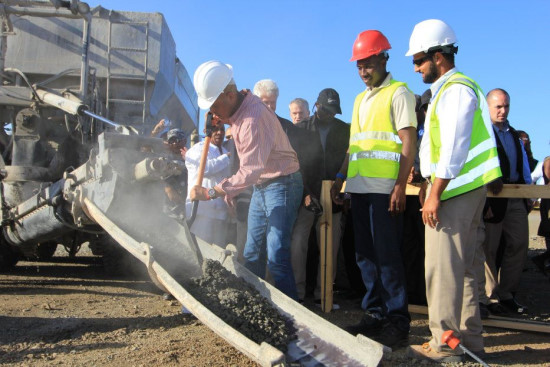

Haiti President Michel Martelly at ground breaking ceremony in Caracol. PHOTO/Haiti Libre
The government of Haiti agreed Tuesday to allow a local painting manufacturing company become the second tenant at a major industrial park under construction in the northern end of the country.
The agreement came after President Michel Martelly took a tour of a 10-megawatt electrical plant that will power the Caracol Haiti Industrial Park and houses for up to 1,500 workers by year’s end.
The newest tenant, Peintures Caraibes SA, will join South Korean garment manufacturer Sae-A Trading Co. Ltd. and will export paint made by Sherwin Williams along with its own locally made paint.
The facility will initially employ 167 people, with the expectation of hiring a total of 350 people, said Pierre Yves Gardere, CEO of Peintures Caraibes.
“It’s Haiti companies that came to the park and we’re waiting for others to come, too,” Martelly said at the future site of Peintures Caraibes, which is expected to begin production in October.
Financed by US$224 million in subsidies, the Caracol Park is the U.S.’s biggest investment in Haiti since the 2010 earthquake clobbered the capital of Port-au-Prince and threw up to 1.5 million people into grim settlements in southern Haiti.
The bulk of reconstruction has focused on the crowded capital and other heavily damaged cities, but the U.S. government has also directed rebuilding efforts to other parts of Haiti.
The Caracol project on a 617-acre (250-hectare) site was in the works long before the earthquake and is supposed to be Haiti’s largest private employer. The goal is to provide 20,000 jobs at the park and create 133,000 in all through cottage industries.
Sae-A, the main tenant, is scheduled to begin shipping T-shirts in September. Among the company’s 20 existing factories are plants in Nicaragua, Guatemala, Indonesia and Vietnam.
Sae-A has contracts with Wal-Mart Stores Inc. to make products in Haiti, and Target Corp. executives recently toured the project.
Workers will be paid Haiti’s minimum wage, which is US$5 a day, and will be eligible for bonuses based on performance.
Critics of garment sector in Haiti, say the wage isn’t enough to provide a living.
Critics also worry the industrial park could replicate earlier development efforts that spawned poor neighborhoods.
One of the biggest shantytowns in Haiti, Cite Soleil, was originally designed as a housing project for people working in a nearby manufacturing plant in Port-au-Prince. But when years of political instability scared off investors, the facility faltered and so did its employees. Cite Soleil is now a maze-like shantytown.
Caracol’s proponents argue they have spread investments in multiple communities in the north in an effort to prevent such an outcome. The projects range from not only housing and infrastructure but also agriculture.
“The idea was really to do development differently and to break with the development that Haiti has seen in the past,” said Jean-Louis Warnholz, a senior adviser in the U.S State department.
Copyright 2012 The Associated Press