Business
Haiti: Gold Rush – but will it benefit the people?
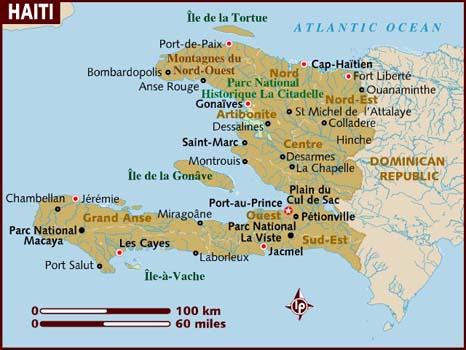

Haiti might be “poorest country in the Americas,” but the tiny nation is also sitting on a gold mine.
The new Prime Minister Laurent Lamothe says he’s banking on the wealth in the northern mountains to lift Haiti out of poverty, but if history is any guide, the mining of gold, silver and copper hidden in the hills will mostly benefit foreign shareholders as it scars and pollutes an already denuded and fragile landscape.
Haiti might have something to gain, but it also has much to lose.
Backroom deals, legally questionable “memorandums”, and test drilling carried out with no public scrutiny and little government oversight are all part of the new gold rush in Haiti.
With US$ 20 billion worth of gold, copper and silver hidden in the hills of Haiti, investors in North America convinced of the buried treasure, have already spent US$ 30 million dollars collecting samples, digging, building mining roads and doing aerial surveys.
The fairy tale is true, but it might not have a “happily ever after” ending.
A 10-month investigation into the Haiti “gold rush” by the watchdog consortium Haiti Grassroots Watch (HGW) discovered backroom deals, players with widely diverging objectives, legally questionable “memorandums”, and a playing field that is far from level.
Although the law in Haiti states that all subsoil resources belong to “the Haitian nation”, so far the nation has been kept in the dark about the digging and testing going on in the north of the country.
Dieuseul Anglade, a well-respected geologist who headed the state mining agency for most of the past 20 years, was recently fired. Was it because he has consistently championed tougher laws and better deals for the state, and for the people of Haiti?
“Minerals are part of the public domain of the state,” the 62-year-old Anglade told HGW a month before he was removed from his post.
The geologist said that if tougher laws and better contracts with the mining companies are not written, it would be better to “leave the minerals underground.”
Another major player in the gold game, Canadian company – Eurasian Minerals – has a different opinion of who should exploit Haiti’s riches.
Eurasian Minerals and its’ subsidiaries in Haiti, are poised to mine on the very same ground where Christopher Columbus and the Spaniards once forced the indigenous peoples of Haiti to dig for gold.
Within 40 years of the famed 1492 landing, hard labor in the mines, murder and European diseases reduced the population from perhaps 300,000 to about 600.
Eurasian Minerals recently returned to the same hills where so many died, and has been quietly buying up licenses: 53 of them so far. The company now controls exploration or exploitation rights to over one third of Haiti’s north.
Eurasian Minerals – which has tested over 44,000 samples so far – is partnered with the world’s number two gold producer, U.S.-based mining giant Newmont Mining.
Another Canadian company, Majescor, and a small U.S. company, VCS Mining, and their subsidiaries have licenses for tracts totaling over 750 square kilometers.
Altogether, about 15 percent of Haiti’s territory is under license to North American mining firms and their partners.
As Majescor’s Haiti subsidiary said in a recent corporate presentation: Haiti is “the sleeping giant of the Caribbean!”
The giant was “asleep” because Haiti’s minerals have previously been too expensive to extract thanks to the tumult of the past three decades, characterized by brutal coups d’état, and due to local resistance to the mining companies.
But the price of gold has held steady above US$1,500 an ounce for the past year, Haiti hosts a U.N. peacekeeping force of 10,000 that will assure a modicum of security for the companies, and just next door in the Dominican Republic, foreign gold giants say they have found the largest gold reserve in the Americas: 24 million ounces.
In a nation where unemployment reaches 70 percent, and where most of the government’s budget is covered by foreign aid, the buried treasure sounds like El Dorado.
But not all citizens of Haiti are as enthusiastic as the country’s leaders and foreign mining companies. Nor is it clear that the eventual revenues that might be generated would benefit both Haiti and its people.
The mining companies estimate that the hills of Haiti hold over US$ 20 dollars in gold – much of it “invisible” because it exists in tiny particles in the rock and dirt. Extraction will only be possible with environmentally hazardous pit mines.
Pit mining can potentially poison water supplies and damage the environment.
Newmont Mining, Eurasian Minerals’ partner, knows its pits. The gold giant opened the world’s first pit mine in Nevada in 1962 and later dug in Ghana, New Zealand, Indonesia, and other countries.
In Peru, Newmont Mining runs one of the world’s largest open-pit gold mines: the 251-square-kilometer Yanacocha mine.
But even with its years of experience, the company’s track record is far from error-free. In Peru, farmers’ organizations claim their water supply has been slowly polluted with cyanide, and in 2000, Newmont Minings’ Peruvian trucking company spilled 330 pounds of mercury, causing dozens of people to become sickened with deadly diseases.
In Ghana, Newmont Mining operates a mine located in a farming region known as Ghana’s “breadbasket”. So far, its operations have displaced about 9,500 people, 95 percent of whom were subsistence farmers, according to Environmental News Service.
Newmont Mining has poisoned local water supplies there at least once, by its own admission. In 2010, the company agreed to pay US$ 5 million in compensation for a 2009 cyanide spill.
In a May 25 email to HGW, Diane Reberger of Newmont Mining wrote, “We can assure you that Newmont Mining is committed to strong environment, social and ethical practices.”
Former state mining agency chief Anglade and other Haitian experts are worried that a pit mine could be dangerous to Haiti’s already fragile environment. Haiti has only about 1.5 percent tree cover, down from about 90 percent in 1492.
Haiti’s former environment minister Yves-André Wainright, an agronomist by training, noted that some of the areas under license are “humid mountains”, meaning they play “an important biodiversity role and need to be protected, starting in the prospection phase.” They are also home to tens of thousands of farming families.
“When I really think about the possibility of mining, I am not so sure it’s a good thing,” farmer and peasant organizer Elsie Florestan told HGW.
She and her family have some land near Grand Bois, where they grow corn, manioc and sweet potatoes and where Eurasian Minerals and Newmont Mining just finished test drilling.
“They say the company will need to use the river water for 20 years, and that all the water will be polluted,” continued the 41-year-old member of Haiti’s Tèt Kole Ti Peyizan (“Small Peasants Working Together”) peasant movement. “They say we won’t be able to stay here.”
“If we don’t organize and make some noise, nothing good will happen as far as we are concerned,” she added.
Haiti has not signed the international Safety and Health in Mines Convention or the voluntary Extractive Industries Transparency Initiative, both of which – if followed – offer some protections.
So far, licences and permits have been issued behind closed doors, deals have been sealed secretly, and the test drilling has been carried out with no public scrutiny and little government oversight, by the state mining agency’s own admission.
“The government of Haiti does not give us the means we need to be able to supervise the companies,” Anglade confirmed in an interview while still head of the agency.
In addition, Haiti has one of the lowest royalty rates in the hemisphere, collecting only 2.5 percent of the value of each ounce of gold extracted. “A 2.5 percent royalty share is really low. Anything under 5 percent is just really ludicrous for a country like Haiti,” according to mining experts.
This article is a summary of an investigative series by Haiti Grassroots Watch (HGW) which can be read in full here (http://www.ayitikaleje.org/18_01_ENG).